Management Communication N4 Notes- Module 1
BASIC PRINCIPLES OF COMMUNICATION
Define the term communication.
Communication is defined as a two-way process whereby information (message) is sent from one person (sender) through a channel to another(receiver) who in turn reacts by providing feedback
IMPORTANCE OF EFFECTIVE COMMUNICATION
Why is communication important in any business?
In any business, communication is important in the following ways:
- It helps to provide, obtain or exchange information i.e explain duties, give instructions, solve problems or make decisions during meetings.
- To form or maintain healthy relationships between i.e employee and employers, management and staff members, colleagues, and the public.
- To persuade others to think or act the way you do i.e. it helps motivate workers to be more productive and persuade a client to make use of your service or product.
- To make decisions about what you think and what you want to do.
- To express yourself and your ideas to others.
ADVANTAGES OF EFFECTIVE COMMUNICATION.
What are the advantages of effective communication in an organization.
Communicating effectively with clients and employees has the following advantages:
- Increased productivity
- Better and effective decision making
- Healthy and better employee relationship
- Better co-operation from workers
- Saves time and money
- Successful problem solving
- Greater job satisfaction
- Less conflict and less friction
THE COMMUNICATION PROCESS.
It is the linking process between business people or management and staff members to convey messages of various kinds.
Elements of the communication process.
Harold Laswell (1948) stated that the act of communication can be described by answering the following questions:
- Who?
- Says what?
- Through which channel?
- To whom?
- With what effect?
Harold broke the communication process into the following components:
- A sender – Who initiates communication
- Sends a message ( sends information)
- Through a channel ( Using a channel)
- To a receiver (To someone to whom the message is intended)
- Feedback (The receivers response )
Therefore; communication is a circular dynamic process e.g two people talk to each other, there is continuous and active flow of information.
- One person(sender) speaks while the other (receiver) listens. The receiver answers or reacts by providing feedback in the form of a message or action while the other listens.
- The receiver now becomes the sender while the original sender now becomes the receiver. i.e the two exchange roles continually and there are no fixed roles for speaking and listening.
COMMUNICATION MODEL
A model is a visual presentation of the core elements of a specific subject, e.g communication model shows the main elements of communication and the relationship between the elements.
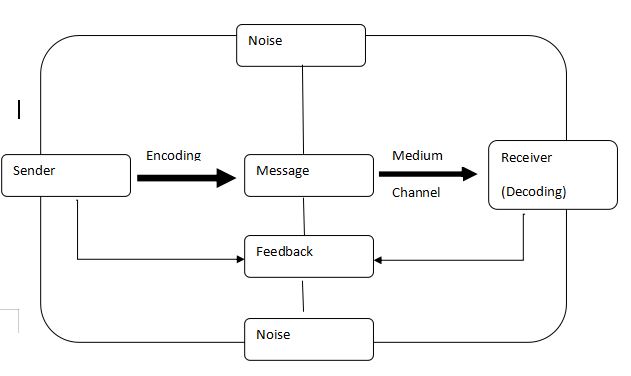
Sender
- Is the source of communication also referred to as a communicator, addresser, transmitter, or encoder.
- It is the person who initiates the communication activity and formulates the message.
- The sender sends a message because of a need to convey information, express feelings, obtain feedback or satisfy a need.
- The success of the communication depends on the sender’s ability to speak, write, reason and listen well.
Encoding
- Is the process of formulating thoughts into a message using a code e.g English in conjunction with pictures,figures or sign language which both parties understand.
Message
- This is the information which is conveyed during the process of communication.
- The receiver must understand the content and know what it means.
Receiver
- Also referred to as the addressee; respondent; destination or decoder.
- It is the person to whom the sender directs the message.
- The receiver is responsible for making sense of, interpreting and reacting to the message.
- The receiver provides feedback.
Decoding
- A process of interpreting the code (language, pictures, signs) in order to understand it.
Channel/ Medium
- It is the way in which the message is sent from sender to receiver and feedback is sent from the receiver to the sender.
- There are two channels of communication i.e verbal and non verbal.
- Examples of verbal communication are voice, telephone, intercom, interview, meeting, fax, letter, memo, radio, e.t.c
- Examples of non-verbal communication are body language, pictures, music, and graphs.
Feedback
- Also referred to as the reaction or response to a message.
- Is the message the receiver sends in response to the sender’s message.
- It is the receiver’s reaction which can be verbal or non-verbal.
- Feedback indicates that communication has taken place successfully and that the message was understood correctly.
Noise
- It is the communication barriers or interference i.e. something that disturbs communication from taking successfully.
- It is there to cause a communication breakdown or prevents the receiver from receiving the message.
CATERGORIES OF COMMUNICATION
Name and explain FOUR categories of communication
The type of communication depends on the number of people involved in the communication process
Communication is divided into four categories namely:
- Intrapersonal communication.
- Is communication within oneself when we think of something or talk to ourselves e.g what on earth shall I wear for the interview.
- Intrapersonal communication involves writing diaries, planning, dreaming e.t.c
- Interpersonal communication
- Is communication between two people; between individuals in a group; between groups e.g conversation between colleagues, discussing a formal meeting, interviewing a job applicant.
- Extrapersonal communication
- Is communication between a person and an animal, object or plant e.g shouting at a DVD when it fails to play a disc.
- Mass communication.
- Is communication between a sender and a large number of people who do not know each other.
- The message is transmitted through mass media e.g TV, radio, newspapers, e.t.c
Differentiate between mass communication and interpersonal communication.
Answer.
| MASS COMMUNICATION | INTERPERSONAL COMMUNICATION | |
| 1 | Large number | 2 people/groups |
| 2 | Complicated technology and requires expert knowledge. | Direct and simple channel. |
| 3 | Sender and receiver do not know each other | Sender and receiver know each other |
| 4 | Message is directed at large number of people and is impersonal | Message is direct and personal |
| 5 | One way process with no feedback | Two way process with immediate feedback |
INTERPERSONAL COMMUNICATION IN DETAIL.
- Success in business world depends on an individual’s ability to communicate effectively interpersonally.
- Interpersonal communication uses both verbal and non verbal communication.
- VERBAL COMMUNICATION
- Is communication using words in speaking, writing, reading and listening
- In most businesses, the whole day is spent communicating verbally.
- Oral communication
- Is referred to as spoken verbal communication
- It can be direct e.g face to face with a person or indirect e.g in a telephone conversation or public address. There is no eye contact.
- Written communication.
- is communication done in writing.
- Can also be direct or indirect
- Direct written communication includes business letters. memos, faxes, notices, agendas and reports addressed to specific individuals.
- Indirect written communication includes newspaper reports, press releases and adverts.
- NON VERBAL COMMUNICATION
- Communication using means other than words e.g facial expressions, gestures, sign language or objects to get a message across.
- Using of non verbal communication increases awareness of the nonverbal signs, other people’s nonverbal messages, interpreting them correctly and understanding each other better.
- Knowledge of nonverbal communication improves interpersonal communication skills e.g you can learn more about a customer by watching their body movements, expressions and gestures than listening to what they say.
- People are unaware that the way they dress, hold their bodies and funny manners they do convey certain messages.
- Non-verbal communication is often culture-specific.
- Nonverbal communication can strengthen, contradict, complement or substitute a verbal message.
Name and give examples of each of the different types of non-verbal communication used.
There are different types of non – verbal communication also called Semiology
- VISUAL SEMIOLOGY
- Is communication by means of anything that needs to be seen by the receiver in order to understand e.g. body movements,graphs or appearance.
- Visual semiology relies on the receiver’s ability to see and thus excludes blind people, o someone in the dark.
- Kinesics
Refers to body movements like gestures, facial expressions and postures. E.g. of facial expression is a smile which conveys a message of approval of an idea.
- Gestures e.g loosening ties is a sign of relaxing
- Posture e.g. resting one’s head on one’s arm shows boredom/tiredness.
- Proxemics
- Is the study of distance, space or contact in human communication.
- The way we use space around another person communicates a specific message.
- Space is divided into:-
- Intimate zone- a distance of up to half a metre
- Personal zone- the distance between half and one metre
- Social zone- the distance between one and two metres
- Public zone- a distance of more than 3 metres
- Graphic representation
- This is information conveyed by means of symbols, graphic signs, and illustrations.
- Graphic representation needs skills of studying and interpreting articles and graphs to form an idea and make decisions and plan strategies.
- Examples of symbols used in companies are logos of company cars like Toyota or audi
- Graphic signs e.g non smoking area sign.
- Colour
- Certain message are conveyed using colours
- g certain clothing colours indicate something e.g red is for valentine,black for funeral
- White could mean purity or peace ; red could also represent danger
- ACOUSTIC SEMIOLOGY
- Communication using sounds or signals other than words e.g music
- Paralingustics
- Involves the use of tone,pace, rhythm and accent in a sender’s words which conveys a meaning.
- g a deep voice indicates self-confidence.
- Filler sounds
- The use of meaningless sounds like Uuh! Aah! Eish!
- These sounds are called hesitation markers since they indicate nervousness, uncertainty and lack of knowledge.
- Music
- Conveys a certain message e.g loud music shows an atmosphere of excitement
- Silence
- Using silence conveys a positive, negative and neutral message e.g being quiet after being shouted at indicates anger or remorse.
- TACESICS
- Refers to communication using touch
- The way one touches another conveys a whole range of messages.
- Touching can be personal or impersonal e.g an arm around a shoulder shows comfort, touching someone’s hands shows attraction, and squeezing or pinching shows affection.
PHATIC COMMUNION
- Is the use of words to convey feeling rather than meaning e.g
- Person A : Good morning. How are you?
- Person B : Fine thanks. How was your weekend?
LISTENING SKILLS
Define listening?
Listening involves paying careful attention to what other people say, absorbing the information, judging it and acting on it.
Importance/Advantages of effective listening.
Why is listening important in an organization.
- Achieving better interpersonal relationship
- Saving time, money and energy
- Avoid mistakes and misunderstandings.
- Identifying problems and grievances before it is too late
- Create a working climate of openness and sensitivity
- Improves motivational and persuasive abilities.
Types of listening
Identify and explain the THREE types of listening.[6[
- Attentive listening
- listening to the speaker’s main goal and find out the central idea of the conversation.
- Critical listening
- listening by analyzing critically, evaluating and judging the speaker’s message throughout the conversation.
- It aims at trying to establish the intention of the message.
- Appreciative listening
- Listening first and then reacting
- Aims at trying to see and idea from the speaker’s point of view.
In all types of listening, providing feedback is the most critical thing since it shows understanding.
DO’S IN LISTENING
- Let the speaker express his/her thoughtfully
- Listen between the lines
- Try to remember important facts
- Write down important details
- Give feedback for important facts first
- Do not ignore when listening.
- Show interest in conversation.
Please sign in to request content and receive replies in your Student Dashboard.