Economics Grade 10 | Term 1 Revision 2
Economics Grade 10
Study the information below and answer following Questions
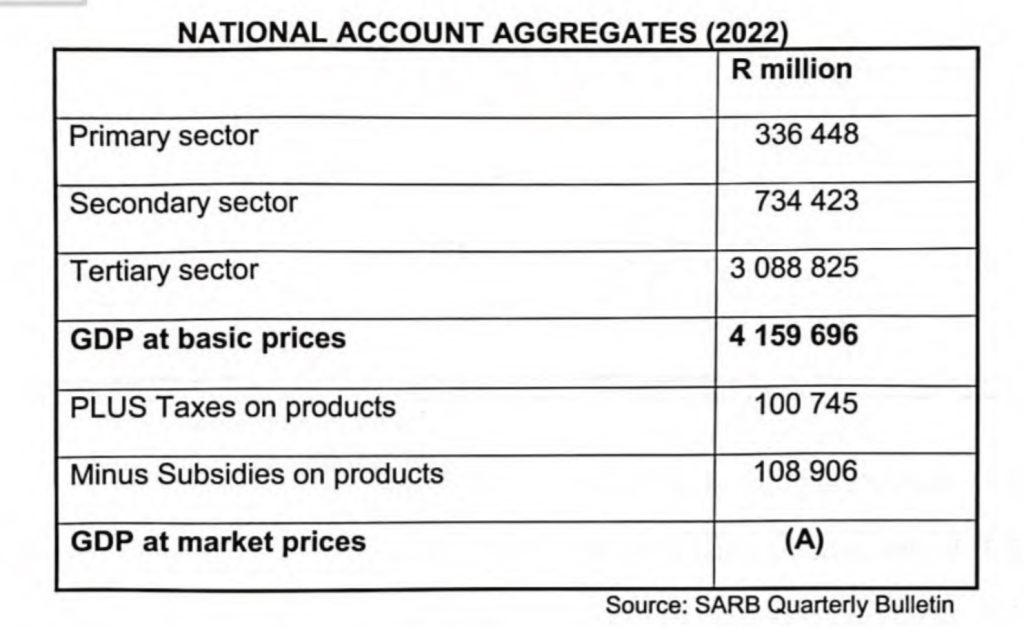
Question: Identify the method of national accounts used above.
The method of national accounting used in the data extract is the production method. This method calculates Gross Domestic Product (GDP) by adding the value added at each stage of production across all sectors of the economy. It focuses on the contribution made by primary, secondary, and tertiary industries to total output.
Question: Which sector contributed the most to the South African GDP according to the extract?
The sector that contributed the most to South Africa’s GDP in the extract is the tertiary sector. The tertiary sector includes services such as trade, transport, finance, education, and healthcare, which form the largest share of economic activity in modern economies.
Question: Briefly describe the term subsidies.
Subsidies refer to financial assistance provided by the government to businesses or households. They are usually given to reduce production costs, encourage the production or consumption of certain goods and services, and support key industries. Subsidies help keep prices affordable and promote economic growth and social welfare.
Question: Why are South Africa’s GDP figures always greater than its GNP figures?
South Africa’s GDP figures are generally higher than its GNP figures because income earned by foreign-owned businesses operating within South Africa is greater than the income earned by South African businesses operating abroad. As a result, more income flows out of the country than into it, which reduces Gross National Product relative to Gross Domestic Product.
Question: Calculate the GDP at market prices (A) as shown in the table. Show all calculations.
GDP at market prices is calculated by adjusting GDP at basic prices for taxes and subsidies on products.
GDP at basic prices = 4 159 696
Add: Taxes on products = + 100 745
Less: Subsidies on products = − 108 906
GDP at market prices = 4 159 696 + 100 745 − 108 906
GDP at market prices = 4 151 535
Final Answer: GDP at market prices = 4 151 535
Study the information below and answer following Questions
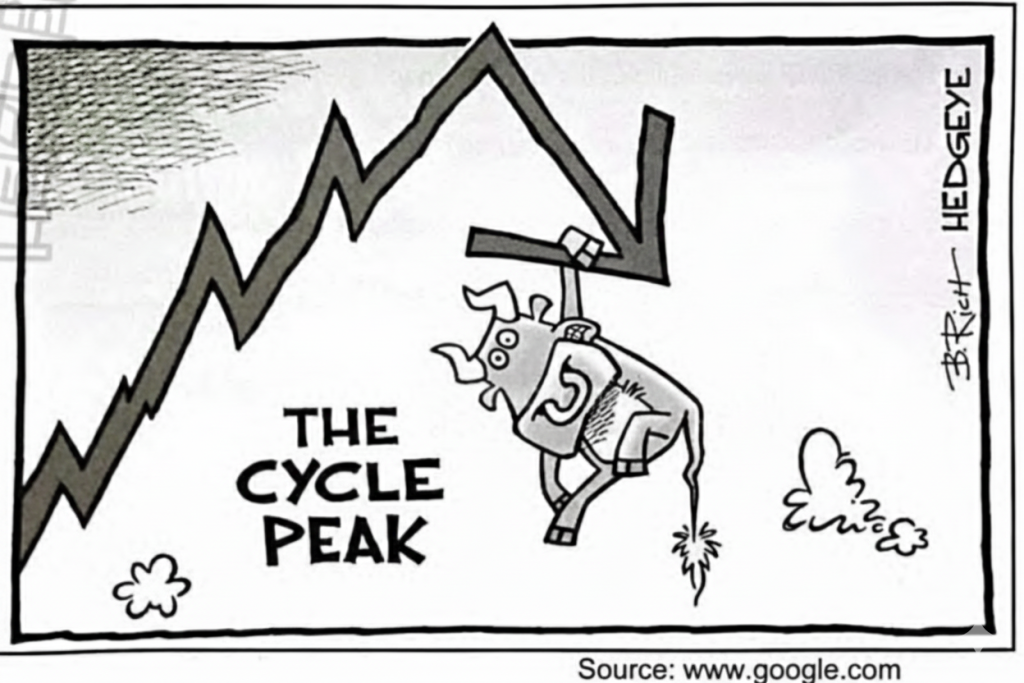
Question: Identify the graph shown in the picture above.
The graph shown is the business cycle, also known as the economic cycle. This graph represents the repeated pattern of expansion and contraction in economic activity over time. It illustrates how output, employment, income, and spending rise and fall as the economy moves through different phases.
Question: Which period is illustrated in the above picture?
The period illustrated is the upswing, also referred to as the expansion phase. During this phase, economic activity increases steadily as businesses produce more goods and services. Employment levels improve, household incomes rise, and consumer spending increases, leading to overall economic growth.
Question: Briefly describe the term leading indicators.
Leading indicators are economic indicators that change direction before the overall economy changes. They are used by economists, businesses, and policymakers to predict or forecast future economic activity. Examples include new business registrations, stock market performance, and manufacturing orders. Because these indicators react early, they provide advance warning of possible expansion or contraction in the business cycle.
Question: Explain recovery as a phase of the business cycle.
Recovery is the phase of the business cycle that occurs after the economy has reached a trough, which is the lowest point of economic activity. During this phase, economic activity starts to increase as businesses begin to expand production in response to improving demand.
In the recovery phase, employment levels rise as firms start hiring more workers, leading to higher household incomes. Increased income results in higher consumer spending, which further stimulates production and investment. Recovery therefore represents the period in which the economy moves upward from the trough towards the peak, signalling a return to economic growth.
Question: How does load shedding affect the business cycle in South Africa?
- Load shedding leads to a decrease in production because many businesses rely on a stable electricity supply to operate machinery, equipment, and technology. When power outages occur, factories, shops, and service providers are forced to stop or reduce operations. Lower production means fewer goods and services are produced, which reduces overall economic activity and contributes to a slowdown in the economy.
- Load shedding also increases operational costs for businesses. To continue operating during power cuts, many firms invest in alternative energy sources such as diesel generators or solar systems. These solutions are expensive to install and maintain, which raises production costs. Higher costs reduce profits and limit the ability of businesses to expand, weakening economic growth.
- Another effect of load shedding is that it discourages both local and foreign investment. Investors prefer stable economies with reliable infrastructure. Frequent power interruptions create uncertainty and increase the risk of doing business in South Africa. As a result, investment levels decline, leading to slower economic growth and pushing the economy into a downswing phase of the business cycle.
- Load shedding can also lead to job losses when businesses become unprofitable. Reduced production and rising costs force some firms to cut back on workers or close down completely. Increased unemployment lowers household income and reduces consumer spending, which further weakens demand in the economy.
- In addition, load shedding reduces the country’s Gross Domestic Product (GDP). Since GDP measures the total value of goods and services produced, lower production levels directly result in a decline in GDP. A falling GDP is a clear sign of economic contraction and negatively affects the position of the economy in the business cycle.
- Finally, load shedding decreases consumer confidence as households experience frequent disruptions to daily life. Power cuts affect cooking, communication, security, and access to services. When consumers feel uncertain about the future, they reduce spending, which lowers demand for goods and services and slows economic activity even further.
Life Sciences Grade 10 Revision 2 | Past Paper Questions & Answers Explained
Question : Discuss exogenous factors as a cause of the business cycle.
Exogenous factors are influences on the economy that originate outside the normal functioning of the market system and are not caused by internal economic activities such as production or consumption. These external forces can disturb economic stability and are important causes of fluctuations in the business cycle, leading to periods of expansion or contraction.
One important exogenous factor affecting the business cycle is weather conditions. Natural disasters such as floods, droughts, cyclones, and tsunamis can have severe economic consequences. Droughts reduce agricultural output, leading to food shortages, higher prices, and lower export earnings. Floods and storms can destroy infrastructure such as roads, factories, and power stations, disrupting production and trade. These events often result in a decline in economic activity, pushing the economy into a downswing or recession.
Technological changes are another major exogenous factor that can influence the business cycle. New inventions, innovations, or technological breakthroughs can stimulate economic growth by increasing productivity and efficiency. Businesses may invest heavily in new machinery, equipment, and skills to adopt new technologies. This increase in investment raises production, employment, and income levels, contributing to an upswing or expansion phase of the business cycle. However, rapid technological change may also make certain skills or industries obsolete, causing temporary disruptions.
Political events also play a significant role as exogenous causes of business cycles. Wars, political instability, corruption, or sudden changes in leadership create uncertainty in the economy. When uncertainty increases, businesses may delay investment and consumers may reduce spending. This leads to lower production and employment, resulting in an economic contraction. Stable political environments, on the other hand, encourage confidence and economic growth.
Government policy is another key exogenous factor influencing the business cycle. Changes in fiscal policy, such as adjustments to taxation and government spending, can stimulate or slow down economic activity. Increased government spending and lower taxes can boost demand and lead to economic expansion. Conversely, higher taxes or reduced government spending can decrease demand and slow the economy. Similarly, monetary policy decisions, such as changes in interest rates by the central bank, affect borrowing and investment from outside the private market system.
International events also affect the domestic business cycle. Economic recessions in major trading partners can reduce demand for exports, leading to lower production and income in the local economy. In addition, changes in global prices of key commodities, such as oil, can increase production costs and inflation. Higher import costs reduce consumer spending and business profits, contributing to economic slowdowns.
Psychological factors are another important exogenous influence on the business cycle. The level of confidence or optimism among consumers and businesses affects spending and investment decisions. When consumers and firms are optimistic about the future, they are more likely to spend and invest, leading to economic expansion. Conversely, pessimism and fear about economic conditions can reduce spending and investment, causing a downturn in the business cycle.
In conclusion, exogenous factors play a significant role in causing fluctuations in the business cycle by influencing economic activity from outside the market system. Weather conditions, technological changes, political events, government policy, international developments, and psychological factors can each trigger expansions or contractions in the economy. Understanding these external influences is essential for managing economic stability and promoting sustainable growth.
Question: Discuss in detail the role of markets in the circular flow of an open economy
Markets are organised mechanisms through which economic activities are coordinated and prices for goods and services are determined. They enable interaction between buyers and sellers and ensure that resources are allocated efficiently. The circular flow model, on the other hand, is a simplified representation of how the different participants in the economy interact with one another through flows of goods, services, resources, and money within an open economic system.
The goods, product, or output market plays a central role in the circular flow of an open economy. This market is responsible for the buying and selling of consumer goods and services produced by firms. In economics, a clear distinction is made between goods and services. Goods are defined as tangible items that satisfy human needs and wants, such as food, clothing, furniture, and motor vehicles. These goods are produced by firms and sold to households, government, and the foreign sector. Within the goods market, the capital goods market exists for the trading of buildings, machinery, and equipment used in production, while the consumer goods market deals with durable goods like cars and appliances, semi-durable goods like clothing, and non-durable goods such as food and toiletries.
Services form another important component of the product market. Services are non-tangible actions that satisfy needs and include activities such as wholesale and retail trade, transport services, banking, insurance, and other financial services. Both private and public goods and services flow from firms and government to households and the foreign sector. These flows are known as real flows. They are accompanied by counter-flows of expenditure by households, government spending, export earnings, and taxes paid to the state, which together sustain economic activity in the circular flow.
The factor, resource, or input market is equally important in the circular flow model. This is the market where factors of production are bought and sold. Households are the owners of factors of production such as labour, land, capital, and entrepreneurship, while firms demand these factors in order to produce goods and services. The factor market includes the labour market, where workers offer their skills; the property market, where land and buildings are hired out; and the financial market, where capital is made available. The supply of factor services from households to firms represents a real flow, while income in the form of wages, rent, interest, and profit flows back to households as a monetary counter-flow. This income enables households to participate in the goods market, thereby maintaining the continuity of the circular flow.
Financial markets play a linking role in the circular flow of an open economy. Although they are not directly involved in the production of goods and services, they connect households, businesses, government, and the foreign sector that have surplus funds with those that require funds. Financial markets ensure that savings are channelled into productive investment. Institutions such as banks, insurance companies, and pension funds operate within these markets and facilitate the efficient mobilisation and allocation of financial resources across the economy.
The money market forms part of the financial market and focuses on short-term and very short-term funds, usually for periods of less than three years. In this market, consumers, businesses, and government save and borrow funds to meet immediate liquidity needs. Financial instruments traded in the money market include bank debentures, treasury bills, and government bonds. The South African Reserve Bank is the key institution in the money market and influences interest rates and the supply of money, thereby affecting borrowing, saving, and spending decisions throughout the economy.
The capital market is concerned with long-term financing, usually for periods of three years or longer. In this market, long-term funds are borrowed and saved to finance major investments such as infrastructure development, industrial expansion, and property development. The Johannesburg Securities Exchange is a key institution in South Africa’s capital market. Financial instruments traded include mortgage bonds and shares. By providing long-term capital, the capital market supports sustained economic growth and development within the circular flow.
The foreign exchange market is a crucial component of the circular flow in an open economy. In this market, businesses buy and sell foreign currencies in order to pay for imported goods and services and to receive payment for exports. These transactions occur mainly through commercial banks and involve electronic transfers from one account to another. The most important foreign exchange markets are located in global financial centres such as London, New York, and Tokyo. The South African rand is traded freely in these markets, for example when individuals buy travellers’ cheques or foreign currency to travel abroad. Imports and exports represent real flows of goods and services across national borders, while the associated payments and receipts represent counter-flows of expenditure and revenue in the circular flow.
In conclusion, markets are the mechanisms that bind the circular flow of income together in an open economy by coordinating the exchange of goods, services, resources, and financial assets. Each market plays a distinct but interconnected role in ensuring that real flows are matched by corresponding monetary flows. When goods, factor, financial, and foreign exchange markets function efficiently, the circular flow remains balanced and economic activity is sustained. A well-functioning market system therefore not only supports continuous production and consumption but also promotes stability, growth, and effective integration of the domestic economy with the global economy.
How can the government contribute positively to the economy?
Government refers to the public authority responsible for making and enforcing laws, collecting revenue, and providing essential services within a country. Through its economic functions, government plays a key role in influencing production, income distribution, and overall economic stability.
One important way in which government contributes positively to the economy is by buying factors of production from households, particularly labour. By employing workers in the public sector, government provides households with income in the form of wages and salaries. This improves the standard of living of citizens and enables households to participate more actively in economic activities through spending and saving.
Government also purchases goods and services from the goods market and distributes them as public goods, especially to poor and disadvantaged communities. These public goods include education, healthcare, housing, sanitation, and security. The provision of public goods improves social welfare and ensures that basic needs are met, which supports long-term economic development.
Another positive contribution is the collection of taxes from households and businesses. Tax revenue is used to fund infrastructure development such as roads, schools, hospitals, electricity, and water supply. Well-developed infrastructure reduces production costs, improves efficiency, and creates a supportive environment for business growth and investment.
Government further supports households through social grants and subsidies. These transfers increase household income, which leads to higher consumption of goods and services. Increased consumption raises demand in the economy, allowing businesses to increase production and profits, which may result in job creation.
Providing financial assistance to local firms is another way government strengthens the economy. Through subsidies, incentives, and support programmes, government helps domestic businesses expand production and improve competitiveness. This support boosts exports of locally produced goods and contributes to economic growth.
Government also attracts foreign firms by creating favourable economic policies, offering investment incentives, and maintaining political and economic stability. Foreign direct investment promotes industrialisation, transfers skills and technology, creates employment opportunities, and increases overall production in the economy.
In conclusion, government contributes positively to the economy through employment creation, provision of public goods, infrastructure development, income redistribution, business support, and the attraction of foreign investment. These actions strengthen the circular flow of income, promote economic growth, and improve the overall welfare of citizens, demonstrating the crucial role of government in achieving sustainable economic development.
Please sign in to request content and receive replies in your Student Dashboard.