
Life-Sciences-Grade-12-March-2026-QP-and-Memo
Question 1.1.1
Which ONE of the following is found only in RNA molecules?
- A. Guanine
- B. Uracil
- C. Thymine
- D. Adenine
Correct Answer: B. Uracil
Uracil is found only in RNA. DNA contains thymine instead of uracil.
Question 1.1.2
Meiosis is significant for the …
- A. production of haploid gametes
- B. production of four diploid gametes
- C. production of genetically identical gametes
- D. doubling of the chromosome number
Correct Answer: A. production of haploid gametes
Meiosis reduces the chromosome number by half to produce haploid gametes required for sexual reproduction.
Question 1.1.3
The following is a list of parts in a male reproductive system:
- Seminal vesicle
- Vas deferens
- Prostate gland
- Urethra
Which ONE of the following combinations is responsible for producing alkaline fluids and nutrients?
- A. (i), (ii) and (iv) only
- B. (i), (ii), (iii) and (iv)
- C. (ii) and (iv) only
- D. (i) and (iii) only
Correct Answer: D. (i) and (iii) only
The seminal vesicle produces nutrient-rich fluid containing fructose, while the prostate gland produces alkaline fluid that protects sperm.
Question 1.1.4
The table below shows amino acids coded for by different mRNA codons.
| mRNA Codon | Amino Acid |
|---|---|
| GCG | Alanine |
| AUG | Methionine |
| AUA | Isoleucine |
| AGG | Arginine |
Which amino acid is coded by the DNA base triplet TAC?
- A. Arginine
- B. Alanine
- C. Methionine
- D. Isoleucine
Correct Answer: C. Methionine
The DNA triplet TAC transcribes to the mRNA codon AUG, which codes for Methionine.
Questions 1.1.5 and 1.1.6 are based on the diagram showing a developing foetus.
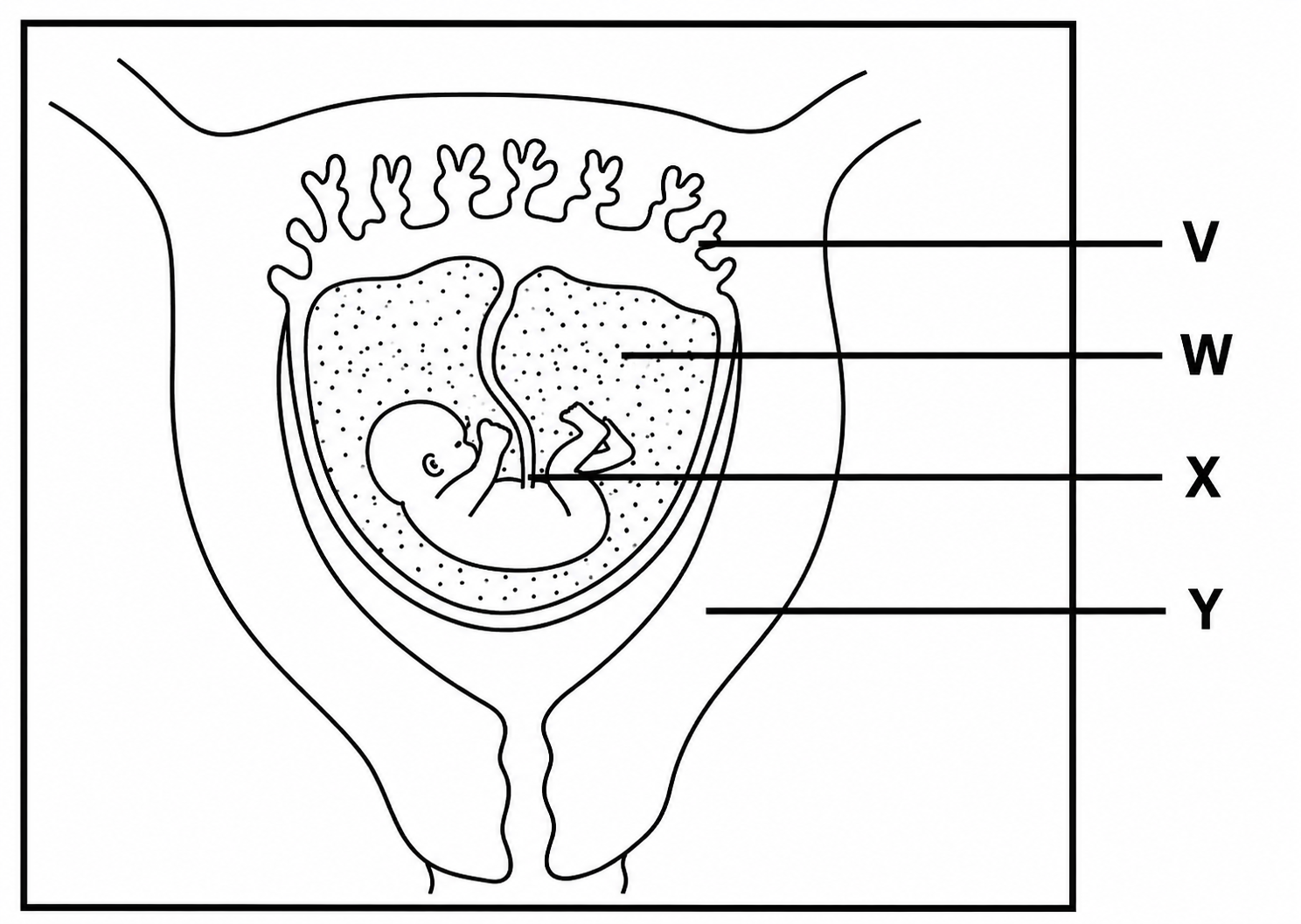
Question 1.1.5
Which ONE of the following combinations is the CORRECT structure for each function?
| Allows Diffusion of Nutrients to the Foetus | Allows Free Foetal Movement | |
|---|---|---|
| A | X | W |
| B | V | Y |
| C | V | X |
| D | X | V |
Correct Answer: C
Structure V represents the placenta, where nutrients diffuse from the mother to the foetus. Structure X represents the amniotic fluid, which allows free foetal movement.
Question 1.1.6
Which ONE of the following structures produces the hormone that thickens the endometrium?
- A. V
- B. W
- C. X
- D. Y
Correct Answer: A. V
Structure V represents the ovary, which produces progesterone. Progesterone thickens and maintains the endometrium during pregnancy.
Question 1.2
Give the correct biological term for each of the following descriptions.
Write only the term next to the question number (1.2.1 to 1.2.5) in the ANSWER BOOK.
The natural shape of the DNA molecule.
Answer: Double helix
DNA consists of two strands twisted around each other, forming a double helix.
The point where adjacent chromatids of homologous chromosomes overlap during crossing over.
Answer: Chiasma
A chiasma is the point where homologous chromosomes exchange genetic material during meiosis.
The release of an ovum from the ovary.
Answer: Ovulation
Ovulation occurs when a mature ovum is released from the ovary into the oviduct.
Division of the cytoplasm.
Answer: Cytokinesis
Cytokinesis is the division of the cytoplasm to form separate daughter cells.
A blood vessel that transports deoxygenated blood from the foetus to the mother.
Answer: Umbilical artery
The umbilical artery carries deoxygenated blood and waste products from the foetus to the placenta.
Question 1.3
Indicate whether each of the descriptions in COLUMN I applies to
A ONLY, B ONLY, BOTH A AND B or
NONE of the items in COLUMN II.
Write A only, B only, both A and B, or none next to the question number
(1.3.1 to 1.3.3) in the ANSWER BOOK.
| Question | Column I | Column II |
|---|---|---|
| 1.3.1 | The structure where testosterone is produced |
A: Epididymis B: Cowper’s gland |
| 1.3.2 | A hollow ball of cells that implants in the endometrium |
A: Blastocyst B: Morula |
| 1.3.3 | Location of a DNA molecule in the plant cell |
A: Mitochondria B: Chloroplast |
The structure where testosterone is produced.
Answer: None
Testosterone is produced in the testes by the interstitial (Leydig) cells, not in the epididymis or Cowper’s gland.
A hollow ball of cells that implants in the endometrium.
Answer: A only
The blastocyst is a hollow ball of cells that implants into the uterine lining. A morula is a solid ball of cells.
Location of a DNA molecule in the plant cell.
Answer: Both A and B
Both mitochondria and chloroplasts contain their own DNA in addition to the DNA found in the nucleus.
Question 1.4
The diagram below shows a sperm cell.
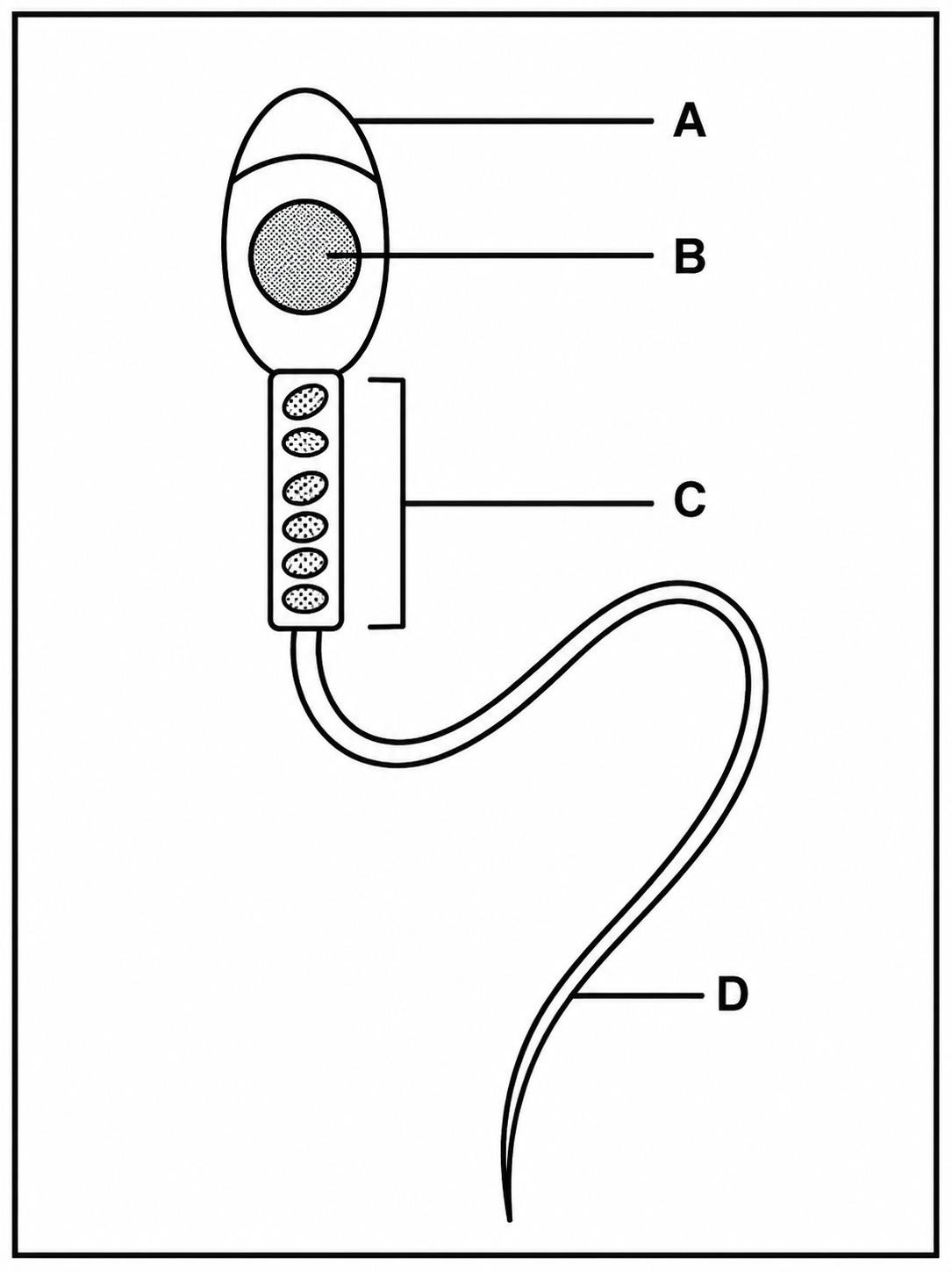
Identify part:
(a) C
Answer: Middle piece (Neck)
The middle piece contains numerous mitochondria that supply energy for sperm movement.
(b) D
Answer: Tail (Flagellum)
The tail propels the sperm forward, allowing it to swim towards the ovum.
Give the LETTER and NAME of the part that contains the:
(a) Genetic material
Answer: B – Nucleus
The nucleus contains the haploid set of chromosomes that carries the father’s genetic information.
(b) Enzymes to penetrate the egg layers
Answer: A – Acrosome
The acrosome contains digestive enzymes that help the sperm penetrate the protective layers surrounding the ovum.
(c) Organelle that provides energy for sperm motility
Answer: C – Middle Piece (Neck)
The middle piece contains mitochondria that release energy through cellular respiration, enabling movement of the tail.
Acrosome = enzymes, Nucleus = genetic material, Middle Piece = energy,
Tail = movement.
Question 1.5
The diagram below represents a cell in a phase of meiosis.
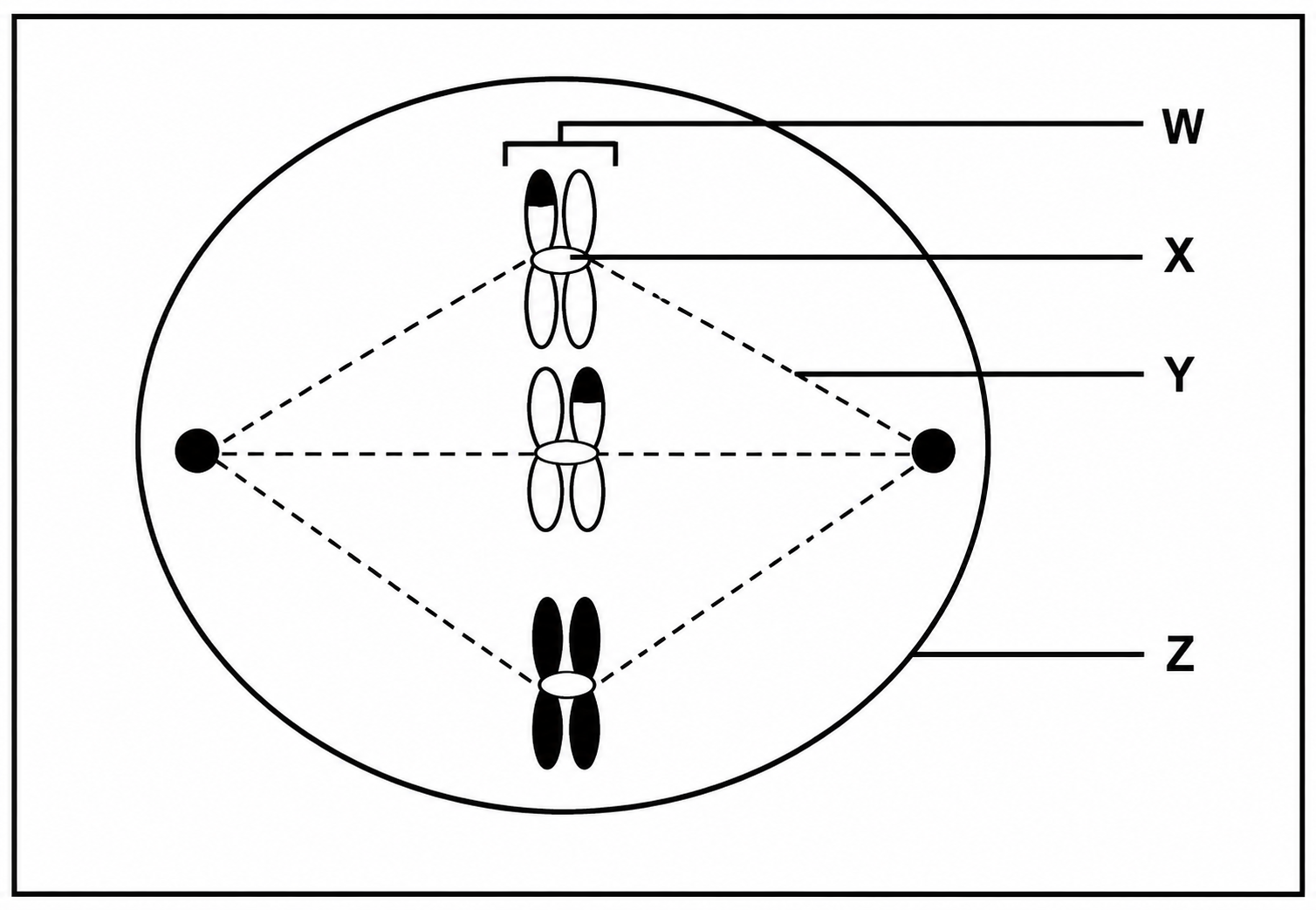
Identify part:
(a) W
Answer: Chromosome
A chromosome consists of genetic material made up of DNA and proteins.
(b) Y
Answer: Spindle Fibre
Spindle fibres attach to chromosomes and assist in their movement during cell division.
(c) Z
Answer: Cell Membrane
The cell membrane surrounds the cell and controls the movement of substances into and out of the cell.
Give the LETTER and NAME of the part responsible for joining two chromatids together.
Answer: X – Centromere
The centromere joins two sister chromatids and serves as the attachment point for spindle fibres.
Name the part in a flower where meiosis occurs to produce male gametes.
Answer: Anther
Meiosis occurs in the anther to produce pollen grains that contain the male gametes.
How many chromosomes:
(a) Were there in this cell at the beginning of meiosis?
Answer: 6 chromosomes
The diploid parent cell contained six chromosomes before meiosis began.
(b) Will be found in this cell at the end of meiosis?
Answer: 3 chromosomes
Meiosis halves the chromosome number, producing haploid cells with three chromosomes.
Identify the phase of cell division represented in the diagram.
Answer: Metaphase II
During Metaphase II, chromosomes line up at the equator of the cell and are attached to spindle fibres from opposite poles.
Question 2.1
The diagram below represents a process in a cell.
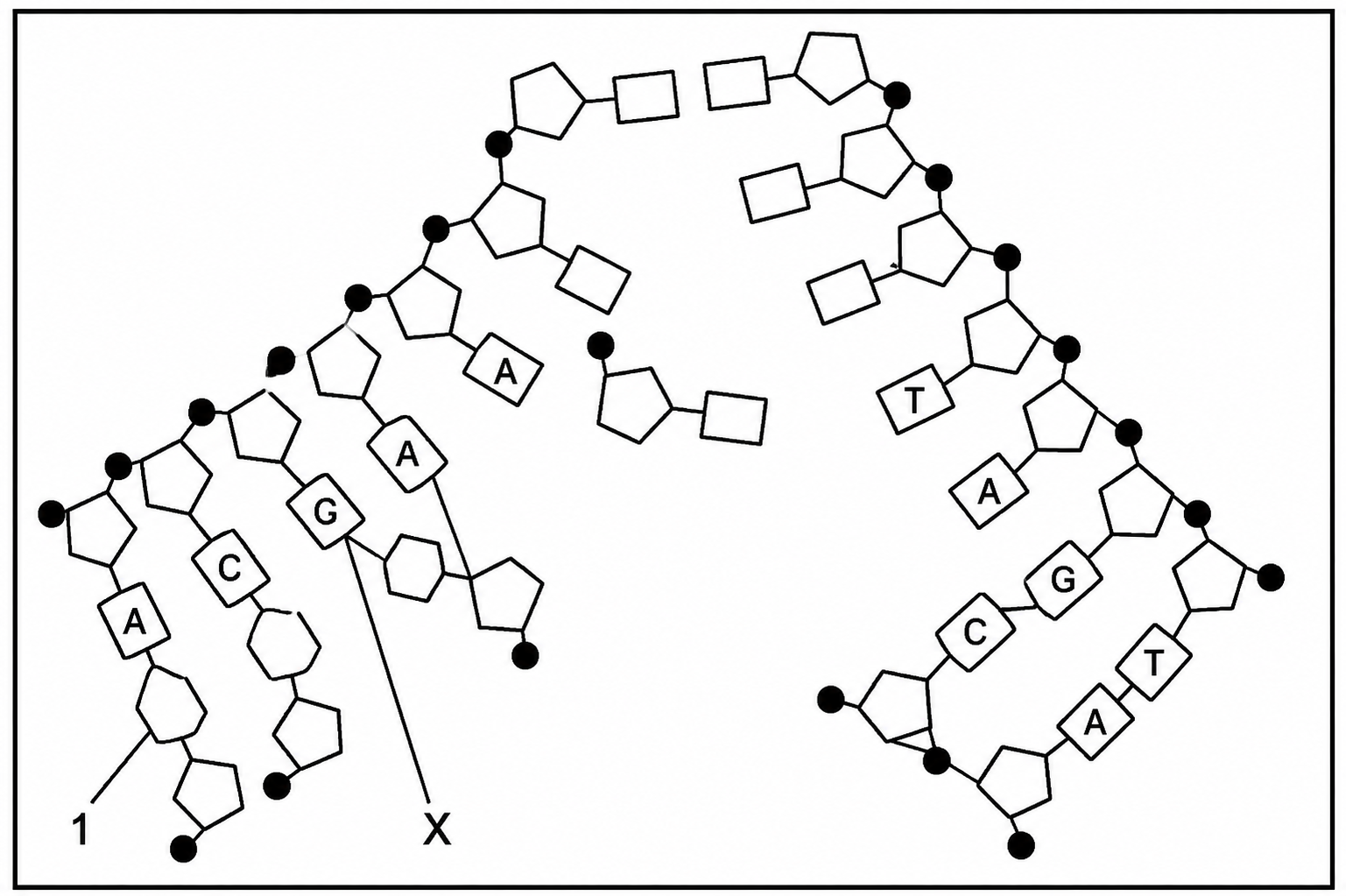
Identify:
(a) Bond X
Answer: Hydrogen bond
Hydrogen bonds join complementary nitrogenous bases on opposite DNA strands.
(b) Nitrogenous base 1
Answer: Thymine (T)
Adenine always pairs with thymine in DNA through complementary base pairing.
Name the process shown in the diagram.
Answer: DNA Replication
DNA replication is the process by which a DNA molecule makes an identical copy of itself before cell division.
State ONE importance of the process named in Question 2.1.2.
Answer: Ensures that daughter cells receive identical genetic information.
DNA replication doubles the genetic material before cell division so that each daughter cell receives a complete copy of DNA.
Tabulate TWO differences between transcription and the process named in Question 2.1.2.
| Transcription | DNA Replication |
|---|---|
| Only one DNA strand acts as a template. | Both DNA strands act as templates. |
| Produces mRNA. | Produces identical DNA molecules. |
| Uses RNA nucleotides. | Uses DNA nucleotides. |
| Adenine pairs with uracil. | Adenine pairs with thymine. |
| Only a section of DNA is copied. | The entire DNA molecule is copied. |
Any TWO valid differences between transcription and DNA replication would earn full marks.
Question 2.2
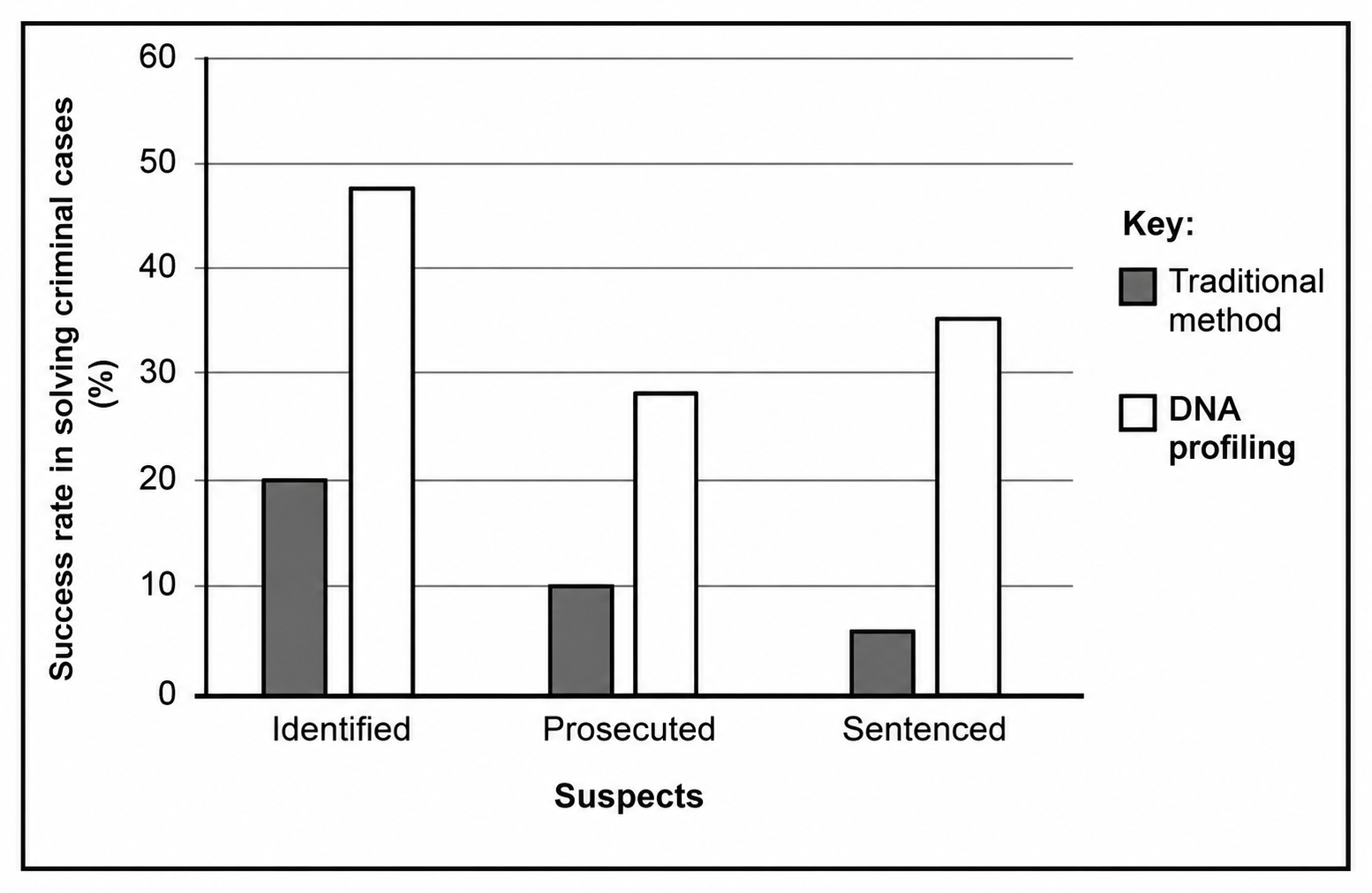
The graph below shows the percentage success rate in solving criminal cases using
traditional methods and DNA profiling.
Give TWO other uses of DNA profiling other than the one shown in the graph.
Answer:
- Paternity testing
- Identifying relatives
Other acceptable answers include identifying missing persons,
identifying human remains, diagnosing genetic disorders and
matching tissues for organ transplants.
State the percentage of suspects:
(a) Sentenced using DNA profiling
Answer: 35%
The graph shows that approximately 35% of suspects were sentenced using DNA profiling.
(b) Prosecuted using traditional method
Answer: 10%
The graph indicates that 10% of suspects were prosecuted using traditional methods.
Explain how DNA profiling is used in identifying criminals.
Answer:
- DNA samples are collected from the crime scene and from the suspect.
- A DNA profile is produced for each sample.
- The DNA profiles are compared.
- If the DNA profile of the suspect matches the DNA profile from the crime scene, the suspect was present at the crime scene.
DNA profiling is highly accurate because every individual, except identical twins,
has a unique DNA profile.
samples such as blood, hair, saliva or skin cells to identify individuals.
Answer (Any ONE):
- Molecule X has thymine; Molecule Z has uracil.
- Molecule X is double stranded; Molecule Z is single stranded.
- Molecule X is long; Molecule Z is short.
- Molecule X has deoxyribose sugar; Molecule Z has ribose sugar.
These are all acceptable memorandum answers describing structural differences
between DNA (molecule X) and RNA (molecule Z).
Question 3.1
Down syndrome is a condition caused by non-disjunction in humans during cell division.
The table below shows the effect of maternal age on the incidence of Down syndrome babies
per 1 000 mothers.
| Maternal Age (Years) | Incidence of Down Syndrome Babies per 1 000 Mothers |
|---|---|
| 25 | 0.8 |
| 30 | 1 |
| 35 | 2.5 |
| 40 | 10 |
| 45 | 25 |
Name the phase of meiosis where non-disjunction occurs.
Answer: Anaphase I or Anaphase II
Non-disjunction occurs when homologous chromosomes (Anaphase I) or sister chromatids
(Anaphase II) fail to separate properly.
Describe the relationship between maternal age and incidence of Down syndrome babies
per 1 000 mothers.
Answer:
As maternal age increases, the incidence of Down syndrome babies increases.
The increase becomes much more rapid after the age of 35 years.
Calculate the percentage increase in the incidence of Down syndrome babies between
the maternal ages 35 and 45. Show ALL working.
Answer:
Incidence at age 35 = 2.5
Incidence at age 45 = 25
Increase = 25 − 2.5 = 22.5
Percentage Increase =
(22.5 ÷ 2.5) × 100
= 9 × 100
= 900%
Draw a bar graph to show the results in the table.
Draw a bar graph to show the results in the table.
Answer:
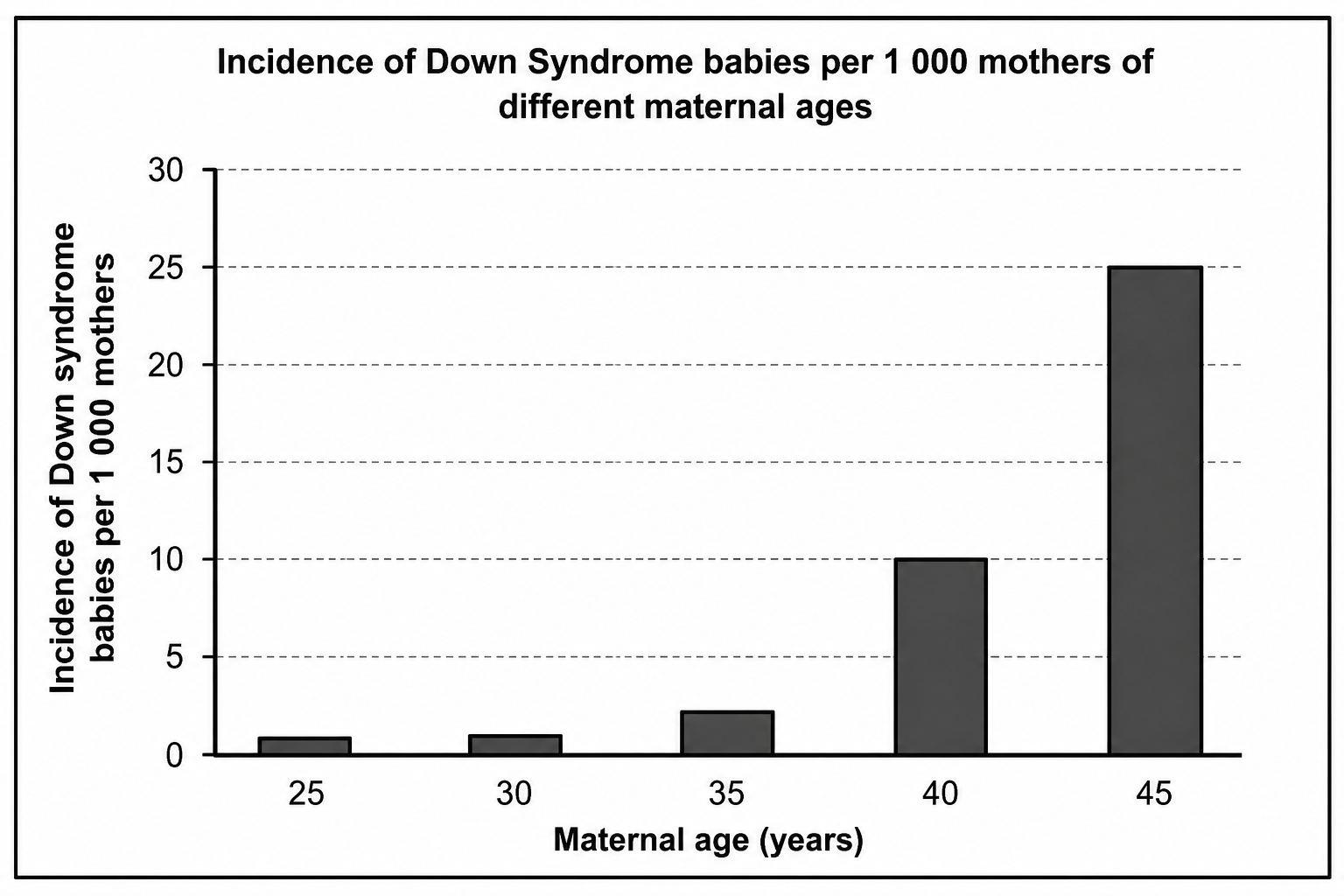
The graph shows that the incidence of Down syndrome babies increases as maternal age increases,
with a particularly sharp increase after the age of 35 years.
increases with maternal age, resulting in a higher incidence of Down syndrome births.
Answer:
The bar graph should include:
- An appropriate title.
- X-axis labelled Maternal Age (Years).
- Y-axis labelled Incidence of Down Syndrome Babies per 1 000 Mothers.
- Bars representing the values 0.8, 1, 2.5, 10 and 25.
- Equal width bars with equal spacing.
- An appropriate scale on the Y-axis.
non-disjunction increases with maternal age, especially after 35 years of age.
“`
Question 3.2
Frogs, birds and other fish have different survival rates of offspring.
The survival rate of offspring per eggs produced in some fish, chicken and frog was determined.
The table below shows the survival rate in different organisms.
| Organism | Survival Rate in Different Organisms |
|---|---|
| Fish | 1–5 per 1 000 eggs |
| Chicken | 100–150 per 250 eggs |
| Frog | 6–10 per 1 000 eggs |
Define the term Ovipary.
Answer: Ovipary is the laying of eggs.
In oviparous animals, the embryo develops inside an egg outside the mother’s body.
Using the table, name the organism that has the:
(a) Lowest survival rate
Answer: Fish
Fish have the lowest survival rate, with only 1–5 offspring surviving per 1 000 eggs.
(b) Highest survival rate
Answer: Chicken
Chickens have the highest survival rate because many more offspring survive from the eggs produced.
Explain:
(a) Why frogs are expected to produce a large number of gametes.
Answer:
- Fertilisation is external.
- Many gametes and offspring do not survive.
Producing a large number of gametes increases the chances that some offspring will survive to adulthood.
(b) The advantage of internal fertilisation in chickens.
Answer:
- Higher chance of fertilisation.
- Gametes are protected from drying out and environmental hazards.
Internal fertilisation improves reproductive success because the sperm and egg meet inside the female reproductive tract.
“`
State the independent variable of this investigation.
Answer: Clomid treatment
The independent variable is the factor deliberately changed by the scientists. In this investigation, Group A received clomid treatment while Group B did not.
List TWO variables that were kept constant and which contributed to the validity of the investigation.
Answer:
- Same age
- Same form of infertility
Keeping these factors the same ensured that differences in FSH levels were more likely due to the clomid treatment and not other variables.
Give ONE reason why the FSH level of participants was measured before the use of clomid treatment.
Answer: Baseline FSH level before treatment
Measuring FSH before treatment provided a starting point against which any changes after treatment could be compared.
“`
State TWO ways in which the scientists ensured the reliability of the investigation.
Answer:
- 16 females participated in the investigation
- Investigation conducted over a period of 5 months
Reliability was improved because the investigation included multiple participants and was conducted over an extended period rather than relying on a single measurement.
Explain the:
(a) Purpose of Group B in this investigation
Answer: Control group for comparison
Group B did not receive clomid treatment, allowing the scientists to compare results and determine whether any differences were caused by the treatment.
(b) Effect of clomid treatment in females struggling with infertility
Answer: Increased FSH level / stimulated ovulation
The investigation found that Group A had a higher average FSH level than Group B. Increased FSH stimulates the development of ovarian follicles and promotes ovulation.