Consumer Studies Grade 12
Explain the term counterfeit goods.
Counterfeit goods are defined as an illegal copy, replica, or fake version of an original product. These products are designed to mimic the appearance and branding of genuine items but are often made with lower-quality materials and lack the authenticity of the original. Counterfeit goods are created without the authorization of the brand owner and infringe on intellectual property rights. The production and sale of counterfeit items can harm the original brand’s reputation and reduce its profits.
Study the picture below and answer the questions that follow.
Identify the logo in the picture above.
The logo in the picture represents “Fair Trade.” This emblem signifies that the products bearing it adhere to ethical standards related to fair trade practices, ensuring the products were made under responsible conditions. Fair Trade certification assures consumers that items with this logo were created in ways that prioritize worker rights, fair wages, and sustainable practices.
To be able to place the logo on goods, it must pass a test. Name the qualifying criteria for manufacturers to be able to use the emblem/logo on their clothing items.
To place the Fair Trade logo on their products, manufacturers must meet specific qualifying criteria:
- Pay Fair Wages: Workers involved in creating the products should receive fair compensation, ensuring they can meet their basic needs and sustain their livelihoods.
- Provide Good Working Conditions and Decent Working Hours: Safe and healthy working conditions should be maintained, along with reasonable working hours to protect the well-being of employees.
- Do Not Use Child Labour: The production process should strictly avoid using child labor, respecting children’s rights and prioritizing their education and development.
- Comply with Civil Labour Laws and Safety Laws: Manufacturers must adhere to both local and international labor laws, including those related to workplace safety, to ensure that production facilities are regulated and inspected.
- Support Environmental Sustainability: Production practices should be environmentally friendly, prioritizing methods that reduce pollution, waste, and resource depletion to safeguard natural ecosystems.
These criteria ensure that products labeled with the Fair Trade logo meet ethical and sustainable standards, benefiting both workers and the environment.
Define the term dress code.
A dress code is a set of rules that specifies the type of clothing a company expects its employees to wear at work. Dress codes are typically created to establish a uniform appearance, promote professionalism, and ensure appropriate attire within the workplace. Alternatively, a dress code may be a document drawn up by a company to outline the acceptable standards of dress for employees, ensuring that all staff members meet the organization’s expectations regarding appearance and attire.
Read the scenario below and analyse the pictures. Answer the questions that follow.
| Gloria, who is 20-years-old, is appointed as an office assistant at a fashion wholesaler. She assists in the sales department on Mondays and Fridays. Her contract indicates that she should wear company uniform on Mondays and Fridays when working in public. The company uniform consists of a pencil skirt, white shirt and a formal jacket. The rest of the week she should dress professionally. No informal clothes, shorts, jeans, tekkies (sneakers) or brand labels are allowed. Below are the outfits she selected for a week. |
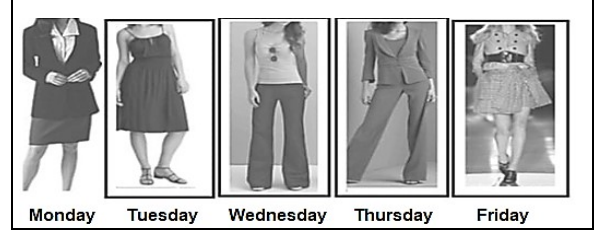
Evaluate if her selected outfits comply with the company’s dress code and the requirements of her contract.
Evaluating Gloria’s outfits reveals whether they comply with her company’s dress code and contractual requirements:
- Monday: Her attire complies with the company’s dress code, as she is wearing the prescribed company uniform. This demonstrates her adherence to the required standards when representing the company in public.
- Tuesday: The outfit appears too informal, with exposed shoulders. To align with the dress code, Gloria could wear a jacket over the dress or choose an outfit that covers her shoulders, creating a more professional look.
- Wednesday: While her pants are appropriate for the workplace, the top is too casual. Replacing it with a more formal top would ensure compliance with the dress code.
- Thursday: The chosen attire is professional and suitable for the work environment, meeting the dress code standards.
- Friday: Gloria’s outfit does not align with the dress code requirements. She should wear the designated company uniform, which includes a pencil skirt, white shirt, and formal jacket, especially since she will be interacting with the public.
Illustrate and explain the FIVE phases/stages in the fashion cycle by means of a graph.
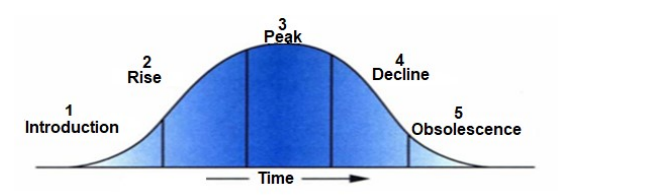
The fashion cycle has five distinct stages:
- Introduction Phase: In this initial stage, a new fashion style is introduced, and consumers are exposed to it for the first time. During this phase, people decide whether to accept or reject the style.
- Rise Phase: As the fashion gains acceptance, it starts becoming more popular, and an increasing number of people adopt it. This phase signifies growing interest and adoption by a broader audience.
- Peak Phase: At this peak stage, the fashion reaches maximum popularity. It becomes widely worn and highly recognized, often seen across different demographics and media.
- Decline Phase: In this stage, interest in the fashion starts to fade as consumers grow bored, and fewer people continue to wear it. Eventually, the style begins to lose its widespread appeal.
- Obsolescence Phase: The fashion becomes outdated and virtually disappears. At this point, it may be marked down in stores, with only a few people still wearing it as it fades from the public eye.
These stages illustrate how fashion trends evolve over time, moving from novelty to peak popularity and ultimately fading into obsolescence.
Explain why fashion cycles overlap.
Fashion cycles overlap because as older trends decline in popularity, interest in newer trends simultaneously increases. Consumers grow bored with outdated styles, and as demand decreases for these older trends, they gradually wear them less frequently. At the same time, new trends are introduced and begin to capture the public’s interest, often popularized by celebrities and advertisements. Furthermore, retailers promote these emerging styles in magazines and store displays, further accelerating the transition from old to new trends. This overlapping nature of fashion cycles ensures a continuous evolution of styles that keeps consumer interest engaged.
Consumer Studies Grade 12 | Final Exam Revision | Past Exam Questions and Answers | The Consumer