
GRADE 12 CONSUMER STUDIES
| COLUMN A FASHION CYCLE | COLUMN B DESCRIPTION |
|---|---|
| 1.2.1 Decline | A a new fashion is represented to the market at international fashion shows |
| 1.2.2 Introduction | B fewer people are wearing the fashion and are looking out for something new |
| 1.2.3 Peak | C fashion is always changing and it is not static |
| 1.2.4 Obsolescence | D fashion reaches the height of its popularity and many people wear it |
| 1.2.5 Rise | E the fashion cycle is now complete and garments will go out of fashion |
| F the popularity of the fashion is increasing and more people are accepting and buying the fashion |
SHOW ANSWER – QUESTION 1.2
- 1.2.1 – B: Decline is the stage when fewer people continue wearing a fashion and begin looking for something new.
- 1.2.2 – A: Introduction is when a new fashion is first presented to the market, often at international fashion shows.
- 1.2.3 – D: Peak is when the fashion reaches its highest popularity and is worn by many people.
- 1.2.4 – E: Obsolescence is the final stage, when the fashion cycle is complete and the garments go out of fashion.
- 1.2.5 – F: Rise is when the fashion becomes increasingly popular and more people accept and buy it.
| COLUMN A PROPERTY BUYING COST | COLUMN B DESCRIPTION |
|---|---|
| 1.3.1 Initiation fee | A fee based on the market value of the property |
| 1.3.2 Property tax | B these fees are paid for the registration of the mortgage loan and property title |
| 1.3.3 Deeds office fee | C these taxes are paid to transfer the property from the seller to the buyer |
| D a percentage of the cost price of the home, payable by the buyer | |
| E once-off fee payable to the bank after approval of the loan |
SHOW ANSWER – QUESTION 1.3
- 1.3.1 – E: The initiation fee is a once-off fee payable to the bank after the loan has been approved.
- 1.3.2 – A: Property tax/rates are based on the market value of the property.
- 1.3.3 – B: Deeds office fees are paid for registration of the mortgage loan and property title.
| 1.4.1 | Interest that is calculated on the original loan amount |
| 1.4.2 | A scheme where a product is sold and members are recruiting other members |
| 1.4.3 | Goods that the supplier has managed to import but the manufacturer does not want it sold in the country |
| 1.4.4 | A written promise to repair/replace a specific part without charge if it breaks/does not work properly within a specific period |
| 1.4.5 | The amount/cost charged by financial institutions to use their money |
SHOW ANSWER – QUESTION 1.4
- 1.4.1 Simple interest.
- 1.4.2 Legal pyramid schemes / Multilevel marketing (MLM) schemes.
- 1.4.3 Parallel imports / Grey goods.
- 1.4.4 Warranty.
- 1.4.5 Interest.
| A | Wearing clothes that fit well. |
| B | Using as many accessories as possible. |
| C | Not wearing clothes that will offend others. |
| D | Keeping nails and hair neatly groomed. |
| E | Wearing provocative clothing. |
| F | Wearing comfortable shoes. |
SHOW ANSWER – QUESTION 1.5
- A – Wearing clothes that fit well: Well-fitting clothing creates a neat, tidy and professional appearance.
- C – Not wearing clothes that will offend others: Appropriate clothing shows respect for the workplace and the people around you.
- D – Keeping nails and hair neatly groomed: Good personal grooming contributes to a clean, presentable and professional image.
| A | Use a gas stove |
| B | Rather grill your food in the oven |
| C | Prepare one pot meals in the oven or on the stove |
| D | Match the size of the saucepan with the size of the stove plate |
| E | Keep the oven door open when cooking food |
| F | Cut food into smaller pieces |
| G | Do not lower the temperature once food starts boiling |
| H | Boil a full kettle of water for three cups of coffee |
SHOW ANSWER – QUESTION 1.6
- A – Use a gas stove: This reduces the amount of electricity used for cooking.
- C – Prepare one-pot meals in the oven or on the stove: Cooking several ingredients together can reduce the number of appliances and cooking processes needed.
- D – Match the size of the saucepan with the size of the stove plate: The heat is used more efficiently when the pot fits the plate, reducing wasted energy.
- F – Cut food into smaller pieces: Smaller pieces cook more quickly, reducing cooking time and electricity use.
GRADE 12 CONSUMER STUDIES
QUESTION 2: THE CONSUMER
Inflation for 2025 was the lowest in 21 years. The December print concludes the result for the calendar year. The average inflation rate for 2025 was 3,2%. This is the lowest in 21 years (since 2004) when it was 1,4%. The next most recent year that inflation was lower than 3,2% was in 1969 (3,0%), 56 years ago.
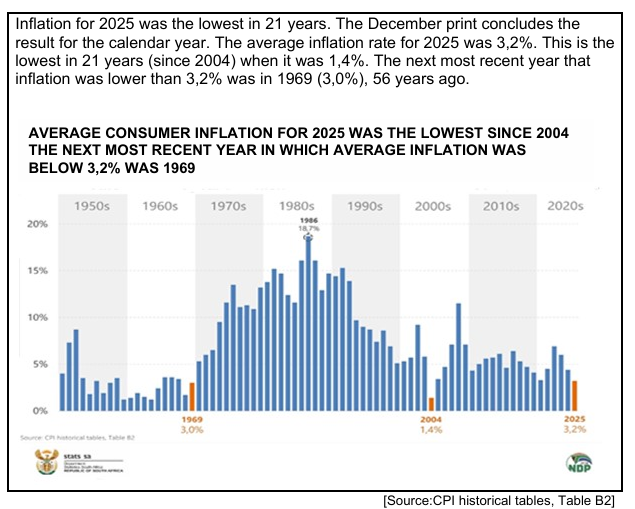
THE NEXT MOST RECENT YEAR IN WHICH AVERAGE INFLATION WAS BELOW 3,2% WAS 1969
2.1.1 Define the following terms:
(a) Inflation (2)
SHOW ANSWER – 2.1.1 (a)
Inflation is the rise in the prices of goods and services over a specific period. It can also be described as the average increase in the prices of goods and services over a year.
(b) Repo Rate (2)
SHOW ANSWER – 2.1.1 (b)
The repo rate is the interest rate charged by the South African Reserve Bank when commercial banks borrow money from it. It is the rate at which the Reserve Bank lends money to commercial banks and other lending institutions.
2.1.2 Demonstrate the effect of a lower inflation rate on the purchasing power of the rand. (4)
SHOW ANSWER – 2.1.2
A lower inflation rate means that prices are increasing more slowly. The rand therefore loses its purchasing power at a slower rate, so consumers can generally afford more with the money they have than they could when inflation was higher. If the prices of goods and services decrease, or rise more slowly, households may have more disposable income available to meet their basic needs.
- A decrease in petrol and electricity prices can reduce transport, production and operating costs. This may contribute to lower prices for goods and services.
- Lower production costs can make it easier for businesses to produce goods and services. This may also create more job opportunities.
- When salaries increase while inflation remains low, families may have more money available. This can improve their standard of living and allow them to spend on luxury products as well as basic needs.
- People who receive fixed or investment incomes, including pensioners, may benefit because the value of their income is not eroded as quickly by rising prices. They may also earn more interest because of lower inflation.
2.1.3 Explain how the Consumer Price Index (CPI) is used to determine the inflation rate. (4)
SHOW ANSWER – 2.1.3
The Consumer Price Index (CPI) measures the changes in the prices of a selected group of goods and services, commonly called a basket of goods and services. The prices of the items in this basket are monitored and compared over time, usually over a 12-month period. The change is expressed as a percentage. The annual percentage change in the CPI is used as the inflation rate, making the CPI a measure or yardstick for tracking inflation.
- The CPI measures, calculates or determines changes in prices.
- It looks at a group or basket of products and services.
- The prices are compared over a specific period, commonly 12 months.
- The change is expressed as a percentage; the annual percentage change in the CPI is the inflation rate.

2.2.1 Identify the type of scam presented in the picture. (1)
SHOW ANSWER – 2.2.1
Phishing scam.
2.2.2 Suggest THREE guidelines to protect consumers from this type of scam. (3)
SHOW ANSWER – 2.2.2
- If an email appears fake or looks like spam, delete it without opening it. Do not click on links or respond to suspicious messages.
- Keep anti-spam and anti-virus software up to date so that suspicious messages and harmful software can be detected and blocked.
- Never provide personal details, passwords or banking information by email.
- Do not open attachments in emails that claim to come from your bank, as they may contain harmful software or lead to fraudulent websites.
- Check bank and credit-card statements regularly so that unauthorised transactions can be identified quickly.
- If you think you have given financial information, such as a credit-card number, to a phisher, contact your bank or credit-card company immediately.
2.2.3 Name FOUR other types of scams a consumer should be aware of. (4)
SHOW ANSWER – 2.2.3
- Lottery scam / prize-notification scam.
- Credit-card fraud.
- Work-from-home scam.
- Computer-virus scam.
- Advertisement of room / flatmate scam.
- Letter asking for help / advance-fee type scam.
- Identity theft.
- 419 scam.
2.3 Discuss how a cooling-off period can prevent a consumer from unnecessary purchases. (3)
SHOW ANSWER – 2.3
- The cooling-off provision applies to goods, except services.
- The National Credit Act allows five working days to cancel a contract for goods purchased through direct marketing, without giving a reason and without a penalty.
- The supplier or credit provider must refund money already paid within seven business days / fifteen days of receiving the notification.
2.4 “Income tax is the South African government’s biggest source of income.”
2.4.1 Describe what income tax is. (2)
SHOW ANSWER – 2.4.1
Income tax is a tax charged on the income and profit received by a taxpayer. It is calculated on a sliding scale, which means that the amount of tax payable increases as a person's taxable income increases: the more a person earns, the more income tax they generally pay.
2.4.2 Show the relationship between earning a high salary and paying taxes. (4)
SHOW ANSWER – 2.4.2
South Africa’s tax system is based on the principle that people should contribute to the wealth of the country in relation to their own ability to earn. Income tax, also known as Pay As You Earn (PAYE), is deducted when a salary is paid. As a result, a person who earns a higher salary generally pays more income tax than someone who earns less.
A higher salary can also increase the amount of other taxes a consumer pays because higher-income consumers may buy more goods and services, own more valuable property, drive more often and purchase more expensive or imported goods. For example:
- People contribute to the wealth of the state or country in relation to the extent to which they contribute to their own wealth.
- Income tax / PAYE is payable at the same time that a salary is paid or earned.
- The higher the salary, the more income tax / PAYE is paid.
- Consumers earning high salaries are likely to buy more goods and services.
- They may therefore pay more Value Added Tax (VAT) than consumers who buy fewer goods and services.
- High-income consumers may own one or more cars, drive or travel more, and use more petrol or diesel.
- They may consequently pay more fuel levy and toll levy because they use more fuel and roads.
- Homeowners pay municipal rates, and the amount is based on the value of the property.
- The higher the value of the property, the higher the municipal rates payable.
- A high-income consumer may be able to buy an expensive property in an affluent area.
- Transfer duty is payable when property is bought, and it is based on the value of the property.
- A consumer who buys a more expensive property will pay more transfer duty.
- Estate duty is charged on the value of property or assets owned by South African citizens at the date of death.
- If a person accumulated more valuable property during their lifetime, a higher value of assets may result in more estate duty being payable.
- People who earn more may buy more imported goods and therefore pay more import duty.
- People with higher salaries may buy more luxury goods, alcohol or perfume and pay more excise / sin taxes.
South Africans are angry as Johannesburg faces a growing water crisis.
Some Johannesburg residents, “haven’t had a drop of water for more than three weeks straight: forced to travel to get water from municipal tankers and washing in buckets”, said NPR. Many have taken to the streets in protest.
2.5.1 Name FOUR causes of water pollution. (4)
SHOW ANSWER – 2.5.1
- Using washing powders, cleaning agents or toiletries that are not environmentally friendly.
- Agricultural pollution, including the overuse of pesticides and fertilisers, or chemicals and micro-organisms seeping into groundwater.
- Dumping or throwing litter into rivers, dams and lakes.
- Destruction of river catchments through urbanisation, deforestation, damming of rivers or destruction of wetlands.
- Accidental pollution, such as burst pipes or tanks, major leaks, fires and oil spills.
- Untreated sewage flowing into rivers or catchment areas.
- Industrial waste, including factories using fresh water to carry waste away into rivers and lakes.
- Marine dumping / dumping litter into the sea.
- Leaks from underground petroleum storage facilities or pipes.
- Mining activities that cause acid mine drainage.
2.5.2 Suggest THREE tips for our schools on water-saving methods. (3)
SHOW ANSWER – 2.5.2
- Check taps regularly and repair dripping taps. A dripping tap can waste approximately 30–40 litres of water every day.
- Fit tap aerators, which reduce the flow of water by approximately 50–70%.
- Turn off taps while washing or soaping hands, and open the tap only when rinsing.
- Encourage learners to drink from refillable bottles instead of cupping water in their hands while a tap is running.
- Check toilets and repair leaking cisterns, pipes and toilet fittings.
- Reduce the volume of water used for each toilet flush by placing a brick or a two-litre bottle in the cistern, where appropriate.
2.5.3 Discuss why it is necessary that the municipality supply clean safe water to all citizens. (4)
SHOW ANSWER – 2.5.3
Clean, safe water is essential because water is a basic human need and every person needs it to survive. Municipalities must ensure that water is properly treated before it reaches households so that it is safe to drink and does not expose people to contamination or waterborne diseases. Citizens also need a reliable supply of clean water to maintain personal hygiene, prepare food and keep their surroundings clean. Safe water and adequate sanitation help protect public health and dignity.
- Water is a basic need that all people require to survive.
- The municipality must ensure that water is properly treated to protect people and prevent contamination.
- People need clean water for hygiene and sanitation.
GRADE 12 CONSUMER STUDIES
QUESTION 3: FOOD AND NUTRITION
3.1 Define the following terms:
3.1.1 Allergens (2)
SHOW ANSWER – 3.1.1
Allergens are substances that cause an allergic reaction in a person who is sensitive to them.
3.1.2 Food irradiation (2)
SHOW ANSWER – 3.1.2
Food irradiation is the treatment of food with light or radio waves/radiation to improve its safety, acceptability or shelf life. The rays penetrate the food and kill undesirable bacteria and insects.
3.2 Recommend with reasons, THREE dietary guidelines for the management of obesity. (3 × 2) (6)
SHOW ANSWER – 3.2
Dietary changes can help a person manage obesity by reducing excess energy intake, controlling hunger and supporting a healthier body weight. Suitable guidelines include:
- Include more high-fibre foods, such as wholegrains, fruit, vegetables and pulses. Fibre helps a person feel full for longer, delays hunger and can reduce overeating.
- Eat at least three meals a day and do not skip breakfast. Skipping meals can make a person extremely hungry and more likely to overeat later. Regular meals also help maintain normal metabolism.
- Reduce the intake of fat and choose lean meat, fish or chicken. This lowers the total energy/kilojoule intake and supports weight loss.
- Choose grilling, baking or steaming instead of frying. Frying adds extra fat and kilojoules, which can contribute to excess energy being stored as body fat.
- Include more low-GI foods. These help control blood-glucose levels and delay hunger, making it easier to manage food intake.
- Eat more pulses, such as beans, lentils and peas. They are filling and generally low in fat, helping to reduce overeating.
- Choose healthy snacks and reduce junk food and sweets between meals. This lowers the total kilojoules consumed during the day.
- Eat smaller portions. Controlling portion sizes reduces total energy intake and can assist with weight loss.
- Eat at least five portions of fruit and vegetables each day. They provide fibre, help a person feel satisfied and can reduce the amount of other, more energy-dense foods eaten.
3.3 Read the case study below and answer the questions that follow.
3.3.1 Give the incubation period of gastroenteritis. (1)
SHOW ANSWER – 3.3.1
A few hours to a few days.
3.3.2 List THREE symptoms these toddlers may have experience to show that they have gastroenteritis. (3)
SHOW ANSWER – 3.3.2
- Loose stools or non-bloody diarrhoea.
- Stomach cramps or abdominal pain.
- Nausea.
- Bloating.
- Fever.
- Vomiting.
- Muscle aches or headaches.
3.3.3 Explain how gastroenteritis could have been transmitted to the toddlers. (3)
SHOW ANSWER – 3.3.3
The lack of running water at the day-care centre could have allowed germs to spread through contaminated food, water, utensils and hands. For example:
- Food may have been prepared using contaminated water, allowing germs to enter the toddlers’ meals.
- Bottles and utensils may not have been washed thoroughly because there was not enough water to clean and rinse them properly.
- The toddlers may have drunk contaminated water.
- An infected toddler may have passed the infection to other children through contact or contaminated surfaces.
- Staff may not have washed their hands properly after changing nappies, allowing germs to spread to food, bottles or other children.
- A staff member who was infected may have handled food without washing their hands first.
3.4 Study the information on the label of a packet of biscuits and answer the questions that follows:
| INGREDIENTS | |
| Wheat flour Stabiliser Maltodextrin Creamer Palm oil Emulsifier Beef Extract Casein | Salt Tartrazine Flavour enhancer Milk solids Monosodium glutamate Xanthan gum Anticaking agent Whey powder |
3.4.1 Explain what food additives are. (2)
SHOW ANSWER – 3.4.1
Food additives are natural or chemical substances/ingredients deliberately added to food during processing or production to perform specific functions. They may be added to preserve food or improve its flavour, texture or appearance.
3.4.2 Identify from the list below the ingredients that are responsible for:
(a) Improving the natural taste of the product (1)
(b) Improving the texture as it absorbs water, swells and thickens (1)
(c) Improving the colour of the product (1)
SHOW ANSWER – 3.4.2
- (a) Salt or monosodium glutamate.
- (b) Stabiliser or emulsifier.
- (c) Tartrazine.
3.5 Read the scenario below and answer the questions that follow.
3.5.1 Name the disorder Lydia suffers from. (1)
SHOW ANSWER – 3.5.1
Bulimia or bulimia nervosa.
3.5.2 Analyse how the following will assist Lydia in recovering:
(a) Psychological treatment (3)
SHOW ANSWER – 3.5.2 (a)
Psychological treatment can help Lydia understand and address the emotional causes of her eating behaviour. Counselling can help her deal with guilt, depression and negative feelings about her body. Support from family and friends can help her feel less isolated and encourage her to continue treatment. A doctor may prescribe antidepressant medication if it is needed. By addressing her psychological needs, treatment can help her restore a healthier relationship with food and her body.
(b) Nutritional education and treatment (3)
SHOW ANSWER – 3.5.2 (b)
A dietitian can teach Lydia about balanced eating and help her develop regular, healthy eating habits. Nutritional guidance can help her stop the cycle of binge eating and purging by showing her how to plan suitable meals and choose healthier alternatives. She can be encouraged to eat a balanced diet containing sufficient carbohydrates and fats for energy, as well as protein to build and repair body tissues and maintain normal body functions.
3.6 Study the recipe below and answer the questions that follow.
EASY PANCAKES
- Mix 1 cup flour, 2 tsp baking powder, 2 tbsp sugar, and a pinch of salt.
- Whisk in 1 egg, ¾ cup water, and 2 tbsp oil.
- Fry in a greased skillet until bubbly, then flip.
Discuss the suitability of this dish for each of the following food-related health conditions:
(a) Gluten intolerance (3)
SHOW ANSWER – 3.6 (a)
The pancakes are not suitable for a person with gluten intolerance. The recipe contains wheat flour, and wheat contains gluten. Eating the pancakes may therefore cause symptoms in a person who cannot tolerate gluten. A gluten-free flour would be needed as a substitute.
(b) Milk allergy (2)
SHOW ANSWER – 3.6 (b)
The pancakes are suitable for a person with a milk allergy because the listed recipe uses water rather than milk and does not include dairy products. The ingredients should still be checked to ensure that the flour or other products have not been contaminated with milk ingredients.
3.7 Read the statement below and answer the question that follow:
The majority of consumers who purchase organic food perceive it to be healthier, but is it really worth spending up to 40% more on what could be essentially the same product?
Do you agree with the above statement? Justify your opinion and draw a clear conclusion regarding the benefits of organic food. (6)
SHOW ANSWER – 3.7
Yes, I agree that organic food can offer important benefits, although consumers should consider its higher price. Organic farming generally limits the use of synthetic pesticides and chemicals, which may reduce consumers’ exposure to residues that could be harmful to health. Organic farming can also be better for animal welfare because free-range and organically farmed animals are treated more humanely, have more space to move around and are fed a more natural diet. Their meat may also have a better taste. Organic animals are not given growth hormones and unnecessary antibiotics. In addition, organic farming can reduce pollution and lessen the impact of harmful chemicals on the environment.
Conclusion: Organic food can benefit human health, animal welfare and the environment. However, it may cost more, so consumers should weigh these benefits against their household budget when deciding whether to buy it.
GRADE 12 CONSUMER STUDIES
QUESTION 4: CLOTHING
4.1 Define the term style. (2)
SHOW ANSWER – 4.1
Style refers to the specific characteristics or features that distinguish one product from another similar product. In clothing, these features give a garment its particular appearance and make it recognisable as a particular design.
4.2 List FOUR reasons why fashion changes. (4)
SHOW ANSWER – 4.2
- Economic factors: Changes in the economy and consumers’ spending power influence the clothing people can afford and the fashions they buy.
- Social factors: Changes in society, lifestyles, values and the way people interact can influence clothing preferences.
- Technological factors: New technology allows manufacturers to develop different fabrics, materials, designs and ways of producing clothing.
- Political factors: Political events, policies and changes in society can influence what people wear and how fashion develops.
- Consumers become bored with existing styles quickly and continually look for something new.
- The need for sustainability encourages clothing manufacturers to change the styles and materials they use.
4.3 Explain the difference between retrospective fashion and vintage fashion. (4)
SHOW ANSWER – 4.3
Retrospective fashion refers to new or second-hand clothing that takes inspiration from styles of previous eras. Designers look back at earlier fashions and recreate them. A retrospective garment is not necessarily an original old garment; it may be a faithful copy of an earlier design.
Vintage fashion refers to an original clothing item from a previous era. It is an older garment that was actually manufactured many years ago and has been preserved from that period.
The key difference is that retrospective fashion is inspired by or copies an earlier style, while vintage fashion is an original garment from the past.
4.4 Discuss the versatility of a denim jacket in a person’s wardrobe. (6)
SHOW ANSWER – 4.4
A denim jacket is a versatile wardrobe item because it can be styled in many different ways and worn for different occasions. It is useful as a layering piece over a shirt, dress or top, and can be worn with jeans or many other outfits. It can be dressed up for a smarter look or worn casually for everyday activities.
- It is an excellent layering item and can be worn over other garments.
- It can be worn by both males and females.
- It is low-maintenance, easy to wash and requires little or no ironing.
- It can be worn in different seasons, including winter and summer.
- It can be matched with many outfits, such as dresses, shirts, tops and jeans.
- It is available in a wide variety of styles and designs.
- It is a timeless or classic fashion item that does not quickly go out of fashion.
- It is suitable for people of different ages, both young and old.
- It can be worn for formal or casual occasions, depending on how it is styled.
- It is easy to mix and match with other colours.
4.5 Evaluate the benefits of buying classic fashions such as practical leather shoes and bags for one’s working wardrobe. (4)
SHOW ANSWER – 4.5
Buying classic items such as practical leather shoes and bags is a good investment for a working wardrobe. Classic styles do not quickly go out of fashion, so they can be worn for many years rather than replaced every season. This saves money and gives good value for money. Classic items are often well made and durable, which means they can withstand regular use. Their simple designs and neutral colours also make them easy to coordinate with different work outfits. In addition, classic styles are generally tasteful and appropriate for a professional working environment.
- Classic styles are timeless and do not quickly go out of fashion, so they can be worn for many years.
- They save money and offer good value because they do not need to be replaced frequently.
- They are usually good quality and durable, so they last longer.
- Classic styles suit most people.
- They are often available in neutral or basic colours and can be mixed and matched with many outfits.
- They are tasteful and help a person dress suitably for work.
GRADE 12 CONSUMER STUDIES
QUESTION 5: HOUSING
5.1 Read the extract below and answer the questions that follow.
After their break-up, Lindiwe moved out of the apartment they rented and signed for. They had no formal agreement with regards to the monthly rental that Lindiwe paid every month. After two months, Thabisa was evicted from the apartment but decided to take the matter to the small claims court. The first thing the lawyer asked her was: “Did you read the lease agreement?”
5.1.1 Explain what a lease agreement is. (2)
SHOW ANSWER – 5.1.1
A lease agreement is a written or verbal contract between the owner of a property (the landlord) and a tenant. It gives the tenant the right to use and occupy the property for an agreed period in return for payment of rent.
5.1.2 The first thing the lawyer asked Thabisa was: “Did you read the lease agreement?” List the information that must be included in the lease agreement. (4)
SHOW ANSWER – 5.1.2
- The address and number of the property.
- The date on which the lease document was signed.
- The signatures of the tenant, property owner and a witness.
- The date on which the rental period starts and the length or duration of the lease.
- Details about renewal of the lease.
- The amount of each rental instalment.
- Clauses setting out the rights and responsibilities of the tenant and landlord. These may cover the deposit, water and electricity costs, subletting, whether pets are allowed, inspection of the property and the owner's access to the unit.
A lease should clearly state the conditions agreed to by both parties so that the landlord and tenant understand their responsibilities and can refer to the agreement if a disagreement arises.
5.1.3 Thabisa considers buying a property after her eviction. Apply your knowledge of housing options by referring to the advantages of:
(a) Full-title (Free-standing) property (3)
SHOW ANSWER – 5.1.3 (a)
- The buyer becomes the legal owner of the property and has greater control over it.
- The owner can make changes or improvements to the property.
- Owning a free-standing home can provide a sense of security, privacy and independence.
- The property can be used as security when applying for a bank loan.
- It can be a sound investment because its value may increase over time.
- A room can be rented out to earn additional income.
- The owner can leave the property to children in a will or sell it and potentially make a profit.
- A business can be operated from the home, subject to approval from the local authority.
(b) Sectional-title property (3)
SHOW ANSWER – 5.1.3 (b)
- The buyer becomes the legal owner of the unit.
- Living in a complex may provide greater security than living in a free-standing house.
- The owner can use the common areas and shared facilities of the complex.
- These developments are often closer to city centres or workplaces, which can reduce travelling costs.
- The owner has fewer individual maintenance responsibilities because the body corporate manages and maintains the shared property.
- The Sectional Titles Act protects the interests of sectional-title owners.
- The owner saves on the cost and effort of maintaining a large property and garden.
5.2 Read the advertisement below and answer the questions that follow.
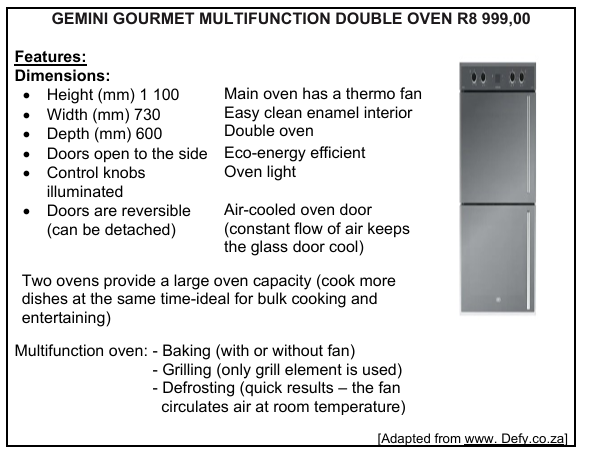
GEMINI GOURMET MULTIFUNCTION DOUBLE OVEN
Features
- Height (mm): 1 100
- Width (mm): 730
- Depth (mm): 600
- Doors open to the side
- Control knobs illuminated
- Doors are reversible (can be detached)
- Main oven has a thermo fan
- Easy clean enamel interior
- Double oven
- Eco-energy efficient
- Oven light
- Air-cooled oven door (constant flow of air keeps the glass door cool)
Two ovens provide a large oven capacity
Cook more dishes at the same time – ideal for bulk cooking and entertaining.
Multifunction oven
- Baking: with or without fan
- Grilling: only grill element is used
- Defrosting: quick results – the fan circulates air at room temperature
5.2.1 Name TWO possible disadvantages of using this oven. (2)
SHOW ANSWER – 5.2.1
- It is expensive and costs more than a single oven.
- It takes up a lot of space because it is large and tall.
- It cannot be installed underneath a counter.
- Only the main oven has a thermo fan.
5.2.2 Name TWO advantages of using energy efficient appliances. (2)
SHOW ANSWER – 5.2.2
- They use less electricity, which lowers household running costs and helps consumers save money.
- They place less demand on the national electricity grid.
- Using less energy is better for the environment because it can reduce pollution and the carbon footprint, helping to conserve the natural environment.
5.2.3 Discuss the suitability of this oven in terms of:
(a) Saving human energy (2)
SHOW ANSWER – 5.2.3 (a)
The oven is suitable for saving human energy because its easy-clean enamel interior reduces the effort needed to clean it. The illuminated control knobs make it easier to see and operate the settings. Its double-oven design allows several dishes to be prepared at the same time, saving the cook time and effort, especially when preparing food in bulk. The oven is also positioned at eye level, so the user does not have to bend down when using it.
(b) Saving non-human energy (2)
SHOW ANSWER – 5.2.3 (b)
The oven is described as eco-energy efficient, so it is designed to use electricity more economically. Its different functions allow the user to select the most suitable cooking method and use the fan or heating elements as needed. The defrost function circulates room-temperature air to defrost food quickly without using the full heating function. The double oven can also cook several dishes at once, saving electricity compared with cooking them separately at different times.
GRADE 12 CONSUMER STUDIES
QUESTION 6: ENTREPRENEURSHIP
6.1 Read the case study below and answer the questions that follow.
6.1.1 Define the term mark-up. (3)
SHOW ANSWER – 6.1.1
Mark-up is the amount or percentage added to the cost price of goods to cover overhead expenses and still leave money for a profit. In other words, a business adds an extra amount to what it cost to make or buy an item so that the selling price can cover expenses and provide profit.
6.1.2 Identify THREE resources available to Liya. (3)
SHOW ANSWER – 6.1.2
- Sewing machine.
- Overlocker.
- Her sewing skill.
- Her sewing experience.
- Her parents’ home as a workspace.
- Knowledge of entrepreneurship gained at school.
- Old denim supplied by friends and family.
Any three of these resources may be identified.
6.1.3 List the objectives of advertising. (4)
SHOW ANSWER – 6.1.3
- Create awareness of a product or service so that potential customers know it exists.
- Generate consumer interest and encourage people to find out more about the product.
- Persuade customers to buy the product or use the service.
- Expand the market by reaching new customers.
- Maintain sales by reminding existing customers about products or reliable services.
- Announce the location of the business.
- Inform customers about a modification or expansion of the business.
- Provide contact details so customers can request more information or place orders.
Advertising can therefore attract new customers, encourage purchases and keep a business visible to its existing market.
6.1.4 Explain to Liya why it would be beneficial to provide training to the person that she employs. (4)
SHOW ANSWER – 6.1.4
Training will help the employee understand the work they must do and the standard expected by Liya. When the employee has the correct skills and knowledge, the quality of the handmade products can improve and work can be completed more efficiently. Training can also increase productivity because the employee is more confident and capable. It may motivate the worker and improve morale, while reducing mistakes, waste of materials and unnecessary damage to or repairs of equipment.
- Employees understand their duties and what is expected of them.
- The quality of work improves.
- Productivity increases.
- Employees may feel more motivated and have better morale.
- Less material is wasted.
- Maintenance and repair costs for equipment may be reduced.
6.1.5 State the purpose of a financial feasibility study. (3)
SHOW ANSWER – 6.1.5
- It identifies the strengths and weaknesses of an existing business or a proposed business idea.
- It helps determine whether the business is likely to succeed by comparing its total costs with the revenue it is expected to earn.
- It helps the entrepreneur make an objective decision about whether to continue with the business idea.
- It identifies changes or adaptations that could be made to improve the profitability of the business.
- It helps calculate the start-up capital required and identify where that capital could be obtained.
- It helps estimate the return on investment or profit that may be expected.
6.1.6 Discuss the factors Liya had to consider when choosing a product for her small scale business. (4 × 2) (8)
SHOW ANSWER – 6.1.6
When choosing a product for a small business, an entrepreneur needs to consider whether the necessary skills, equipment, workspace and raw materials are available. Liya’s case shows that these resources were already accessible to her, making the production of denim bags and other useful articles a practical business choice.
- Availability of human skills: Liya can sew because her grandmother taught her and she gained sewing experience while spending holidays on the farm. This means she already has the skill needed to make the products.
- Availability of financial and other resources: She inherited a sewing machine and an overlocker, so she already has important equipment needed to produce the items.
- Availability of workspace: She can operate the micro enterprise from her parents’ home, giving her a place to work without needing to rent separate business premises.
- Availability of raw materials: Friends and family give her old denim, providing material that she can reuse to make bags and other useful articles.
6.1.7 Explain the components of the marketing mix as seen in the case study. (3)
SHOW ANSWER – 6.1.7
- Product: Creative bags and other handy articles made from old denim.
- Place: The products are sold at markets and selected small arts and craft stores.
- Promotion: Liya advertises her enterprise on social media.
These three elements show what Liya sells, where customers can buy it and how she makes potential customers aware of her products.
6.1.8 Liya sells 60 denim shopping bags per month. Her expenses are as follow:
- Sewing supplies: R300,00
- Labour: R1 400,00
- Transport: R300,00
- Other costs: R200,00
She adds 70% mark-up. Calculate the selling price of ONE shopping bag. Show ALL calculations. (4)
SHOW ANSWER – 6.1.8
Step 1: Calculate the total monthly expenses.
| Sewing supplies | R300,00 |
| Labour | R1 400,00 |
| Transport | R300,00 |
| Other costs | R200,00 |
| Total expenses | R2 200,00 |
R300,00 + R1 400,00 + R300,00 + R200,00 = R2 200,00
Step 2: Calculate the 70% mark-up.
70 ÷ 100 × R2 200,00 = R1 540,00
Step 3: Add the mark-up to the total expenses.
R2 200,00 + R1 540,00 = R3 740,00
Step 4: Divide by the 60 bags produced per month.
R3 740,00 ÷ 60 = R62,33
Selling price of one shopping bag = R62,33.
Keep the full amounts during the calculation and round the final selling price to two decimal places.
6.1.9 Analyse why Liya’s business will show sustainable profitability. (8)
SHOW ANSWER – 6.1.9
Liya’s business has several advantages that can help it remain profitable over time. She already owns important equipment, works from her parents’ home and receives old denim from friends and family. These arrangements keep her operating and material costs low. She also uses social media to advertise and sells through markets and selected craft stores, avoiding the high costs of running her own shop. The rapid growth of her client base suggests that customers want her products. Her environmentally friendly use of old denim may also attract consumers who care about reducing waste.
- She inherited a sewing machine and an overlocker: She did not have to buy this equipment, reducing her start-up and equipment costs.
- She works from her parents’ home: She does not have to pay rent for separate business premises, keeping monthly overhead expenses lower.
- She receives old denim from friends and family: She spends very little on purchasing raw materials, which reduces the cost of producing each item.
- She advertises on social media: This is a relatively inexpensive way to promote her products and reach potential customers.
- She sells at markets and selected arts and craft stores: She does not need to pay the expenses involved in operating her own shop.
- Her client base expanded rapidly: This shows that there is demand for her products, creating opportunities for continued sales.
- She reuses old denim and reduces waste: This environmentally friendly approach may appeal to nature lovers and consumers who prefer products that reuse materials instead of requiring new resources.
These factors help keep costs down while supporting sales and customer demand. Together, they can help Liya maintain a profit over time.