
Life Sciences Grade 10 — Free State March 2025
SECTION A — QUESTION 1
1.1 Multiple-choice questions
1.1 Various options are given as possible answers to the following questions. Choose the answer and write only the letter (A to D) next to the question number (1.1.1 to 1.1.5) in the ANSWER BOOK, for example 1.1.6 D.
1.1.1 A Dutch scientist who designed the first microscope and is regarded as the father of microscopy.
Answer: B — Antonie van Leeuwenhoek
Antonie van Leeuwenhoek
was the Dutch scientist associated with the first microscope and is regarded as the father of microscopy.
1.1.2 The diagram below shows enzyme action.
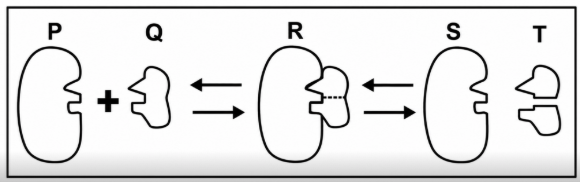
What does Q represent in the diagram above?
Answer: D — Substrate
Substrate
is the substance that fits into the active site of an enzyme during enzyme action.
1.1.3 The most important function of the cell wall in a plant cell, is to...
Answer: D — produce lignin to support the cell.
The correct answer is to
produce lignin to support the cell
; lignin contributes to the strength and support of plant cell structures.
1.1.4 Which inorganic compound is most abundant in healthy bodies of plants and animals?
Answer: B — Water
Water
is the inorganic compound that is most abundant in healthy bodies of plants and animals.
1.1.5 The dark coloured body in the nucleoplasm of the nucleus.
(5 × 2) (10)
Answer: D — Nucleolus
The
nucleolus
is the dark coloured body found in the nucleoplasm of the nucleus.
1.2 Biological terms
Give the correct biological term for each of the following descriptions. Write only the term next to the question number (1.2.1 to 1.2.4) in the ANSWER BOOK.
1.2.1 Part of the microscope that concentrates light rays from the light source onto the specimen
Answer: Condenser
The
condenser
concentrates light rays from the light source onto the specimen.
1.2.2 Deficiency caused by lack of iodine in humans
Answer: Goitre
Goitre
is the deficiency condition caused by a lack of iodine in humans.
1.2.3 Organic compounds made up of the elements C, H, O and N
Answer: Proteins
Proteins
are organic compounds made up of the elements C, H, O and N.
1.2.4 Fats mainly derived from plants, that are liquids at room temperature
Answer: Unsaturated fats
Unsaturated fats
are fats mainly derived from plants that are liquids at room temperature.
(4 × 1) (4)
1.3 Column A and Column B
Indicate whether each of the descriptions in COLUMN I applies to A ONLY, B ONLY, BOTH A AND B or NONE of the items in COLUMN II. Write A only, B only, both A and B or none, next to the question number (1.3.1 to 1.3.3) in the ANSWER BOOK.
| Column I | Column II |
|---|---|
| 1.3.1 Nutrients needed in small quantities |
A: Macro-elements
B: Micro-elements |
| 1.3.2 Controls all cell activities. |
A: Cytoplasm
B: Nucleus |
| 1.3.3 Spontaneous movement of gas molecules from an area of high concentration to an area of low concentration until equilibrium is reached |
A: Diffusion
B: Osmosis |
(3 × 2) (6)
1.3.1 Answer: B only — Micro-elements
Micro-elements
are nutrients needed in small quantities.
1.3.2 Answer: B only — Nucleus
The
nucleus
controls all cell activities.
1.3.3 Answer: A only — Diffusion
Diffusion
is the spontaneous movement of gas molecules from an area of high concentration to an area of low concentration until equilibrium is reached.
TOTAL SECTION A: 20
SECTION B — QUESTION 2
2.1 Different organelles in a cell
2.1 The diagrams below represent different organelles in a cell.
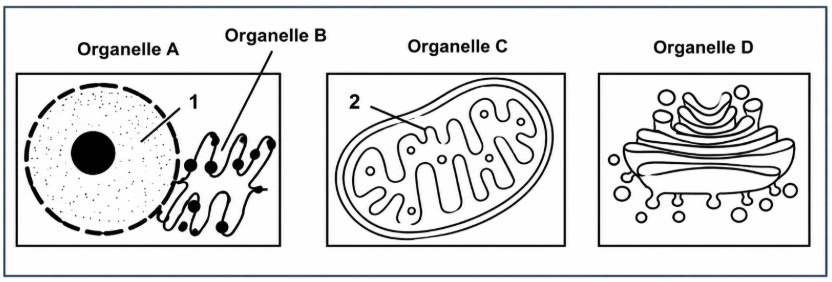
2.1.1 Give the LETTER and NAME of the organelle:
(a) Where protein synthesis takes place
(b) That produces mucus
(c) Which contains chromatin network
(a) Where protein synthesis takes place
(b) That produces mucus
(c) Which contains chromatin network
2.1.1
- (a) B — Ribosome . Protein synthesis takes place at the ribosome.
- (b) D — Golgi body . The Golgi body produces mucus as specified in the question.
- (c) A — Nucleus . The nucleus contains the chromatin network.
2.1.2 Identify part:
(a) 1
(b) 2
(a) 1
(b) 2
2.1.2
- (a) 1 — Nucleoplasm . This is the material within the nucleus surrounding the nuclear structures.
- (b) 2 — Crista / inner membranes . These are the folded inner membranes shown in the organelle.
2.1.3 Give TWO functions of the endoplasmic reticulum in organelle A.
Answer
- It transports substances through the cytoplasm. The endoplasmic reticulum provides a pathway through which substances can be transported within the cell.
- It increases the internal surface area of the cell. Its extensive membrane system increases the internal surface area available for cellular processes.
- Smooth ER is involved in the processing, packaging and transport of lipids. Smooth ER therefore contributes to the processing, packaging and transport of lipids within the cell.
- Rough ER is involved in protein synthesis. The rough ER has ribosomes associated with it, linking it to protein synthesis.
2.1.4 Describe the process that occurs in organelle C.
Answer: Aerobic respiration
Aerobic respiration is the process in which energy, in the form of ATP, is released from carbohydrates in the presence of oxygen.
2.1.5 Describe the structure of cell membranes that allows selective/differential permeability.
Answer
The cell membrane contains phospholipid molecules and large protein molecules that move around within the membrane . This membrane structure allows substances to pass through selectively or differentially.
TOTAL QUESTION 2: 15
QUESTION 3
3.1 Food tests
3.1 A learner carried out three food tests on samples of peanuts, apples and potatoes. The following table shows the results. On the table, a tick (✓) shows a positive result and a cross (X) shows a negative result.
| TEST | REAGENT | PEANUTS | APPLES | POTATOES |
|---|---|---|---|---|
| P | Iodine solution | ✓ | ✓ | ✓ |
| Q |
Fehling's A and B
OR Benedict's solution |
X | ✓ | X |
| R | Ether or alcohol | ✓ | X | X |
3.1.1 Name ONE organic nutrient present in:
(a) Peanuts
(b) Apples
(a) Peanuts
(b) Apples
3.1.1
- (a) Starch / fats . A positive result for test P identifies starch, while the peanut sample also gives a positive lipid result.
- (b) Glucose . The positive result in test Q identifies glucose in the apples.
3.1.2 During which test (P, Q or R) is it necessary to heat the contents of the test tube to increase the reaction rate?
Answer: Q
The contents of test
Q
need to be heated to increase the reaction rate for the test being used.
3.1.3 If a protein test was done on peanuts:
(a) Name the reagent used for the test
(b) Give the colour change observed if the test is positive
(a) Name the reagent used for the test
(b) Give the colour change observed if the test is positive
3.1.3
- (a) Biuret test / copper sulphate solution and sodium hydroxide solution. These reagents are used for the protein test.
- (b) Blue to purple/violet. With Millon's reagent, a clear solution changes to wine red. A positive protein test therefore gives the stated colour change according to the reagent used.
(6)
3.2 Investigation: effect of temperature on rennin activity
3.2 Rennin is an enzyme found in the stomachs of mammals, and its function is to solidify milk. An investigation was conducted to determine the effect of temperature on the enzyme activity of rennin.
These steps were followed:
• 3 Test tubes, each with a volume of 10 cm³, were numbered from 1 to 3.
• A visible mark was made 2 cm from the bottom of each test tube, and each tube was filled with milk up to the 2 cm mark.
• 3 ml of rennin was added to each test tube, and the tubes were kept for 15 minutes at different temperatures.
• Test tube 1: 10°C
• Test tube 2: 37°C
• Test tube 3: 50°C
The presence of a reaction was indicated by the milk becoming solid. Enzyme activity was measured in reactions per second.
| TEST TUBE | TEMPERATURE / °C | ENZYME ACTIVITY / SECOND(S) |
|---|---|---|
| 1 | 10 | 5 |
| 2 | 37 | 25 |
| 3 | 50 | 10 |
3.2.1 Identify the independent variable.
Answer: Temperature
Temperature is the independent variable because it is the factor deliberately changed between the test tubes.
3.2.2 Give TWO ways how they ensured the validity of this experiment.
Answer
- The same test tubes were used / test tubes with a volume of 10 cm³ were used. Keeping the test tubes and their volume consistent helps ensure that the temperature is the factor being investigated.
- The same amount of milk was used / the milk was filled up to the 2 cm mark. This keeps the amount of milk comparable in all test tubes.
- The same amount of rennin was added / 3 ml of rennin was added. Using the same quantity of rennin prevents the amount of enzyme from becoming a different variable.
- The same period was used / all test tubes were kept for 15 minutes at different temperatures. Keeping the reaction time the same makes the comparison between temperatures valid.
3.2.3 Draw a line graph to represent the enzyme activity at different temperatures.
Model graph
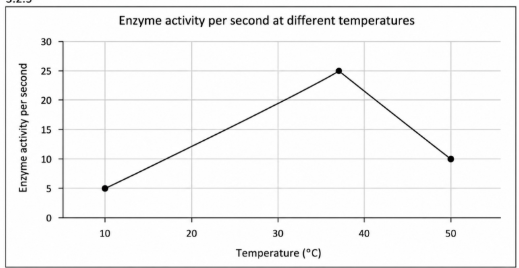
The plotted results are
(10,5), (37,25) and (50,10)
, with temperature on the X-axis and enzyme activity per second on the Y-axis.
(9)
TOTAL QUESTION 3: 15
TOTAL SECTION B: 30
GRAND TOTAL: 50