
NATIONAL SENIOR CERTIFICATE EXAMINATIONS
LIFE SCIENCES P1
MAY/JUNE 2025
This question paper consists of 17 pages.
Copyright reserved
INSTRUCTIONS AND INFORMATION
Read the following instructions carefully before answering the questions.
- Answer ALL the questions.
- Write ALL the answers in the ANSWER BOOK.
- Start the answers to EACH question at the top of a NEW page.
- Number the answers correctly according to the numbering system used in this question paper.
- Present your answers according to the instructions of each question.
- Do ALL drawings in pencil and label them in blue or black ink.
- Draw diagrams, tables or flow charts only when asked to do so.
- The diagrams in this question paper are NOT necessarily drawn to scale.
- Do NOT use graph paper.
- You must use a non-programmable calculator, protractor and a compass, where necessary.
- Write neatly and legibly.
QUESTION 1
SHOW ANSWER
The yolk provides nutrients to the developing embryo.
SHOW ANSWER
The pituitary gland secretes prolactin.
The diagram below represents part of the central nervous system of this person.
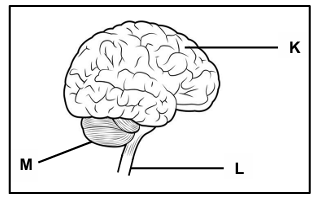
Which parts of the central nervous system are probably damaged?
SHOW ANSWER
SHOW ANSWER
(ii) Deepening of the voice
(iii) Onset of menstruation
(iv) Oily skin
Which combination of characteristics occurs due to the secretion of testosterone?
SHOW ANSWER
The table below shows the results of a sperm analysis of four semen samples.
Identify the sample that was obtained from an infertile man.
| Sample | NUMBER OF SPERM IN SAMPLE (million/cm3) | INACTIVE SPERM (%) |
|---|---|---|
| A | 23 | 30 |
| B | 25 | 20 |
| C | 22 | 25 |
| D | 20 | 15 |
SHOW ANSWER
Sample A is infertile because it has 30% inactive sperm, meaning only 70% of the sperm are active, which is below the stated minimum of 75% active sperm.
SHOW ANSWER
It is most likely that …
SHOW ANSWER
The following is a list of reproductive strategies in vertebrates:
(ii) External fertilisation
(iii) Precocial development
(iv) Parental care
(v) Ovipary
Which combination of strategies applies to eagles?
SHOW ANSWER

Which ONE of the following combinations is CORRECT?
| X | Y | Z | |
|---|---|---|---|
| A | Carbon dioxide | Hypothalamus | Pituitary gland |
| B | Water | Hypothalamus | Medulla oblongata |
| C | Carbon dioxide | Carotid artery | Medulla oblongata |
| D | Water | Carotid artery | Pituitary gland |
SHOW ANSWER
(10 x 2) (20)
Give the correct biological term for EACH of the following descriptions. Write only the term next to the question numbers (1.2.1 to 1.2.8) in the ANSWER BOOK.
SHOW ANSWER
SHOW ANSWER
SHOW ANSWER
SHOW ANSWER
SHOW ANSWER
SHOW ANSWER
SHOW ANSWER
SHOW ANSWER
Indicate whether each of the descriptions in COLUMN I apply to A ONLY, B ONLY, BOTH A AND B or NONE of the items in COLUMN II. Write A only, B only, both A and B or none next to the question numbers (1.3.1 to 1.3.3) in the ANSWER BOOK.
| COLUMN I | COLUMN II |
|---|---|
| 1.3.1 A larger number of male and female gametes are produced | A: External fertilisation B: Internal fertilisation |
| 1.3.2 A plant defence mechanism | A: Thorns B: Chemicals |
| 1.3.3 Contributes to the movement of sperm | A: Mitochondria B: Tail |
(3 x 2) (6)
SHOW ANSWERS
1.3.1 — A only
1.3.2 — Both A and B
1.3.3 — Both A and B
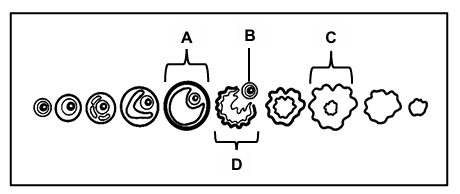
The diagram below represents a part of the menstrual cycle that occurs in the human ovary.
SHOW ANSWER
(a) A (1)
(b) B (1)
(c) C (1)
SHOW ANSWER
(a) Graafian follicle
(b) Ovum
(c) Corpus luteum
(a) Controls the development of structure A (1)
(b) Is secreted by structure A (1)
(c) Stimulates the process occurring at structure D (1)
SHOW ANSWER
(a) FSH / Follicle stimulating hormone
(b) Oestrogen
(c) LH / Luteinising hormone
(7)
The diagram below represents the human eye.
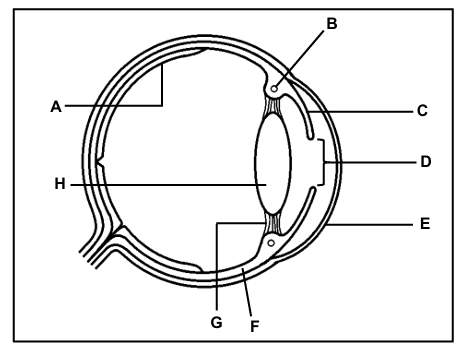
(a) D (1)
(b) E (1)
SHOW ANSWER
(a) Pupil
(b) Cornea
(a) Choroid (1)
(b) Iris (1)
SHOW ANSWER
(a) F
(b) C
SHOW ANSWER
Rods
Cones
SHOW ANSWER
(9)
TOTAL SECTION A: 50
QUESTION 2
The diagram below shows the male reproductive system.
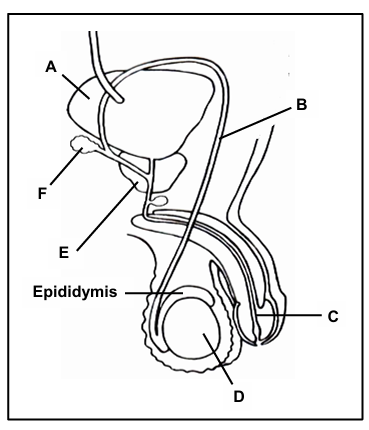
(a) E (1)
(b) F (1)
(c) C (1)
SHOW ANSWER
(a) Prostate gland
(b) Seminal vesicle
(c) Urethra
SHOW ANSWER
SHOW ANSWER
Under the influence of testosterone, diploid cells / germinal epithelium in the seminiferous tubules of the testes undergo meiosis, which reduces the chromosome number and forms haploid sperm cells.
Explain how this affects the composition of semen. (2)
SHOW ANSWER
Because the epididymis is blocked, sperm are prevented from entering the vas deferens / leaving the testes. As a result, fewer sperm reach the semen, resulting in few sperm / a low sperm count.
(10)
The diagram below represents human embryonic development.
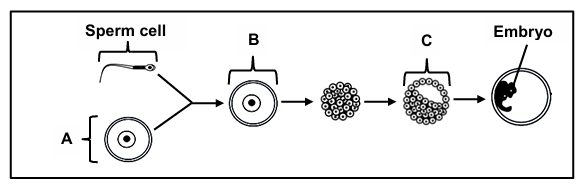
(a) Cell B (1)
(b) Structure C (1)
SHOW ANSWER
(a) Zygote
(b) Blastocyst / blastula
SHOW ANSWER
Cell A is haploid / has 23 chromosomes / contains the genetic material of the female, whereas cell B is diploid / has 46 chromosomes / contains the genetic material of both parents. This is because cell A is not fertilised, whereas cell B is formed after fertilisation and is therefore fertilised.
SHOW ANSWER
SHOW ANSWER
- Allows for free movement of the foetus.
- Protects the foetus against mechanical injury / acts as a shock absorber.
- Prevents dehydration of the foetus.
- Prevents temperature changes.
(9)
Basal body temperature is the body temperature while a person is at rest. An increase above the basal body temperature occurs immediately after the day of ovulation. The basal body temperature method can be used by women who want to fall pregnant.
The graph below represents the body temperature chart of a woman with a 28-day menstrual cycle.
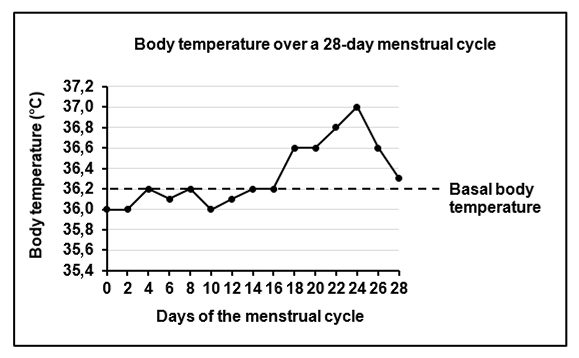
(a) Basal body temperature (1)
(b) Day of ovulation (1)
SHOW ANSWER
(a) 36,2˚C
(b) Day 16
SHOW ANSWER
Explain why the increase in basal body temperature occurs only after ovulation. (2)
SHOW ANSWER
The increase in basal body temperature occurs only after ovulation because the corpus luteum is formed after ovulation and it secretes progesterone. The secretion of progesterone therefore causes the basal body temperature to increase after ovulation.
SHOW ANSWER
Basal body temperature is measured when a person is at rest because physical activity / increased cellular respiration changes body temperature. By measuring the temperature at rest, low physical activity / cellular respiration prevents a change in body temperature from affecting the reading.
(8)
Read the extract below.
There are two main types of hearing loss. Type A hearing loss occurs when there is a blockage in the transmission of sound waves and vibrations through the outer and middle ear. Type B hearing loss is caused by damage to the hearing receptors of the inner ear or to the nerves that carry sound impulses to the brain.
The diagram below represents the human ear.
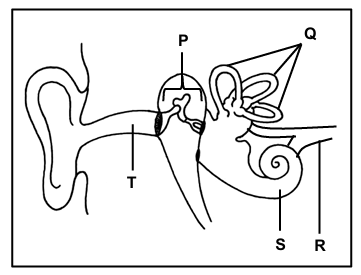
(a) Type A hearing loss (2)
(b) Type B hearing loss (2)
SHOW ANSWER
(a) P and T
(b) S and R
SHOW ANSWER
SHOW ANSWER
When the hearing receptors are stimulated by pressure waves, they convert the stimulus / pressure waves to an impulse and then transfer it to the auditory nerve.
SHOW ANSWER
If the bones at P are fused, the ossicles will not vibrate freely / fewer or no vibrations will be carried to the oval window. This causes decreased amplification of sound, so fewer or no pressure waves will form in the cochlea. As a result, the receptors in the cochlea will not be stimulated / will be stimulated less, and therefore less or no impulses will reach the cerebrum.
(11)
Scientists investigated the effect of different doses of alcohol on reaction time in humans.
- A dose is the amount of alcohol given per kilogram of body mass.
- Reaction time is the time it takes a person to react once a stimulus is received.
The procedure was as follows:
- Two 30-year-old male volunteers participated in the investigation which was conducted for a period of 7 days.
- They did not drink alcohol for a period of 24 hours prior to testing.
- They were given different amounts of alcohol on 4 different days.
- Their reaction times were determined 30 minutes after consuming the alcohol.
The results of the investigation are shown in the table below.
| DAY OF INVESTIGATION | ALCOHOL DOSE (mg/kg body mass) | REACTION TIME (seconds) — MALE 1 | REACTION TIME (seconds) — MALE 2 |
|---|---|---|---|
| 1 | 0 | 1,86 | 1,82 |
| 3 | 200 | 1,91 | 1,94 |
| 5 | 400 | 2,02 | 2,06 |
| 7 | 600 | 2,11 | 2,15 |
(a) Independent variable (1)
(b) Dependent variable (1)
SHOW ANSWER
(a) Alcohol dose
(b) Reaction time
SHOW ANSWER
- Age / 30 years old.
- Gender / men.
- Volunteers were tested over a period of 7 days.
- Volunteers abstained from alcohol for 24 hours prior to testing.
- Volunteers had their reaction time measured 30 minutes after consuming the alcohol / period from consumption to testing was the same.
SHOW ANSWER
- Use more than 2 volunteers / increase the number of volunteers.
- Repeat the investigation / take multiple readings for the same dose.
SHOW ANSWER
The participants only received alcohol every second day to ensure that there is no alcohol in the body from the previous dose and that only the alcohol given on the day is tested for.
SHOW ANSWER
SHOW ANSWER
The results show that higher doses of alcohol increase the reaction time, as the reaction time increased as the alcohol dose increased.
(12)
[50]
QUESTION 3
The diagram below represents part of a reflex arc.
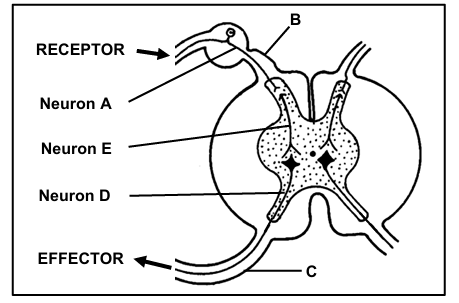
(a) Dorsal root (1)
(b) Sensory neuron (1)
SHOW ANSWER
(a) B
(b) A
SHOW ANSWER
A synapse ensures that nerve impulses are transmitted in one direction, from one neuron to the next.
(a) Significance of a reflex action (2)
(b) Effect on the reflex arc if neuron A is cut (3)
SHOW ANSWER
(a) A reflex action is a rapid / automatic reaction to a stimulus that protects the body from damage. Because the response occurs rapidly and automatically, the body can react quickly to a potentially harmful stimulus.
(b) If neuron A is cut, no impulse will be transmitted from the receptor to the spinal cord / interneuron. As a result, the effector will not be stimulated.
SHOW ANSWER
Model answer: Diagram of a motor neuron (D), with a correct caption and any three correct labels.
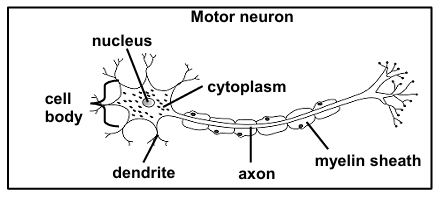
(13)
Read the extract below.
In people with diabetes mellitus, the beta cells in the pancreas are unable to secrete sufficient amounts of insulin. These people are treated with regular injections of insulin.
Electronic pumps have been developed as an alternative to injections. They pump insulin into the blood according to different blood glucose concentrations. The pump can be clipped to a piece of clothing or fastened to the skin with an adhesive patch. These pumps then infuse insulin through the skin into the blood.
(a) Groups of cells in the pancreas that contain the beta cells (1)
(b) Signal for the pump to turn on and start pumping insulin (1)
SHOW ANSWER
(a) Islets of Langerhans
(b) A high concentration of glucose in the blood
SHOW ANSWER
The cells have endocrine characteristics because they secrete hormones / insulin / glucagon directly into the blood and have no ducts through which the hormones are released.
SHOW ANSWER
Insulin stimulates the conversion of glucose to glycogen in the liver and promotes the absorption / usage of glucose by the muscle cells. This helps to reduce the concentration of glucose in the blood.
SHOW ANSWER
Electronic pumps are more effective because they deliver insulin specifically according to the glucose level, allowing for better blood glucose management / regular dosing. In this way, insulin delivery can respond to changes in blood glucose levels.
(8)
Describe the role of the human skin in the regulation of body temperature on a cold day. (6)
SHOW ANSWER
Cold receptors in the skin convert the stimulus to an impulse which is sent to the hypothalamus. The hypothalamus stimulates vasoconstriction in the skin / stimulates blood vessels of the skin to constrict. Less blood flows to the skin / sweat glands, so less heat is lost from the skin through radiation. The sweat glands are stimulated to produce less sweat and less heat is lost through evaporation of sweat.
Knowing the salt level in the blood of humans can provide information on their health and lifestyle. The normal salt level in the blood is between 136 mmol/ℓ and 145 mmol/ℓ. Salt levels in the blood below 136 mmol/ℓ are an indication of hyponatremia, and salt levels in the blood higher than 145 mmol/ℓ are an indication of hypernatremia.
A group of people with the same diet had their blood salt levels tested.
The table below shows the results.
| SALT LEVELS IN THE BLOOD (mmol/ℓ) | NUMBER OF PEOPLE |
|---|---|
| Lower than 136 | 5 |
| 136 to 140 | 15 |
| 141 to 145 | 21 |
| Higher than 145 | 4 |
(a) Hypernatremia (1)
(b) Normal blood salt levels (1)
SHOW ANSWER
(a) 4
(b) 36
SHOW ANSWER
Receptor cells detect the low salt level, after which the adrenal glands are stimulated and more aldosterone is secreted. The increased aldosterone causes the reabsorption of salt / sodium in the renal tubules into the surrounding blood capillaries to increase. As a result, less salt is excreted, causing the salt level in the blood to increase towards the normal level.
SHOW ANSWER
Model histogram:
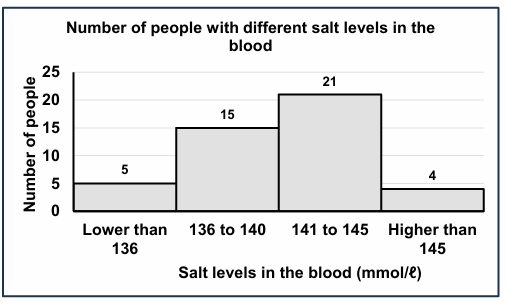
Graph requirements: use a histogram; include a caption containing both variables; label the X- and Y-axes correctly, including the correct unit for the X-axis; use the correct scale; use equal-width bars with no spaces; plot all four coordinates correctly.
(14)
An investigation was conducted to determine the response of plant seedlings to light.
The procedure was as follows:
- Grain seeds were allowed to germinate into seedlings.
- One half of the seedlings were planted in one small pot and the other half in another small pot.
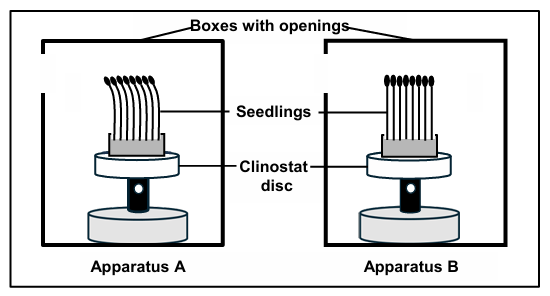
- When the stems reached a height of approximately 1 cm, the pots were placed on the discs of two clinostats. A clinostat is an apparatus consisting of a slowly rotating disc when switched on.
- Both sets of apparatus (A and B) were placed inside boxes with openings on one side only for light to enter (unilateral light).
- One clinostat was switched on and the other one was switched off.
- The apparatus was left for two weeks.
The results after two weeks are represented in the diagram below.
SHOW ANSWER
SHOW ANSWER
SHOW ANSWER
All the seedlings grew straight up / showed no phototropism because they were evenly exposed to light / not exposed to unilateral light. As a result, there was equal distribution of auxins, so no side of the seedlings experienced greater growth than the other.
SHOW ANSWER
The seedlings/stems grew/bent to the left / towards the light because they were exposed to light from one side / unilateral light. In response to the unilateral light, auxins diffuse to the right / dark side of the seedlings, where their concentration becomes higher. The high concentration of auxins on the right / dark side stimulates cell elongation / cell division / growth on that side. As the cells on the right side grow more, that side becomes longer and the seedlings/stems bend towards the light.
(9)
[50]
TOTAL SECTION B: 100
GRAND TOTAL: 150