Life Sciences P1 May June 2023

Life Sciences P1 — May-June 2023

150 marks · 2½ hours · Grade 12

SECTION A

QUESTION 1

1.1.1

Diabetes mellitus is caused by an …
Aoversecretion of glucagon.
Bundersecretion of glucagon.
Coversecretion of insulin.
Dundersecretion of insulin.

1.1.2

Receptors that are stimulated by the low water levels in the blood are located in the …
Arenal tubules.
Bhypothalamus.
Cpituitary gland.
Dcarotid artery.

1.1.3

The myelin sheath on a nerve cell …
Aprovides electrical insulation.
Btransports impulses towards the cell body.
Creceives impulses from the axon.
Dconverts stimuli into impulses.

1.1.4

The structure where sperms are temporarily stored is the …
Atestis.
Bepididymis.
Cvas deferens.
Dpenis.

1.1.5

Which ONE of the following is a function of the amniotic fluid?
AProvides nutrition to the foetus
BProtects the foetus against mechanical injury
CSupplies oxygen to the foetus
DRemoves the metabolic waste from the foetus
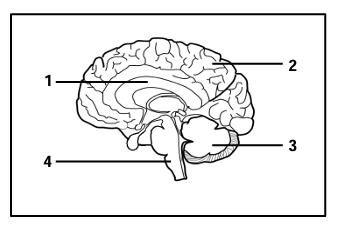
Questions 1.1.6 and 1.1.7 — Brain diagram
Questions 1.1.6–1.1.7 — Brain diagram

1.1.6

Which ONE of the following represents the corpus callosum?
A1
B2
C3
D4

1.1.7

Which ONE of the following is the function of part 3?
AControls voluntary movements
BControls involuntary actions
CCoordinates voluntary movements
DControls all sensations

1.1.8

The placenta is formed by the …
Aamniotic fluid and amnion.
Bchorionic villi and endometrium.
Camnion and endometrium.
Damniotic fluid and chorionic villi.

1.1.9

An oversecretion of the hormone produced by the thyroid gland may result in a person …
Againing weight, because of an increased metabolic rate.
Bgaining weight, because of a decreased metabolic rate.
Closing weight, because of an increased metabolic rate.
Dlosing weight, because of a decreased metabolic rate.
GroupAge (years)Average testosterone level (n/M)
I0–10less than 5
II11–1515
III16–2019

1.1.10

Testosterone levels are higher in …
AGroup I than Group III due to the start of puberty.
BGroup II than Group I due to the start of puberty.
CGroup III than Group I because it is needed to inhibit the growth of long bones.
DGroup I than Group II because it is needed to inhibit the growth of long bones.

1.2 Biological terms

1.2.1

The process of maintaining a constant internal environment in the human body

1.2.2

The organelles found in large quantities in the neck region of a sperm cell

1.2.3

The disease characterised by the degeneration of brain tissue, leading to memory loss

1.2.4

The layer in the eye that is richly supplied with blood vessels

1.2.5

The type of development in birds in which the young is born fully developed and able to move and feed itself

1.2.6

Groups of cells in the pancreas that secrete insulin and glucagon

1.2.7

The structure in the sperm that contains enzymes to dissolve the outer layer of the ovum

1.2.8

A blood vessel that transports carbon dioxide from the foetus to the placenta

1.3 A only / B only / Both / None

1.3.1

An extra-embryonic membrane found in the amniotic egg
Column IColumn II
An extra-embryonic membrane found in the amniotic eggA: Chorion
B: Allantois

1.3.2

A structure in the ear that absorbs excess pressure waves from the cochlea
Column IColumn II
A structure in the ear that absorbs excess pressure waves from the cochleaA: Pinna
B: Auditory canal

1.3.3

A structure that transports semen out of the body
Column IColumn II
A structure that transports semen out of the bodyA: Scrotum
B: Urethra

1.4 Nervous system

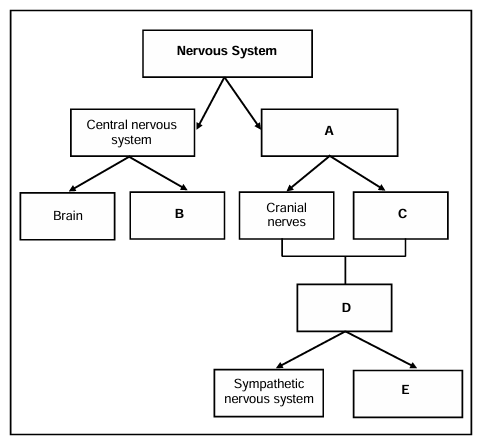
Question 1.4 — Flow diagram of the nervous system

1.4.1(a)

Identify the component of the nervous system represented by A.

1.4.1(b)

Identify the component of the nervous system represented by D.

1.4.2

Name the type of nerves found at C.

1.4.3

Give the LETTER and NAME of the component that slows down the heart rate when an emergency situation has passed.

1.4.4

Name the nerve cells that make up nervous tissue.

1.4.5

State TWO ways in which the brain is protected.

1.5 Middle and inner ear

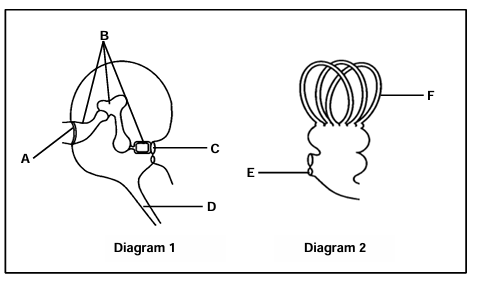
Question 1.5 — Parts of the middle and inner ear

1.5.1

Identify part F.

1.5.2

Give the collective term for bones B.

1.5.3(a)

Give the LETTER and NAME of the structure that equalises pressure between the outer and middle ear.

1.5.3(b)

Give the LETTER and NAME of the structure that creates pressure waves in the inner ear.

1.5.4(a)

Name the receptors that are stimulated by a change in the position of the head.

1.5.4(b)

Name the receptors that are stimulated by a change in the direction and speed of movement of the head.

SECTION B

QUESTION 2

2.1 Female reproductive system
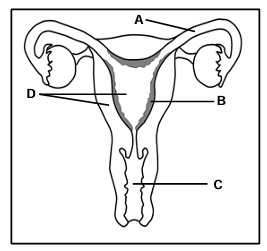
Question 2.1 — Female reproductive system

2.1.1

Identify part B.

2.1.2

Name the process that takes place in part A that leads to zygote formation.

2.1.3

Describe the process named in QUESTION 2.1.2.

2.1.4

Describe the development of the zygote until implantation occurs.

2.1.5

Explain TWO ways in which part D is structurally suited for gestation.

2.1.6

Describe how the secretion of the prostate gland provides protection for the sperm from the conditions in part C.

2.2 Plastic linked to female infertility

PLASTIC LINKED TO FEMALE INFERTILITY

Several studies indicate that bisphenol A (BPA), a chemical used in the production of many household plastic products, may be linked to female infertility (inability to get pregnant naturally and to deliver a healthy baby). BPA can be ingested or absorbed through the skin when using plastic products.

BPA seems to interfere with the normal secretion of FSH by the pituitary gland and is linked to abnormal menstrual cycles and reduced implantation rates. These studies also show a link between high BPA levels and a decrease in the development and maturation of ovarian follicles.

2.2.1

State ONE function of FSH.

2.2.2

Name ONE other hormone in females that is secreted by the pituitary gland during the menstrual cycle.

2.2.3

Explain how an undersecretion of the hormone in QUESTION 2.2.2 may lead to infertility.

2.2.4

Explain why a decrease in the maturation of ovarian follicles may lead to reduced implantation rates.

2.3 Spermatogenesis

2.3

Describe the process of spermatogenesis.

2.4 Reproduction in frogs

Frogs can survive in water and on land. Most frogs, however, need water for reproduction. During the breeding season, male and female frogs release millions of gametes into the water.

2.4.1

Name the type of fertilisation described above.

2.4.2

Explain why millions of gametes are released.

2.4.3

State why the reproduction in frogs is an example of ovipary.

2.5 Thermoregulation

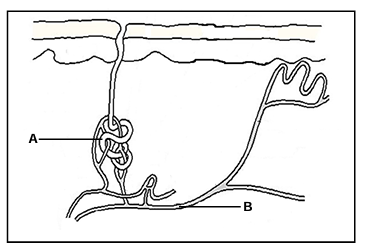
Question 2.5 — Skin structures involved in thermoregulation

2.5.1

Give TWO reasons why part A is classified as an exocrine gland.

2.5.2

Describe the role of skin receptors in thermoregulation.

2.5.3

Explain why structure B dilates on a hot day.

2.6 Hearing loss in factory workers

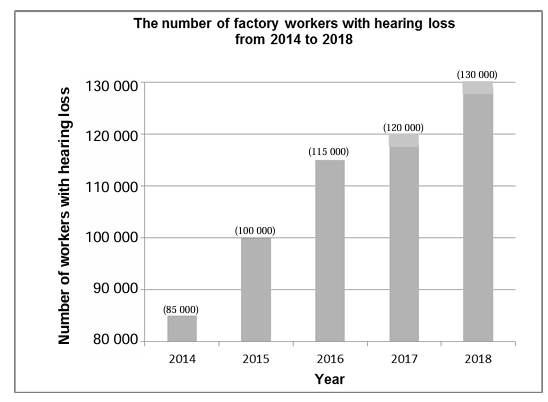
The survey recorded factory workers with hearing loss from 2014 to 2018. The results are shown in the table below.

YearNumber of factory workers with hearing loss
201485 000
2015100 000
2016115 000
2017120 000
2018130 000

2.6.1

Name the structure in the ear where the organ of Corti is located.

2.6.2

Calculate the percentage increase in the number of factory workers with hearing loss between 2014 and 2018. Show ALL workings.

2.6.3

Suggest ONE reason for the increase in the number of factory workers with hearing loss caused by exposure to loud noise in this country.

2.6.4

Explain why damage to the auditory nerve may result in hearing loss.

2.6.5

Draw a bar graph to represent the data in the table.

QUESTION 3

3.1 Abscisic acid and dormancy
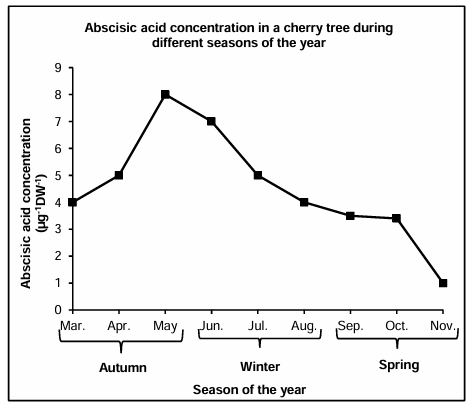
Question 3.1 — Abscisic acid concentration in a cherry tree during different seasons

3.1.1

During which month was the abscisic acid concentration the lowest?

3.1.2

Explain the trend of the graph from March to May.

3.1.3

Suggest ONE reason for the dormancy in cherry trees during the winter months.

3.2 Geotropism

3.2.1

Describe the role of auxins in roots.

3.2.2

When a plant is placed horizontally, with light coming from all directions, the auxins will accumulate on the lower side of both the stem and the roots. Explain the difference in the response of the stem and the roots after a few days.

3.3 Hyperaldosteronism investigation

Hyperaldosteronism is a disorder caused by the oversecretion of aldosterone and has been linked to high blood pressure in humans.

Scientists investigated the influence of increased aldosterone levels on blood pressure.

The procedure was done as follows:

  • 1 688 healthy volunteers, aged 55, participated in the investigation.
  • The participants' blood pressure was measured and recorded before the start of the investigation.
  • The participants were injected with a dose of aldosterone in the morning and their blood pressure was measured every hour for 12 hours.
  • This procedure was followed over four days for each individual and the average blood pressure was calculated.
  • All participants followed the same diet during the period of the investigation.

3.3.1

Name the gland that secretes aldosterone.

3.3.2(a)

Identify the independent variable.

3.3.2(b)

Identify the dependent variable.

3.3.3

Give TWO reasons why the results of the investigation may be considered reliable.

3.3.4

Explain TWO reasons why it was important for the participants to follow the same diet during the investigation.

3.3.5

Explain why the participants' blood pressure was measured before the start of the investigation.

3.3.6

Explain why the levels of salt in the urine of participants is expected to decrease after being injected with aldosterone.

3.4 Adrenalin and increased energy production

3.4

Describe how the secretion of adrenalin causes increased energy production in an emergency situation.

3.5 Human eye

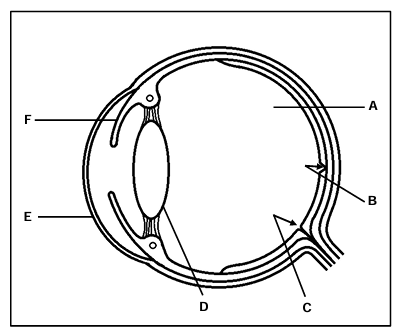
Question 3.5 — Human eye

3.5.1

Identify structure F.

3.5.2

State TWO functions of fluid A.

3.5.3

Describe the structural difference between area B and area C.

3.5.4

Name the visual defect that occurs when the curvature of part E is uneven.

3.5.5

Explain how the sight of a person will be affected if cataracts developed in part D.

3.5.6

Describe the process of accommodation that takes place when an object is less than 6 metres away from the eye.
Scroll to Top