
Management Communication N4
30 May 2022 · Time: 2 hours · Total: 100 marks
- Answer all the questions.
- Read all the questions carefully.
- Number the answers according to the numbering system used in this question paper.
- Write neatly and legibly.
Open “SHOW ANSWER” under a question to view the model answer. Select it again to hide the answer.
QUESTION 1: COMMUNICATION PRINCIPLES [20]
1.1The interactive model of communication.
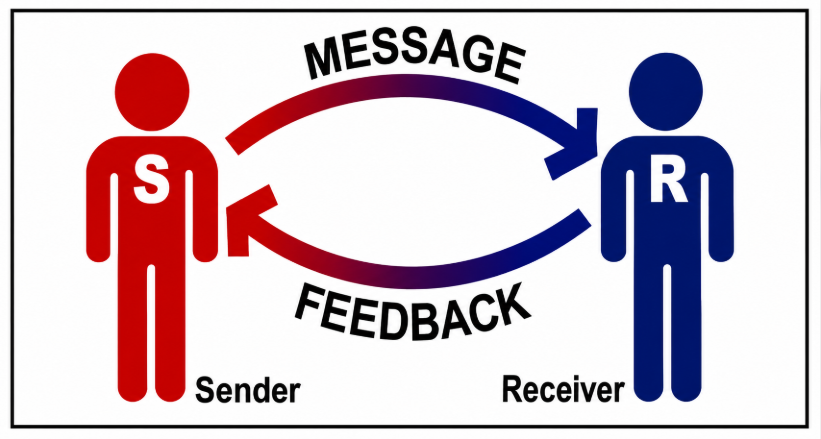
1.1.1Identify and explain the THREE missing elements in the communication model above. (3 × 2) (6)
SHOW ANSWER
Encoding: Encoding is the process in which the sender turns an idea into words, symbols or actions that can be communicated. The sender decides what to say and how best to express it.
Medium/channel: The channel is the route used to carry the message from sender to receiver, such as face-to-face conversation, telephone, radio or television. The channel should suit the message and the people receiving it.
Barriers: A barrier is anything that interferes with a message being sent, received or understood. For example, noise, unclear language or distraction can prevent the receiver from understanding what the sender intended.
Decoding is the receiver's process of interpreting the message and working out what it means before responding or giving feedback.
1.1.2Distinguish between verbal and non-verbal communication. Provide examples for each. (2 × 2) (4)
SHOW ANSWER
Verbal communication uses words to communicate, either orally or in writing. Examples include explaining something in a spoken conversation and sending a letter or email.
Non-verbal communication communicates meaning without relying on words. It can include signs, gestures, posture, clothing, symbols, pictures and sounds. For example, a nod may show agreement, while a warning sign communicates through a symbol.
1.1.3Non-verbal communication is particularly important when dealing with customers.
(a) Provide TWO practical examples of body language which could offend a customer.
(b) Provide ONE practical example of each of the effective use of tempo and pitch when speaking to customers. (2 × 2) (4)
SHOW ANSWER
(a) Body language that could offend a customer:
- Avoiding eye contact: Looking away throughout the conversation may make the customer feel ignored or give the impression that the employee is not interested.
- Folding one's arms across the chest: This can appear defensive, impatient or unwelcoming, even if the employee does not intend to send that message.
- Slouching or leaning back: This posture may make the employee seem bored or disrespectful instead of attentive to the customer's concern.
(b) Effective use of pitch and tempo:
- Pitch: Use a calm, moderate pitch that is neither too high nor too low. A controlled voice helps the customer hear the message without feeling that the employee is shouting or reacting emotionally.
- Tempo: Speak at a steady, moderate pace—not so quickly that the customer cannot follow, and not so slowly that the conversation becomes unclear or unnatural. Pronounce words clearly and avoid mumbling or stuttering.
1.2Explain REASONING as a factor that could affect communication. (2)
SHOW ANSWER
Reasoning is the process of thinking logically, understanding information and using it to form judgements or conclusions. It can affect communication because people may interpret the same message differently depending on how they assess the information. If a person reaches a conclusion without considering the facts carefully, they may misunderstand the sender's meaning or respond inappropriately.
1.3Give ONE word/term for each of the following descriptions by choosing a word/term from the list below. Write only the word/term next to the question number (1.3.1–1.3.4) in the ANSWER BOOK.
phatic communication; kinesics; graphics; para-linguistics; acoustic semiology; proxemics; tacesics; visual semiology
1.3.1Body language i.e. eye contact, hand gestures and posture.
SHOW ANSWER
Kinesics — the study of body movements used in communication, including eye contact, gestures and posture.
1.3.2The study of space and distance.
SHOW ANSWER
Proxemics — the study of how space and physical distance between people communicate meaning.
1.3.3The study of sound.
SHOW ANSWER
Acoustic semiology — the study of sound as a means of conveying meaning.
1.3.4Communication using touch. (4 × 1) (4)
SHOW ANSWER
Tacesics — communication through touch, such as a handshake or a reassuring touch where appropriate.
QUESTION 2: INTERPERSONAL COMMUNICATION AND SOCIAL INTERACTION [20]
2.1Read the following scenario and answer the questions which follow.
In a 2015 study, a British newspaper did research on young women's self-esteem and experiences with social media. Most felt insecure. Many reported obsessing over the number of 'likes' they were getting, feared not looking beautiful in their photos and thought others would think they looked different on social media to real life. They also worried about which photos to upload, photo-shopping it and regularly checking their updated 'like' counts. This increased their own insecurities. Research shows social media environments might influence women to engage in social comparisons leading to feelings of inadequacy and body dissatisfaction.
[Adapted from-https://www.in-mind.org/article/s selfie-esteem-]
2.1.1Explain the THREE elements (parts) of one's self-image. (3)
SHOW ANSWER
1. What one thinks of oneself: This is a person's own view of who they are, including how they judge their qualities, abilities and appearance.
2. What one thinks others think of one: This is the person's belief about how other people see them. It is about what the person thinks others believe, which may not be the same as what those people actually think.
3. What one hopes to become: This is the ideal future self—the person someone would like to be or the qualities they hope to develop.
2.1.2According to research, why do young women, in particular, feel insecure when using social media? (2)
SHOW ANSWER
The research suggests that young women may feel insecure because they worry that others will judge or reject them based on their physical appearance. They compare their appearance and photographs with those of other people, worry about how many 'likes' they receive, and may feel that their online image does not match real life. These comparisons can increase feelings of inadequacy and dissatisfaction with their bodies.
2.1.3Which dimension of the self-image is discussed in the above extract? (1)
SHOW ANSWER
The physical dimension of self-image is discussed. The extract focuses on how young women view their appearance and bodies and how they believe others judge those physical features.
2.1.4Discuss ONE other dimension of the self-image which could affect one's self-esteem. (2)
SHOW ANSWER
One other dimension is the intellectual dimension, which concerns how a person views their intelligence and ability to learn or solve problems. Other acceptable dimensions include the skills dimension (how a person views their social or practical abilities), the psychological dimension (how they view their personality, such as being introverted or extroverted), and the sexual dimension (how they view their gender role or popularity with the opposite sex).
2.1.5List FOUR ways in which young women can improve their self-image pertaining to their bodies. (4)
SHOW ANSWER
Ways to develop a healthier self-image include:
- Avoid comparing yourself with others: People have different circumstances and strengths, so comparisons with edited or carefully selected images can create unfair expectations.
- Recognise your strengths and weaknesses: Understanding what you do well and what you can improve helps you form a balanced view of yourself.
- Be realistic: Set achievable expectations rather than measuring yourself against impossible standards.
- Accept yourself: Recognise that your worth is not determined only by your appearance.
- Help people who are less fortunate: Contributing to others can build perspective and a sense of purpose beyond appearance.
- Question preconceived ideas and keep learning: Exploring different experiences can challenge narrow beliefs about beauty and body image.
- Choose positive role models: Spend time with people who value health, character and individuality rather than appearance alone.
- Cultivate a positive mind-set: Practise balanced self-talk and focus on personal growth instead of constant criticism.
2.2Abraham Maslow's hierarchy of needs theory identified FIVE needs which explain human motivation.
2.2.1Which need is satisfied when using social media? (1)
SHOW ANSWER
The need for social acceptance and love is most directly connected to social media. People want to belong, feel valued and maintain relationships, and social media can appear to meet these needs through connections, comments, friendships and 'likes'.
2.2.2Provide a brief explanation for your answer above. (2)
SHOW ANSWER
Social media can make people feel connected to others and give them opportunities to receive attention, friendship and approval. For that reason, it may appear to satisfy the need for love and social acceptance. However, the number of likes or online contacts does not necessarily prove that a person is genuinely accepted or valued.
2.2.3What does the word 'hierarchy' suggest about needs? (2)
SHOW ANSWER
The word hierarchy suggests that needs are arranged in an order of importance or priority. In Maslow's theory, some needs are generally considered more basic and may need attention before a person focuses strongly on higher-level needs.
2.3The media has often been criticised for portraying the female body in a stereotypical fashion.
What is a stereotype? (3)
SHOW ANSWER
A stereotype is a fixed, simplified belief that people in a particular group all share the same characteristics. It treats individuals as though they are alike instead of recognising their differences. For example, portraying all women as having one particular body type would be a stereotype.
QUESTION 3: INTERVIEWING [15]
3.1Define the term interview. (4)
SHOW ANSWER
An interview is a planned, usually formal oral interaction between two or more people, such as an interviewer and an interviewee or a candidate and an interview panel. It involves exchanging information for a specific purpose and takes place within a limited period. For example, an employer may interview an applicant to assess their suitability for a job.
3.2Choose the correct word(s) from those given in brackets. Write only the word(s) next to the question number (3.2.1–3.2.5) in the ANSWER BOOK.
3.2.1A(n) (informational/persuasive) interview is designed to influence one to change one's behaviour.
SHOW ANSWER
Persuasive interview. A persuasive interview is intended to influence a person's views or behaviour and encourage them to change or take a particular course of action.
3.2.2(Portfolios/psychometric testing) is a screening method where candidates show examples of their work.
SHOW ANSWER
Portfolio. A portfolio is a collection of examples of a candidate's work. It allows the interviewer or employer to assess the candidate's skills and experience by looking at actual work they have produced.
3.2.3A(n) (open-ended/hypothetical) question tests candidates' ability to solve an imaginary problem they might encounter in the workplace.
SHOW ANSWER
Hypothetical question. A hypothetical question presents an imagined situation and asks the candidate how they would respond. It helps the interviewer assess the candidate's judgement and problem-solving approach in a possible workplace situation.
3.2.4With a (leading/reflective) question the interviewer rephrases a statement made by the candidate and changes it into a question.
SHOW ANSWER
Reflective question. A reflective question rephrases or reflects back what the candidate has said, turning it into a question so the interviewer can check meaning or encourage the candidate to clarify their point.
3.2.5A candidate's nervousness during the interview may be viewed as a (perceptual/psychological/physiological) barrier. (5 × 1) (5)
SHOW ANSWER
Psychological barrier. Nervousness during an interview is a psychological barrier because feelings such as anxiety or fear can affect a candidate's confidence, concentration and ability to communicate clearly.
3.3It is the task of the interviewer to establish rapport at the start of the interview.
3.3.1Give another word for the term rapport. (1)
SHOW ANSWER
Rapport means a connection or understanding between people. In an interview, rapport is the sense of trust and ease that helps the interviewer and candidate communicate openly and respectfully.
3.3.2Name FIVE responsibilities of the interviewer during the interview. (5)
SHOW ANSWER
The interviewer has several responsibilities that help make the interview fair, organised and informative:
- Establish rapport: Introduce yourself politely and treat the candidate courteously so the conversation begins on a respectful footing.
- Explain the process: Tell the candidate how the interview will proceed so they understand what to expect.
- Ask prepared questions: Use relevant, planned questions to gather information needed to assess the candidate fairly.
- Allow the candidate to speak freely: Give them enough time to explain their experience and answers without unnecessary interruption.
- Put the candidate at ease: Use a calm and respectful manner so nervousness is less likely to prevent the candidate from expressing themselves.
- Listen and take notes: Pay attention to the answers and record relevant information so decisions can be based on what was said.
- Avoid quick or biased judgements: Assess the candidate against relevant criteria rather than relying on prejudice or first impressions.
- Explain what happens next: Give clear information about the next stage or when the candidate can expect feedback.
QUESTION 4: MASS MEDIA AND ADVERTISING [25]
4.1The mass media influences millions of people worldwide.
4.1.1Complete the definition:
'In mass media communication a sender uses a channel to send a simultaneous message …' (4)
SHOW ANSWER
In mass-media communication, a sender uses a channel to send a message simultaneously to a large or wide audience. Although many people receive the message, they usually receive it individually, and feedback is often indirect and delayed rather than immediate and face-to-face.
4.1.2Name TWO categories of mass media. (2)
SHOW ANSWER
Two categories of mass media are audio media, which communicate mainly through sound, and audio-visual media, which combine sound and images. Other accepted categories are public library, outdoor, print and electronic media.
4.2Identify the following functions of the mass media below: Start each sentence with: To …
4.2.1Newspaper headline: 'Widespread corruption uncovered at top bank!'
4.2.2TV Programme: 'Indian express' on SABC3
4.2.3The 'News at Ten' on SABC TV (3 × 1) (3)
SHOW ANSWER
4.2.1 Newspaper headline — “Widespread corruption uncovered at top bank!”: To act as a moral watchdog. Reporting on alleged corruption can expose wrongdoing and help hold powerful organisations accountable.
4.2.2 TV programme — “Indian express” on SABC3: To promote culture. A programme featuring cultural content can introduce audiences to traditions, artistic expression and ways of life.
4.2.3 “News at Ten” on SABC TV: To inform or render a service. A news bulletin provides people with information about events and issues that may affect their decisions and daily lives.
4.3The target audience is often manipulated to think a certain way.
4.3.1Name TWO techniques of manipulative reporting (2)
SHOW ANSWER
Examples of manipulative reporting techniques include:
- Emotive language: Words chosen to trigger strong feelings can influence the audience's reaction instead of presenting information neutrally.
- Vague language: Unclear or imprecise wording can leave readers with an impression that cannot be checked easily.
- Selective reporting: Including only certain facts while leaving out relevant information can give a one-sided picture of an event.
- Quoting out of context: Using someone's words without the surrounding explanation can distort what they meant.
- Confusing or incorrect statistics: Figures may be presented inaccurately or in a misleading way to make a claim appear stronger than the evidence supports.
- Manipulated or slanted photographs: Edited images or carefully chosen photographs can shape how an audience interprets a person or event.
4.3.2Define the term propaganda. (3)
SHOW ANSWER
Propaganda is an extreme form of manipulative reporting. It involves a deliberate attempt by a person or group to influence people's beliefs or opinions, using whatever methods are considered effective, often to obtain personal or group gain. It may present information selectively or emotionally rather than giving a balanced account.
4.4Create an effective advert by completing the design below.
ADVERT
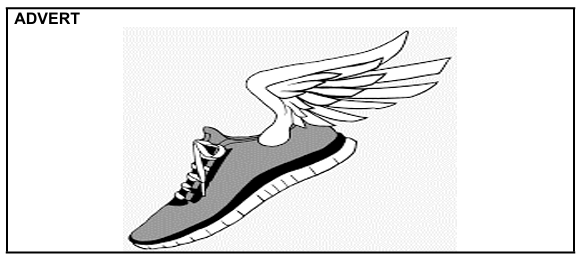
4.4.1Create a heading that draws attention.
4.4.2Maintain interest by providing TWO interesting facts about the product.
4.4.3Name TWO ways in which you can motivate consumers to act. (3 × 2) (6)
SHOW ANSWER
4.4.1 Heading: “Take Flight With Every Step!” A short, energetic heading attracts attention and connects the shoe with movement and activity.
4.4.2 Two interesting facts:
- Choose sports shoes designed for the activity you do, because suitable support can help reduce the risk of some foot and ankle injuries.
- A well-fitting sports shoe should feel secure and comfortable, with enough room for the toes and suitable grip for the activity.
4.4.3 Two ways to motivate consumers to act:
- Offer a promotion: A limited-time discount or special offer can give customers a reason to buy soon.
- Provide contact and purchase details: Include a shop address, website, email or WhatsApp contact so interested customers know how to obtain the product.
4.5Discuss the following criticism of advertising:
'Advertising stimulates false needs'. (3)
SHOW ANSWER
Advertising can stimulate false needs by persuading people that they must own products that are not essential to their well-being. Repeated messages may link a product with popularity, beauty or success, making consumers feel that they are lacking something without it. This can encourage unnecessary spending and over-indebtedness, and can promote materialism by placing too much value on possessions and wants.
4.6Choose the most correct word in brackets. The presentation style of the advert can be described as (factual/ humorous/negative/ fantasy). (2)
SHOW ANSWER
Fantasy. The advert uses an imaginative image of a sports shoe with wings. Since ordinary shoes do not have wings, the visual relies on fantasy to attract attention and suggest lightness, speed or freedom.
QUESTION 5: MEETINGS [20]
5.1Indicate whether the following statements are TRUE or FALSE. Choose the answer and write only 'True' or 'False' next to the question number (5.1.1–5.1.5) in the ANSWER BOOK.
5.1.1AGM's, monthly and special meetings are general meetings.
SHOW ANSWER
5.1.1 True. AGMs, monthly meetings and special meetings are forms of general meetings.
5.1.2An AGM is held once a year to provide feedback to shareholders.
SHOW ANSWER
5.1.2 True. An annual general meeting (AGM) is held once a year and can provide members or shareholders with information and feedback about the organisation.
5.1.3A notice informs members of what will be discussed at the meeting.
SHOW ANSWER
5.1.3 False. A notice informs members about the meeting, including details such as its date, time and place. The agenda sets out the matters that will be discussed.
5.1.4A meeting is convened when the chairperson is present.
SHOW ANSWER
5.1.4 False. A meeting is not properly constituted merely because the chairperson is present. It must also be properly convened and have the required quorum, and it must follow the organisation's rules.
5.1.5Only members may attend and vote at private meetings. (5 × 1) (5)
SHOW ANSWER
5.1.5 True. Only members may attend and vote at private meetings.
5.2Meetings are controlled by different laws or regulations.
5.2.1Explain the meaning of common law.
SHOW ANSWER
Common law refers to law that is not created solely through a specific statute and that develops through legal principles and decisions over time. It may be unwritten and develop through legal principles, decisions and long-standing practices.
5.2.2Explain the meaning of statutory law. (2 × 2) (4)
SHOW ANSWER
Statutory law is law formally enacted by a legislative authority through statutes or Acts. These laws set out rules that people and organisations must follow. The Companies Act is an example relevant to meetings.
5.3What are minutes of the meeting? (2)
SHOW ANSWER
Minutes of a meeting are the official written record of what took place during the meeting. They record the proceedings and key matters dealt with, providing a reference for decisions and actions after the meeting.
5.4Distinguish between a formal and an informal meeting. (2)
SHOW ANSWER
A formal meeting follows recognised procedures and rules. It is properly convened, the chairperson is present, a quorum is established and the meeting is conducted according to the organisation's constitution. An informal meeting is generally more flexible and does not necessarily follow all these formal procedures.
5.5Name THREE aspects addressed by the constitution. (3)
SHOW ANSWER
A constitution sets out the rules and basic arrangements of an organisation. It may address:
- Name of the organisation: Identifies the organisation formally.
- Date of adoption: Records when the constitution came into effect.
- Aims, objectives or mission: Explains why the organisation exists and what it intends to achieve.
- Membership requirements: States who may become a member and any conditions they must meet.
- Executive duties and privileges: Defines the responsibilities and authority of office-bearers.
- Meeting procedures: Sets rules for notices, proxy arrangements and voting.
- Suspension of members: Explains circumstances and procedures for suspending membership.
- Finances: Provides rules for handling the organisation's money.
- Dissolution: Explains how the organisation may be formally closed down.
5.6Explain the following terms in full sentences.
5.6.1Quorum
SHOW ANSWER
A quorum is the minimum number of eligible people who must be present before a meeting can conduct its business validly. If that number is not present, the meeting may not be properly constituted and may need to be postponed or adjourned according to its rules.
5.6.2Ad-hoc committee (2 × 2) (4)
SHOW ANSWER
An ad-hoc committee is a committee established for a particular task or specific purpose, rather than as a permanent committee. It operates for as long as necessary to complete that task and is then dissolved.
TOTAL: 100