
Management Communication N4
Second Paper · Study Paper
Try each question first, then reveal the answer.
Instructions
- Answer all the questions.
- Read all questions carefully.
- Number answers according to the numbering system used in the question paper.
- Start each section on a new page.
- Write neatly and legibly.
- A dictionary may be used.
QUESTION 1: BASIC COMMUNICATION PRINCIPLES
1.1 Match each description in Column A with the correct term in Column B.
Column A: Descriptions
1.1.1 Interview where information is shared
Show answer
1.1.2 Communication between two or more people as individuals or in small groups
Show answer
1.1.3 Distance of between half and one metre maintained between sender and receiver
Show answer
1.1.4 Distance of one to two metres is maintained
Show answer
1.1.5 Personality traits, emotions or psychological state cause the communication process to be ineffective
Show answer
1.1.6 Use of space around people when communicating with others
Show answer
1.1.7 Ambiguity
Show answer
1.1.8 Only possible answer is “yes” or “no”
Show answer
1.1.9 Communication by sound
Show answer
1.1.10 Any factor that prevents communication from taking place effectively
Show answer
Column B: Terms
1.2 Choose the correct option (A–D).
1.2.1 In the communication process, the message is the …
Show answer
1.2.2 Which ONE is NOT an example of a perceptual barrier?
Show answer
1.2.3 … is listening that involves problem solving and evaluating information.
Show answer
1.2.4 Which ONE is a hypothetical question?
Show answer
1.2.5 Tacesics may be in the form of …
Show answer
1.2.6 … is communication that takes place within oneself.
Show answer
1.2.7 Acoustic semiology includes …
Show answer
1.2.8 … is information conveyed through pictures.
Show answer
1.2.9 … is culture specific.
Show answer
1.2.10 A personal letter addressed to you falls under:
Show answer
1.3 Read the scenario and answer the questions.
Veronica: Hi, how are you?
Luthando: Fine thanks.
Veronica: Are you busy Friday afternoon?
Luthando: No, not really. Why?
Veronica: I saw an advert online advertising 50% off all brand names at Z's fashion store. Should we go shopping?
Noisy students pass by, and Luthando asks Veronica to repeat what she said. Veronica tells her about the online advert again.
Luthando: (smiling) Sounds like fun!
Veronica: (thinking to herself) I hope I get a big bargain!
Luthando: I've got to get to class. See you later!
1.3.1 Define communication.
Show answer
How the process works: The sender first forms and encodes an idea, then sends it as a message through a channel. The receiver decodes the message to interpret its meaning. Feedback lets the sender know how the message was understood. Communication can be disrupted by noise at any stage.
1.3.2 Identify the sender and receiver.
Show answer
1.3.3 What category of communication is used? Support your answer.
Show answer
Answer: Interpersonal communication.
Veronica and Luthando are two individuals talking directly, face-to-face, using their voices. This is interpersonal communication because it takes place between people rather than within one person (intrapersonal communication) or from a source to a large audience (mass communication).
1.3.4 Using evidence from the passage, discuss noise.
Show answer
Noise is any factor that interferes with a message and makes it harder for the receiver to understand it. In this scenario, the passing students created noise that distracted Luthando while he was trying to decode Veronica’s message. The example shows that noise is not limited to technical sounds; any distraction that interrupts understanding can act as a communication barrier.
. She could not respond appropriately and asked Veronica to repeat it.1.3.5 Identify the channel and state TWO advantages.
Show answer
Channel: voice / face-to-face direct oral communication.
Advantages:
- Constant non-verbal feedback is received.
- Feedback is direct and immediate.
1.3.6 Name the barrier that caused ineffective communication.
Show answer
1.3.7 Explain phatic communication.
Show answer
1.3.8 Quote ONE example of phatic communication word for word.
Show answer
1.3.9 Give one example of each from the scenario: (a) intrapersonal communication (b) mass communication.
Show answer
(a) Veronica thinking: “I hope I get a bargain.”
(b) The online advert.
QUESTION 2: INTERPERSONAL RELATIONSHIPS AND SOCIAL INTERACTION
Molefi works for a small financial company. He has a good self-image and usually works well under pressure. His manager, Mr Moloi, asked him to complete the budget by a strict deadline. Molefi worked hard, but on the due date a virus destroyed all the information on his computer, including his budget. He was frantic and stressed. Molefi thought: “All managers are the same! I know that he will never believe me!” Instead of explaining the situation to Mr Moloi, he avoided him the whole day.
2.1 State THREE elements of self-image
Show answer
Elements of self-image:
- What you think of yourself / how you perceive yourself.
- Your interpretation of what other people think of you.
- Your ideal self-image / who you hope to be.
These elements reflect your view of your current self, how you believe others see you, and the person you would like to become. They may influence confidence, behaviour and relationships.
- Your interpretation of what other people think of you.
- Your ideal self-image / who you hope to be.
2.2 Give TWO sentences of advice on improving self-image
Show answer
- Interpret other people’s behaviour positively and avoid taking things too personally.
- Take failure and disappointment positively because they are a learning process.
Why this helps: Self-image can be affected by how we interpret events. Looking at situations realistically, learning from setbacks and avoiding assumptions about what others think can help build a more balanced view of yourself.
- Take failure and disappointment positively because they are a learning process.
2.3 Explain social needs of workers in the workplace
Show answer
2.4.1 Define prejudice
Show answer
2.4.2 Define stereotyping
Show answer
2.5 Identify and quote an example of stereotyping from the scenario
Show answer
2.6 Explain gatekeeping
Show answer
2.7 Is Molefi guilty of gatekeeping? Substantiate your answer
Show answer
Yes. He avoided the manager the whole day instead of explaining what had happened.
Reason: By withholding an explanation and avoiding the conversation, Molefi prevented information from being shared openly. This fits the idea of gatekeeping because his behaviour obstructed communication rather than helping the situation to be clarified.
2.8 Illustrate Maslow’s hierarchy of needs
Show answer
Maslow’s hierarchy arranges human needs from basic needs to higher-level personal development needs. Read the diagram from the bottom upwards: physiological needs (such as food and rest), safety, love and belonging, esteem, and self-actualisation. The general idea is that people seek to satisfy basic needs before focusing strongly on higher-level needs. In a workplace, this can help explain why fair pay and safe conditions matter alongside belonging, recognition and opportunities to develop.
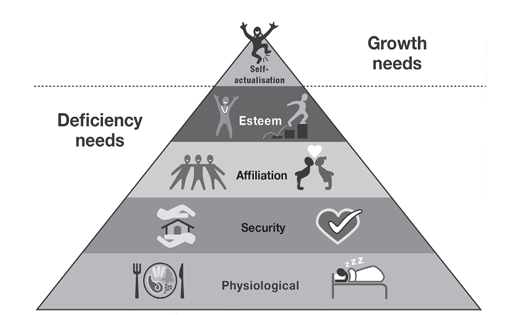
From the bottom to the top: physiological needs, security needs, affiliation (social) needs, esteem needs and self-actualisation needs.
2.9 Discuss TWO types of reference groups with examples
Show answer
- Primary reference group: People with whom an individual has direct contact, such as family.
- Secondary reference group: People with whom an individual has indirect contact, such as in-laws.
QUESTION 3: INTERVIEWING
Study the vacancy headings below and answer the questions.

3.1 Dumisani is applying for a Senior Clerk position and has been invited for an interview. Give FOUR hints for preparing for the interview.
Show answer
- Collect information about the organisation.
- Know the job requirements and make sure the job is relevant to you.
- Be well groomed and look professional.
- Organise personal documents such as your CV, ID, qualifications and driver’s licence.
- Collect typical interview questions and practise answering them.
- Prepare relevant questions to ask the interviewer.
3.2 Illustrate the interview as a communication process according to Jacobson.
Show answer
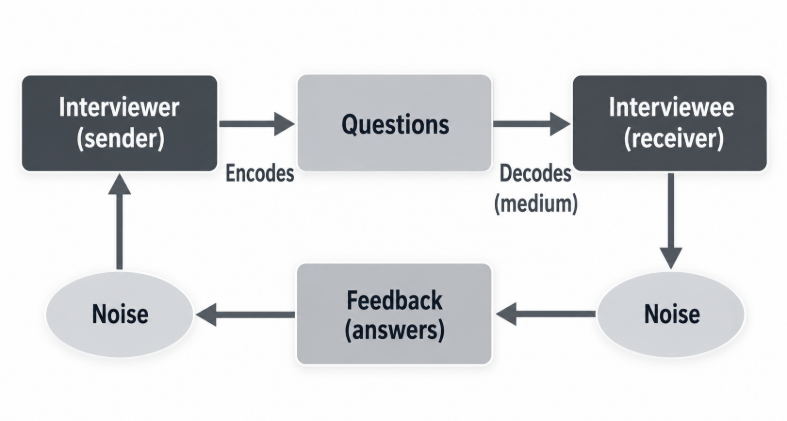
Include and label: sender (interviewer); encoding using a code such as a language; message (questions); channel/medium (face-to-face or voice); receiver (interviewee), who decodes/interprets the questions; feedback (answers from the interviewee); and noise (any disturbance). Connect the stages with arrows to show the communication flow.
3.3 State FOUR types of interview questions and give a full example of each.
Show answer examples
- Closed question: Do you drive?
- Open-ended question: Why do you want to work for us?
- Specific question: Which high school did you attend?
- Reflective question: You said you are a go-getter; how will that benefit us?
- Leading question: I think engineering is not good for girls. What is your opinion?
- Hypothetical question: If we hired you, what new things would you introduce here?
QUESTION 4: MASS MEDIA AND ADVERTISING
Study the advertisement and answer the questions.

4.1 Explain what AIDA stands for in advertising.
Show answer
- A – Attention
- I – Interest
- D – Desire
- A – Action
4.2 How does the advertisement draw attention?
Show answer
QUESTION 5: MEETING PROCEDURE
Study the notice and answer the questions.

5.1 Define the term meeting.
Show answer
5.2 Is the meeting public or private? Support your answer.
Show answer
It is a public meeting.
It was advertised in the mass media / public notice and invites members of the community to attend.
5.3 Explain the term notice of a meeting.