
EDUCATION
REPUBLIC OF SOUTH AFRICA
NATIONAL SENIOR CERTIFICATE
GRADE 11
LIFE SCIENCES
SEPTEMBER 2025 — QUESTION PAPER AND MARKING GUIDELINES
INSTRUCTIONS AND INFORMATION
Read the following instructions carefully before answering the questions.
- Answer ALL the questions.
- Write ALL the answers in the ANSWER BOOK.
- Start the answers to each question at the top of a NEW page.
- Number the answers correctly according to the numbering system used in this question paper.
- Present your answers according to the instructions of each question.
- Do ALL drawings in pencil and label them in blue or black ink.
- Draw diagrams, tables or flow charts only when asked to do so.
- The diagrams in this question paper are NOT necessarily drawn to scale.
- Do NOT use graph paper.
- You may use a non-programmable calculator, protractor and a compass.
- Write neatly and legibly.
SECTION A
QUESTION 1
1.1 Various options are provided as possible answers to the following questions. Choose the answer and write only the letter (A–D) next to the question number in the ANSWER BOOK.
1.1.1 Total number of organisms of a particular species that can be supported by resources in the environment:
Show answer
Carrying capacity is the largest population of a species that an environment can support over time with the resources available, such as food, water, space and shelter.
1.1.2 The part of the brain that stimulates heart muscles when a person is exposed to an environment with a high level of carbon dioxide is the …
Show answer
The medulla oblongata helps control involuntary activities, including breathing and heart rate. It responds to changes such as increased carbon dioxide levels in the blood.
1.1.3 The table below shows rate and depth of breathing in a healthy individual during a three-minute strenuous exercise.
| Time of exercise (minutes) | Rate of breathing (breaths per minute) | Depth of breathing (litres per minute) |
|---|---|---|
| 1 | 10 | 20 |
| 2 | 15 | 30 |
| 3 | 20 | 40 |
Which ONE statement best describes the relationship between time of exercise, rate and depth of breathing?
Show answer
As exercise continues from minute 1 to minute 3, the breathing rate rises from 10 to 20 breaths per minute and the depth of breathing rises from 20 to 40 litres per minute, as shown in the table. During strenuous exercise, the body needs more oxygen and must remove more carbon dioxide, so both the rate and depth of breathing increase.
(3 × 2) (6)
1.2 Give the correct biological term for each description. Write only the term next to the question number in the ANSWER BOOK.
1.2.1 Specialised cells in the inner wall of the Bowman's capsule. (1)
Show answer
Podocytes are specialised cells associated with the inner layer of Bowman’s capsule. They help form the filtration barrier that allows the kidney to filter blood.
1.2.2 The process of eliminating metabolic waste product. (1)
Show answer
Excretion is the removal of metabolic waste products made by the body’s cells, such as urea and excess salts.
(2 × 1) (2)
1.3 Indicate whether each description in COLUMN I applies to A ONLY, B ONLY, BOTH A AND B or NONE of the items in COLUMN II. Write the appropriate response next to each question number.
| Question / Column I | Column II |
|---|---|
1.3.1 Blood vessel that carries deoxygenated blood from the heart to the lungsShow answerAnswer: A only. The pulmonary artery carries deoxygenated blood from the heart to the lungs. The pulmonary vein carries oxygenated blood back to the heart, so only A is correct. | A: Pulmonary artery B: Pulmonary vein |
1.3.2 Sodium level increases in the bloodShow answerAnswer: B only. When sodium levels in the blood increase, less aldosterone is secreted. Aldosterone normally promotes sodium reabsorption by the kidneys, so reducing its secretion helps limit further sodium retention. | A: More aldosterone secreted B: Less aldosterone secreted |
1.3.3 The air passagesShow answerAnswer: Both A and B. The nostrils and bronchi are both parts of the respiratory air passages through which air travels. | A: Nostrils B: Bronchus |
(3 × 2) (6)
1.4 The diagram below shows a part of the human urinary system.
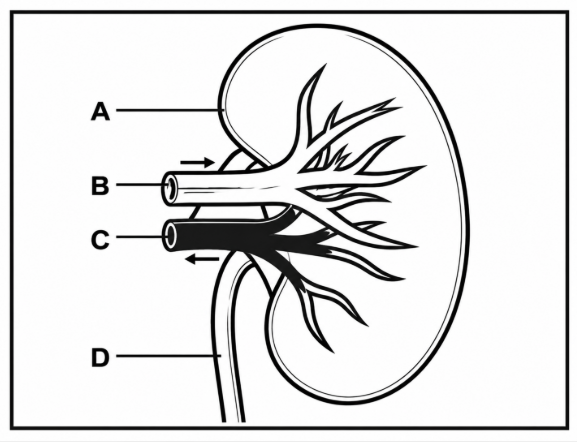
1.4.1 Give the LETTER and NAME of the part that:
(a) Carries blood with nitrogenous waste to the kidney for filtration. (2)
Show answer
The renal artery carries blood containing nitrogenous waste to the kidney, where the blood is filtered.
(b) Carries urine from the kidney to the bladder. (2)
Show answer
The ureter is the tube that transports urine from the kidney to the bladder.
(c) Carries deoxygenated and filtered blood to the heart. (2)
Show answer
The renal vein carries filtered blood away from the kidney towards the heart.
TOTAL SECTION A: 20
SECTION B
QUESTION 2
2.1 The diagram below shows the human lungs.
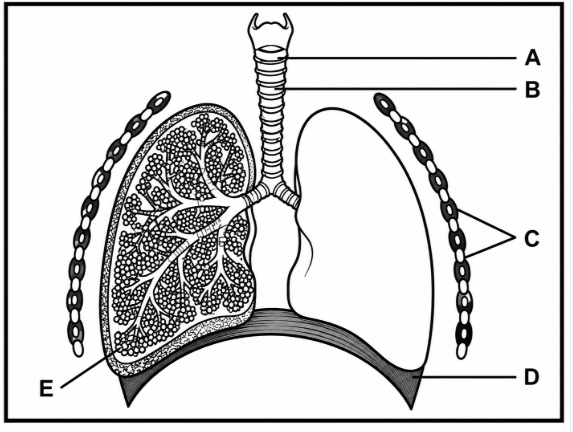
2.1.1 Identify part:
(a) B (1)
Show answer
A bronchus is an air passage that carries air from the trachea into a lung.
(b) E (1)
Show answer
An alveolus is a tiny air sac where oxygen and carbon dioxide are exchanged between the air and the blood.
2.1.2 Describe the role of part C and D during exhalation. (4)
Show answer
During exhalation, the diaphragm relaxes and returns to a dome-shaped position. The external intercostal muscles also relax, causing the rib cage to move downwards and inwards. These movements reduce the volume of the thoracic cavity, increasing pressure inside the lungs and pushing air out.
- The diaphragm relaxes and becomes arched / dome-shaped.
- The external intercostal muscles relax.
- The rib cage moves downwards and inwards.
- The volume of the thoracic cavity decreases, pushing air out of the lungs.
2.1.3 Bronchoalveolar carcinoma is a rare form of lung cancer that originates and damages the cells lining part E. Explain how this disease may result in death if it is not detected earlier. (3)
Show answer
Bronchoalveolar carcinoma damages cells lining the gas-exchange region of the lungs. This can reduce the surface area available for gas exchange or obstruct air passages. As a result, less oxygen enters the blood and reaches tissues, including the heart muscle. Carbon dioxide may also build up because it cannot be exhaled effectively, potentially contributing to heart failure.
- The surface area for gaseous exchange is reduced / air passages may be blocked by tumours.
- Less oxygen enters the blood or reaches body tissues and heart muscles.
- Carbon dioxide may be trapped and not exhaled, potentially resulting in heart failure.
2.2 The bar graph below shows a comparison between youth unemployment in different countries in 2024 and 2025.
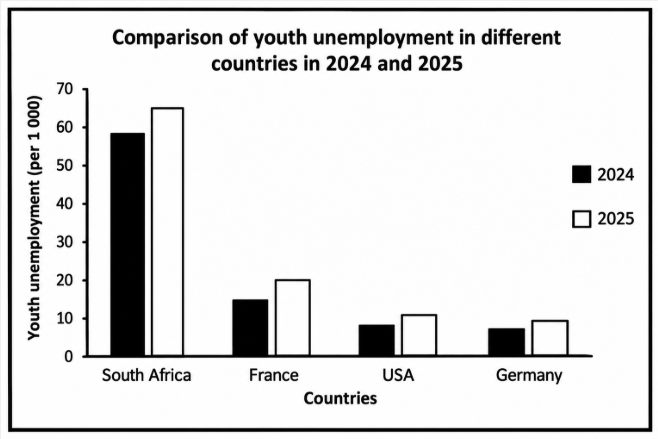
2.2.1 Which country above is classified as a developing country? (1)
Show answer
South Africa is the developing country identified in the graph.
2.2.2 Explain ONE reason for your answer to QUESTION 2.2.1. (2)
Show answer
South Africa has the highest youth unemployment rate shown in the graph. A high rate of youth unemployment is one indicator of the country’s economic challenges.
2.2.3 Calculate the percentage increase in youth unemployment in France between 2024 and 2025. Show ALL working. (3)
Show answer
2024 value = 15; 2025 value = 20.
Increase = 20 − 15 = 5.
Percentage increase = (increase ÷ original value) × 100 = (5 ÷ 15) × 100 = 33.33%.
The 2024 value is the starting value, so divide the increase by 15 and multiply by 100.
[15]
QUESTION 3
3.1 Read the extract below.
THE ECOLOGICAL ROLES OF LIONS
Lions are the apex predator of the African savanna since they hunt in packs. They play the critical role of managing large herbivore populations such as buffaloes, impalas, zebras, and even elephants and giraffes. In a balanced ecosystem, the number of herbivores needs to be kept in balance. If there are too many herbivores, the ecosystem will inevitably degrade.
3.1.1 Name the type of relationship between lions and the herbivores. (1)
Show answer
Lions are predators because they hunt and kill herbivores for food; the herbivores are the prey.
3.1.2 Explain why:
(a) lions are successful predators in the savanna. (2)
Show answer
Lions hunt in packs. Working together allows them to surround or pursue prey and increases their chances of a successful hunt.
(b) the number of herbivores needs to be kept in balance in the ecosystem. (2)
Show answer
Herbivore numbers must remain balanced to prevent overgrazing and land degradation. If too much vegetation is eaten, the ecosystem may support fewer organisms and its carrying capacity can decrease.
3.1.3 Name TWO symbiotic interactions that benefit one species. (2)
Show answer
In commensalism, one species benefits while the other is not significantly affected. In parasitism, the parasite benefits while the host is harmed.
3.2 Grade 11 learners conducted an investigation to determine the effect of drinking water on urine production.
A healthy athlete was requested not to drink water or eat food for 24 hours before the investigation. The investigation was conducted over a period of five days.
The following procedure was followed:
- Day 1 and 2: the athlete was given 500 mL of water to drink each day.
- Day 3: the athlete was given 660 mL of water to drink.
- Day 4: the athlete was given 870 mL of water to drink.
- Day 5: the athlete was given 990 mL of water to drink.
On each day of the investigation, the amount of urine produced by the athlete was measured and recorded over a five-hour period after drinking water.
Results were recorded in the table below:
| Day | Amount of water consumed (mL) | Amount of urine produced (mL/day) |
|---|---|---|
| 1 | 500 | 410 |
| 2 | 500 | 410 |
| 3 | 660 | 604 |
| 4 | 870 | 823 |
| 5 | 990 | 902 |
3.2.1 State ONE:
(a) way in which the reliability of the investigation was ensured. (1)
Show answer
The investigation was conducted over five days. Repeating observations across several days helps show whether the pattern is consistent.
(b) reason why the participant was asked not to consume water or food for 24 hours before the investigation. (1)
Show answer
The participant was asked not to eat or drink for 24 hours to reduce the amount of water in the blood before the investigation and help improve the validity of the results.
(c) planning step the learners considered for this investigation. (1)
Show answer
- Ask the participant’s permission.
- Decide which instrument will be used to collect urine.
- Decide how the results will be recorded.
- Decide the time or venue of the investigation.
3.2.2 Name the hormone responsible for water balance in the body. (1)
Show answer
ADH helps regulate water balance by controlling how much water the kidneys reabsorb.
3.2.3 Explain the role of the hormone mentioned in QUESTION 3.2.2 in the homeostatic response after day 3. (4)
Show answer
After the athlete drinks more water, less ADH is secreted into the blood. The walls of the distal convoluted tubule and collecting tubule become less permeable, so less water leaves the tubules by osmosis and returns to the blood. More water therefore remains in the tubules and is excreted as a larger volume of more dilute urine.
- Less ADH is secreted into the blood.
- The distal convoluted tubule and collecting tubule become less permeable.
- Less water is reabsorbed into the blood by osmosis.
- More water remains in the tubules and is released as a larger volume of dilute urine.
TOTAL SECTION B: 30
GRAND TOTAL: 50