
NATIONAL SENIOR CERTIFICATE
LIFE SCIENCES P1
NOVEMBER 2020
This question paper consists of 16 pages.
INSTRUCTIONS AND INFORMATION
Read the following instructions carefully before answering the questions.
- Answer ALL the questions.
- Write ALL the answers in the ANSWER BOOK.
- Start the answers to EACH question at the top of a NEW page.
- Number the answers correctly according to the numbering system used in this question paper.
- Present your answers according to the instructions of each question.
- Do ALL drawings in pencil and label them in blue or black ink.
- Draw diagrams, tables or flow charts only when asked to do so.
- The diagrams in this question paper are NOT necessarily drawn to scale.
- Do NOT use graph paper.
- You must use a non-programmable calculator, protractor and a compass, where necessary.
- Write neatly and legibly.
QUESTION 1
SHOW ANSWER
SHOW ANSWER
SHOW ANSWER
SHOW ANSWER
SHOW ANSWER
SHOW ANSWER
SHOW ANSWER
SHOW ANSWER
SHOW ANSWER
| GLAND | HORMONE SECRETED | EFFECT ON BLOOD GLUCOSE LEVEL | |
|---|---|---|---|
| A | Pancreas | Insulin | Increase |
| B | Pituitary | Glucagon | Increase |
| C | Pancreas | Insulin | Decrease |
| D | Pancreas | Glucagon | Decrease |
SHOW ANSWER
(10 × 2) (20)
SHOW ANSWER
SHOW ANSWER
SHOW ANSWER
SHOW ANSWER
SHOW ANSWER
SHOW ANSWER
SHOW ANSWER
SHOW ANSWER
SHOW ANSWER
SHOW ANSWER
(10 × 1) (10)
| COLUMN I | COLUMN II |
|---|---|
| 1.3.1 The functional connection between two consecutive neurons | A: Receptor B: Synapse |
| 1.3.2 The young develops and is nourished in an amniotic egg that is retained in the mother’s body | A: Ovipary B: Vivipary |
| 1.3.3 A reproductive strategy in vertebrates where internal fertilisation occurs | A: Altricial development B: Precocial development |
SHOW ANSWERS
1.3.1 — B only. A synapse is the functional connection between two consecutive neurons.
1.3.2 — None. Neither ovipary nor vivipary describes an amniotic egg retained in the mother's body in the way stated here.
1.3.3 — Both A and B. Internal fertilisation can occur in vertebrates showing either altricial or precocial development.
(3 × 2) (6)
SHOW ANSWER
SHOW ANSWER
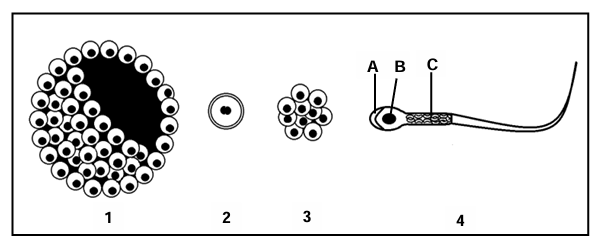
(a) Morula
(b) Structure that will implant in the uterus
(c) Blastula/Blastocyst
SHOW ANSWER
(a) 3
(b) 1
(c) 1
SHOW ANSWER
SHOW ANSWER
(8)
SHOW ANSWER
SHOW ANSWER
SHOW ANSWER
(6)
TOTAL SECTION A: 50
QUESTION 2
(a) A (1)
(b) B (1)
(c) H (1)
SHOW ANSWER
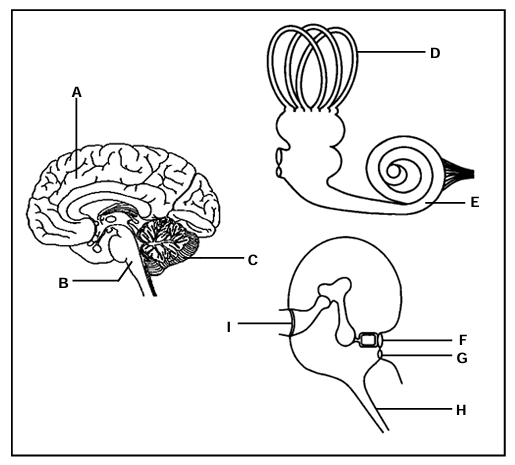
(a) Cerebrum
(b) Medulla oblongata
(c) Eustachian tube
SHOW ANSWER
SHOW ANSWER
SHOW ANSWER
Part B is the medulla oblongata, which controls vital processes such as heartbeat and breathing. If it is damaged, these processes may stop, which can lead to death.
SHOW ANSWER
The impulses received by part C are interpreted there and then sent to the skeletal muscles. The skeletal muscles respond to these impulses, helping to maintain balance.
SHOW ANSWER
If part F hardens, the oval window will not vibrate freely. As a result, fewer or no vibrations will be carried to the cochlea, so fewer or no pressure waves will form in the cochlea. The organ of Corti or hair cells will therefore receive less or no stimulation, so fewer or no impulses will be transmitted to the cerebrum. This ultimately leads to hearing loss.
(15)
SHOW ANSWER
For distant vision, the ciliary muscle is relaxed and the ciliary body/choroid layer moves backward, away from the lens. This makes the suspensory ligaments tight or taut, which increases the tension on the lens. The lens therefore becomes less convex or flatter, so the light rays are refracted less and a clear image falls on the retina.
AN OUTBREAK OF THYROTOXICOSIS
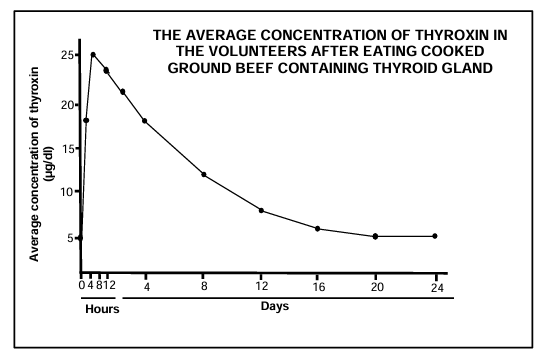
Thyrotoxicosis is a medical condition caused by high levels of thyroxin in the blood. There was a sudden increase in the number of reported cases of this condition in one city. They suspected that this was due to people eating ground beef (minced meat) from a local butcher. The butcher added the thyroid glands of cattle when he produced the ground beef. Some people who ate this ground beef showed symptoms of increased heart rate, excessive sweating and weight loss.
Doctors conducted an investigation to determine if the ground beef caused the thyrotoxicosis. The normal thyroxin levels of 5 volunteers were measured. They were then given cooked ground beef from the butchery to eat. Their thyroxin concentration was measured every 4 hours on day 1 and then once a day for the next 23 days. The average thyroxin levels was calculated and recorded.
SHOW ANSWER
SHOW ANSWER
If the graph reading is 24 µg/dl, the calculation is (24 − 5) ÷ 5 × 100 = 380%.
SHOW ANSWER
Thyrotoxicosis increases the metabolic rate and therefore increases the rate of cellular respiration. More glucose is used and less glucose is stored, while fat is also broken down. The increased use of glucose and the breakdown of fat result in weight loss.
SHOW ANSWER
The thyroxin concentration in the blood is high 8 hours after eating the ground beef. The high thyroxin level causes the pituitary gland to secrete less TSH into the blood, so the TSH concentration decreases.
(11)
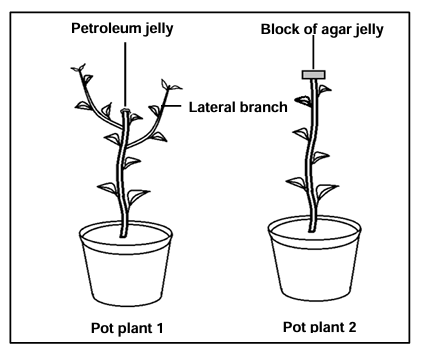
The procedure was as follows:
- Two pot plants (1 and 2) of the same species and age were used.
- The apical buds of both plants were cut at the same length along the stem.
- The cut surface of plant 1 was sealed with petroleum jelly.
- The cut apical bud of pot plant 2 was placed on a block of agar jelly for 2 hours.
- The block of agar jelly was then placed on the cut surface of plant 2.
- The plants were exposed to the same environmental conditions for 2 weeks.
- The growth of both plants was observed at the end of this period.
The diagrams below show the results obtained.
SHOW ANSWER
The apical bud was placed on the agar jelly so that the plant hormone, auxins, from the apical tip could diffuse into the block of agar jelly.
SHOW ANSWER
The stem stopped growing upwards and lateral branches developed.
SHOW ANSWER
Fruit farmers can encourage lateral branches to develop because the lateral branches can bear more fruit, thereby increasing the yield. Alternatively, developing lateral branches can produce shorter trees, which makes harvesting of fruit easier.
SHOW ANSWER
Auxins from the apical bud had diffused into the agar jelly. When the agar jelly was placed on the cut stem, the auxins moved downwards into the stem, where they stimulated cell elongation and growth. This resulted in upward growth of the stem.
(9)
[40]
QUESTION 3
SHOW ANSWER
SHOW ANSWER
SHOW ANSWER
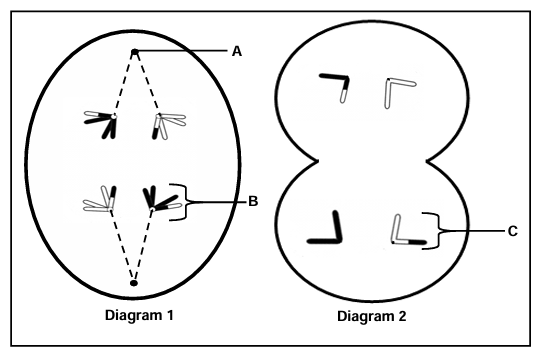
The spindle fibres contract, the centromeres split, and each chromatid is pulled towards the opposite pole. These events describe the movement of the chromatids during the phase.
SHOW ANSWER
SHOW ANSWER
SHOW ANSWER
SHOW ANSWER
Structure B consists of two DNA molecules because it is made up of two chromatids following DNA replication. Structure C consists of one DNA molecule because it is unreplicated, following the splitting of the chromosome during anaphase II.
(10)
SHOW ANSWER
SHOW ANSWER
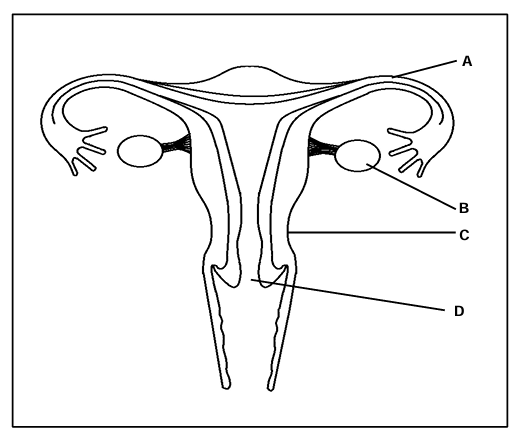
Part A, the fallopian tube or oviduct, is the site of fertilisation. It is also the site where zygote division occurs and it transfers the ovum or embryo towards the uterus.
SHOW ANSWER
Diploid cells in the ovary undergo mitosis to form numerous follicles. Under the influence of FSH, one cell develops, undergoes meiosis, and forms a haploid ovum.
SHOW ANSWER
Structure C is a hollow organ with a muscular wall and a blood-rich lining called the endometrium. These structural features enable it to perform its function during pregnancy.
SHOW ANSWER
When both ovaries are removed, no follicles will develop, so no oestrogen and no progesterone will be produced. Without these hormones, the endometrium will not develop and therefore there will be no developed endometrium to be shed during menstruation.
(10)
An investigation was done to determine how TU affects male fertility.
The procedure was as follows:
- 308 healthy, male volunteers were selected.
- A sperm count for each volunteer was done initially.
- Each volunteer was given 500 mg of TU monthly over a period of 12 months.
- During the period of the investigation, the volunteers were asked to wear loose-fitting trousers and underwear made of the same light fabric.
- A sperm count was done weekly over a period of 24 months.
- The average sperm count was calculated per volunteer.
NOTE: Sperm count refers to the total number of healthy sperm per ml of semen and is an indication of male fertility.
SHOW ANSWER
SHOW ANSWER
SHOW ANSWER
SHOW ANSWER
TU inhibits the secretion of testosterone. Without sufficient testosterone, spermatogenesis cannot take place and sperm will not be produced, thereby reducing fertility.
SHOW ANSWER
Tight-fitting trousers increase the temperature and pressure on the testes. The higher temperature and pressure can decrease the sperm count or decrease sperm production, and can also lead to the production of abnormal sperm, thereby decreasing male fertility.
SHOW ANSWER
The additional sperm counts can determine whether TU is still effective after 12 months and whether the sperm count returns to normal when the treatment stops.
SHOW ANSWER
Cutting and tying the vas deferens prevents sperm from being transported from the epididymis to the urethra. As a result, semen without sperm is released, so sperm cannot reach the ovum for fertilisation and pregnancy is prevented.
(11)
SHOW ANSWER
SHOW ANSWER
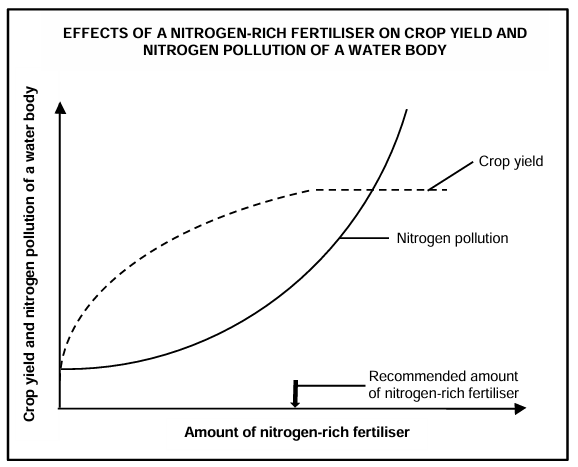
The crop yield reaches a maximum at the recommended amount of fertiliser. Using more fertiliser costs the farmer more without increasing the crop yield, and therefore the farmer's profit will be lower.
SHOW ANSWER
Applying fertiliser during the dry season reduces the amount of fertiliser that can be lost through run-off or leaching.
SHOW ANSWER
An increase in nitrogen pollution can cause an algal bloom. A layer of algae forms on the water and blocks sunlight, so aquatic plants die because they are unable to photosynthesise. Animals that feed on these plants also die. The dead plants and animals are then decomposed, and this decomposition causes an increase in the number of bacteria in the water.
(9)
[40]
TOTAL SECTION B: 80
QUESTION 4
Also, describe the importance of carbon dioxide in regulating atmospheric temperature, and why increasing levels of carbon dioxide leads to global warming.
(20)
SHOW ANSWER
When the body temperature rises above normal, receptors are stimulated and send impulses to the hypothalamus. The hypothalamus sends impulses to the blood vessels in the skin and to the sweat glands. The blood vessels in the skin dilate, so more blood flows to the surface of the skin and more heat is lost from the body. At the same time, more sweat is produced, and heat is lost when the sweat evaporates. These responses reduce the body temperature back towards normal.
When the carbon dioxide concentration in the blood rises above normal, receptor cells in the carotid artery in the neck or in the aorta are stimulated and send impulses to the medulla oblongata. The medulla oblongata sends impulses to the breathing muscles, causing them to contract more actively and increasing the rate and depth of breathing. An impulse is also sent to the heart, causing it to beat faster. More carbon dioxide is therefore transported to the lungs and exhaled, causing the carbon dioxide concentration in the blood to return towards normal.
Carbon dioxide is a greenhouse gas that traps heat and prevents it from escaping from the atmosphere. This is known as the greenhouse effect, which keeps the Earth warm enough for life to exist. When the concentration of carbon dioxide in the atmosphere increases, the greenhouse effect becomes stronger, more heat is trapped in the atmosphere, and the average global temperature increases, causing global warming.
TOTAL SECTION C: 20
GRAND TOTAL: 150