
Life Sciences Grade 10 — March 2025
Q&A Teaching Guide
INSTRUCTIONS AND INFORMATION
Read the following instructions carefully before answering the questions.
- Answer ALL the questions.
- Write ALL the answers in the ANSWER BOOK.
- Start the answers to each question at the top of a NEW page.
- Number the answers correctly according to the numbering system used in this question paper.
- Present your answers according to the instructions of each question.
- Do ALL drawings in pencil and label them in blue or black ink.
- Draw diagrams, tables or graphs when asked to do so.
- The diagrams in this question paper are NOT necessarily drawn to scale.
- DO NOT use graph paper.
- You may use a non-programmable calculator, protractor and a compass.
- Write neatly and legibly.
SECTION A
QUESTION 1
Which of the following is a monomer of proteins?
- Amino acids
- Fatty acids
- Glycerol
- Monosaccharides
Correct answer: A — Amino acids
Proteins are made up of amino acid monomers. The amino acids join together to form protein molecules.
The role of a centrosome during mitosis is to...
- connects two chromatids.
- split and move to opposite poles.
- produce two daughter cells.
- introduce genetic variation.
Correct answer: B — split and move to opposite poles.
During mitosis, the centrosome is involved in organising spindle fibres. The spindle fibres help separate the chromatids and move them to opposite poles of the cell.
Below is a list of importances of mitosis:
- Repairs damaged / worn out cells/ tissues
- Responsible for formation of gametes
- Allows reproduction
- Provide cells with energy
Which ONE of the following is CORRECT combination of the importance’s of mitosis?
- (i), (iii), (iv) only
- (i), (ii), (iii), (iv) only
- (i), (iii) only
- (i), (iv) only
Correct answer: C — (i), (iii) only
Mitosis repairs damaged or worn-out cells and tissues and allows reproduction. These are the two relevant statements in the official answer.
1.2 Give the correct biological term for each of the following descriptions. Write only the term next to the question number (1.2.1 to 1.2.5) in your ANSWER BOOK.
Part of microscope that helps to bring the specimen into focus
Coarse adjustment knob
Phase in mitosis where chromosomes are arranged at the equator
Metaphase
The movement of water molecules from high concentration of water molecules to low concentration of water molecules
Diffusion
Site of protein synthesis
Ribosome
Chemical used to test for starch
Iodine solution
1.3 Indicate whether each of the statements in COLUMN I applies to A ONLY, B ONLY, BOTH A AND B, or NONE of the items in COLUMN II. Write A only, B only, both A and B, or none next to the question number (1.3.1 and 1.3.2) in your ANSWER BOOK.
| Question | COLUMN I | A | B |
|---|---|---|---|
| 1.3.1 | Treatment for cancer | Chemotherapy | Physiotherapy |
| 1.3.2 | Joins two chromatids together | Centrosome | Centromere |
Treatment for cancer: Chemotherapy / Physiotherapy
A only
Chemotherapy is used as a treatment for cancer; physiotherapy is not the treatment identified for this statement.
Joins two chromatids together: Centrosome / Centromere
B only
The centromere joins two chromatids together, whereas the centrosome is involved in organising spindle fibres during cell division.
1.4 The diagram below shows a property of an enzyme
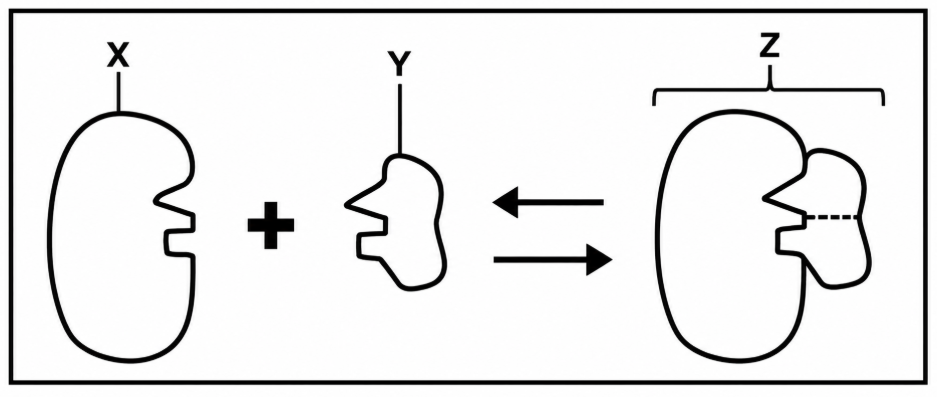
Identify: Structure Y
Substrate molecule
Identify: Structure Z
Enzyme-substrate complex
Identify: The type of model shown in the diagram
Lock and key model
Give the LETTER and NAME of the part that will not be used up in a chemical reaction.
X — Enzyme
The enzyme is not used up in the chemical reaction, so it remains available to catalyse further reactions.
SECTION B
QUESTION 2
2.1 The diagram below shows a plant cell
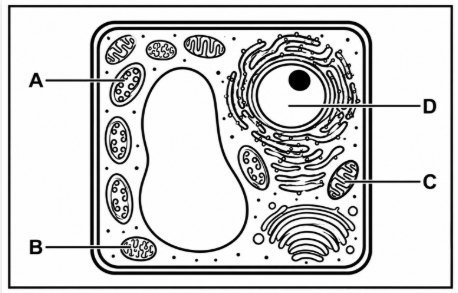
Identify part C.
Mitochondrion
State ONE function of part B.
Provide medium for many chemical reactions to take place.
Another accepted memo point is that it contains all the organelles of the cell. These are both retained here for teaching completeness.
Identify TWO visible features in the diagram that are not typical of animal cells.
Cell wall
Chloroplast
Large vacuole
All three accepted features are shown here so the learner can study the complete valid answer set.
Explain the effect to the plant cell if part D become smaller.
If the large vacuole becomes smaller, the cell loses water, so its turgor pressure decreases. As a result, the cell becomes flaccid and loses some of its shape.
This connects all the substantive memo points in the biological cause-and-effect sequence.
Explain how the number (quantity) of part A will benefit this plant cell.
A larger number of chloroplasts will increase the amount of light absorbed, which increases the rate of photosynthesis and therefore increases the amount of food produced.
2.2 The diagram below a micrograph of a nucleus
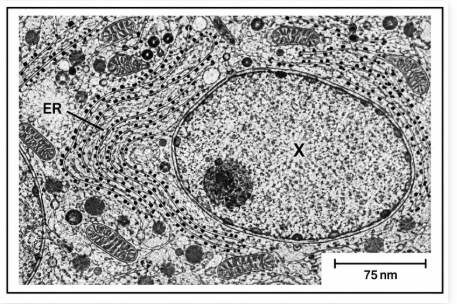
State TWO functions of part X / nucleus.
Controls all the activities in the cell.
Contains DNA which carry hereditary characteristics.
Calculate the actual size of part X in micrometres (1mm = 1000um).
The measured size of the image using a ruler is 75mm and the electron microscopic magnification is 2000x, using the formula:
Actual size = measured size ÷ magnification.
Show ALL calculations.
Calculation:
Actual size = 75 mm ÷ 2000
= 0,0375 mm
Convert millimetres to micrometres:
= 0,0375 × 1000
= 37,5 µm
QUESTION 3
3.1 Amylase is an enzyme that hydrolyses (breaks down) starch into maltose (sugar) in humans
Kelvin conducted an investigation to determine the effect of temperature on amylase breaking down sugar
The procedure of the investigation:
- a solution of amylase was mixed with starch suspension
- the mixtures were kept in test tubes at different temperatures for 15 minutes
- the results were recorded in the table below
| Temperatures (°C) | Units of sugar (arb.) |
|---|---|
| 10 | 10 |
| 20 | 36 |
| 30 | 65 |
| 40 | 90 |
| 50 | 30 |
| 60 | 9 |
Identify the independent variable of the above investigation.
Temperature
Give the optimum temperature for amylase activity.
40 °C
Explain your answer in QUESTION 3.1.2.
The optimum temperature is 40 °C because it was where the enzyme activity was at its maximum/best. At this temperature, amylase breaks down the most sugar, producing 90 sugar units.
Draw a line graph to represent the data in the table above.
Model graph:
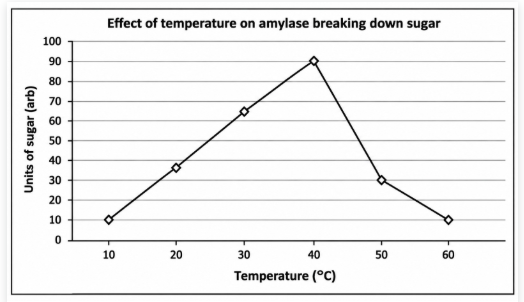
The completed graph represents all six data points from the question. It uses a line graph, a caption containing both variables, correct labels with units on both axes, an appropriate scale on both axes, and all six points plotted correctly.
3.2 The diagram below shows a phase in mitosis
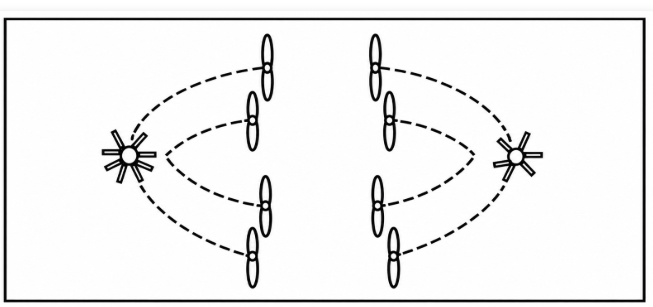
Identify the phase of mitosis shown above.
Anaphase
Describe the events that are taking place in the phase mentioned in QUESTION 3.2.1.
During anaphase, spindle fibres contract/shorten, pulling the chromatids towards opposite poles of the cell.
State how many chromosomes will be present at the end of this cell division.
4 / four