
GRADE 12 CONSUMER STUDIES
DBE May/June 2026
Combined Teaching and Revision Guide • Questions 2–6
QUESTION 2 (40 marks)
Read the relevant information in the question paper and answer the questions that follow.
SHOW ANSWER
- Property rates paid by community members.
- Funding from provincial and national government.
SHOW ANSWER
SARS is responsible for collecting taxes on behalf of the government.
SHOW ANSWER
- Simple interest.
- Compound interest.
SHOW ANSWER
Provisional tax allows taxpayers who earn an irregular income to pay their tax in instalments during the year instead of having to pay one large amount after the end of the tax year. This makes it easier to manage their finances.
SHOW ANSWER
Relevant characteristics for revision:
- A product is sold as part of the scheme.
- Direct marketing is used to sell the products.
- Sales representatives receive a portion of the sales or money generated by members on a lower level.
- Members may benefit from sales made by people they recruit.
- It is a legal marketing system when it is based on genuine product sales rather than recruitment alone.
SHOW ANSWER
- Plant indigenous or water-wise plants because they are adapted to local conditions and generally require less water. Group plants with similar water requirements together.
- Check regularly for leaking taps and pipes and repair them immediately to prevent unnecessary water loss.
- Avoid watering during the hottest part of the day or when it is windy, because water evaporates quickly or is blown away before it can soak into the soil.
- Collect rainwater in a rainwater tank and use it to water the garden.
- Use suitable greywater from the household to water garden plants.
- Use a watering can, bucket or drip-irrigation system to control the amount of water used instead of leaving a hose running.
- Install a timer to limit the time spent watering the garden.
- Cover the soil with mulch to reduce evaporation and retain moisture.
SHOW ANSWER
Plan meals in advance so that the stove and oven can be used efficiently. Planning makes it possible to prepare several dishes together and avoids unnecessary heating of the appliances.
Cook large quantities of food at once. This saves time and electricity because the stove or oven does not need to be switched on repeatedly to prepare separate small meals.
Prepare one-pot meals or casseroles. Several ingredients can cook together in one pot, reducing the number of pots and appliances needed and shortening cooking time.
Prepare food before switching on the stove or oven. Defrost frozen food safely in advance and soak foods such as dried beans where appropriate, so that cooking takes less time.
Match the size of the saucepan to the size of the stove plate. A saucepan that is too small allows heat to escape, wasting electricity.
Cut food into smaller pieces so that it cooks more quickly and uses less electricity.
Keep saucepan lids on while cooking because food cooks more quickly when heat and steam are retained.
Switch off the stove plates or oven shortly before the food is completely cooked. The remaining heat can finish the cooking process.
Reduce the heat once food starts boiling. Food will continue cooking at a lower temperature, which saves electricity.
Keep the oven door closed while food is cooking. Check that the seal is in good condition so that heat does not escape.
Use a convection oven where available. Circulating hot air can reduce cooking time and improve energy efficiency.
SHOW ANSWER
Community members have a responsibility to pay for the municipal services they use, such as water, electricity and refuse removal. These payments help municipalities maintain and provide services to the community.
Residents should use electricity and water responsibly and avoid wasting these resources. They should also avoid littering, keep public areas clean and ensure that they do not block sewer pipes with inappropriate waste.
Community members must respect municipal laws and regulations and use municipal services for their intended purposes. They must not vandalise municipal infrastructure and should report damaged infrastructure so that it can be repaired.
Residents should use the correct official channels when submitting complaints and may participate in community or council processes to remain informed about municipal activities and decisions.
SHOW ANSWER
Municipalities should use their funds to provide essential services and maintain infrastructure that benefits the community.
- Electricity: Purchase electricity for distribution to consumers and provide basic electricity services.
- Water: Purchase and supply water to households, provide basic water services and maintain water infrastructure.
- Public facilities: Maintain parks, sports facilities, cemeteries and other public spaces.
- Healthcare and emergency services: Support municipal health services, clinics, fire and rescue services and ambulance services where these fall within municipal responsibilities.
- Sewerage and waste management: Maintain sewerage infrastructure, provide refuse removal and manage waste-disposal sites.
- Roads and stormwater: Maintain municipal roads, traffic lights and stormwater drainage systems.
- Public transport: Support municipal transport services where provided.
- Libraries and community facilities: Operate public libraries and provide facilities and services for residents.
- Municipal employees: Pay the salaries and wages of municipal workers who provide services.
2.10.1 Increases (4)
SHOW ANSWER – 2.10.1
When interest rates increase, borrowing money becomes more expensive. Consumers may therefore take out fewer loans or use less credit because they will have to pay more interest on the money they borrow.
Monthly repayments on existing loans, such as home loans, vehicle finance and other credit agreements, may also increase. This means that consumers have less disposable income available after paying their debts.
As a result, consumers may reduce their spending on non-essential goods and services and may also have less money available for savings.
Consumers who earn interest on their savings may receive more interest when rates increase. This could give them additional income.
2.10.2 Decreases (4)
SHOW ANSWER – 2.10.2
When interest rates decrease, borrowing money becomes cheaper. Consumers may be encouraged to take out more loans or use credit because the cost of borrowing is lower.
Monthly repayments on existing loans and credit agreements may decrease. Consumers will therefore have more disposable income available after paying their monthly debt instalments.
Consumers may use this additional money to purchase more goods and services, including items they may previously have postponed buying.
Consumers who save money may earn less interest on their savings when interest rates decrease. This may encourage some consumers to spend rather than save.
SHOW ANSWER
Advantages of using credit:
- Consumers can purchase expensive goods immediately and pay for them over time.
- Credit makes it possible to buy essential items when the consumer does not have enough cash available.
- Responsible use of credit and regular repayments can help a consumer build a good credit record.
- Credit can assist consumers to manage unexpected expenses or emergencies.
- Instalments allow the cost of an item to be spread over a longer period.
Disadvantages of using credit:
- Interest and additional fees make the final cost of goods more expensive.
- Consumers may become over-indebted if they borrow more than they can afford to repay.
- Late or missed payments can damage a consumer's credit record.
- Debt repayments reduce the money available for other household expenses.
- Consumers may lose goods purchased on credit if they fail to meet the repayment conditions.
- Easy access to credit may encourage unnecessary or impulsive spending.
QUESTION 3: FOOD AND NUTRITION (40 marks)
3.1.1 Arteriosclerosis (3)
SHOW ANSWER – 3.1.1
Arteriosclerosis is a condition in which the walls of the arteries become thick, hard and less elastic. The arteries lose their flexibility, making it more difficult for blood to flow through them. This can reduce the supply of oxygen-rich blood to body tissues and organs.
A related condition, atherosclerosis, involves the build-up of fatty deposits (plaques) inside artery walls. These deposits narrow the arteries and can contribute to arteriosclerosis.
3.1.2 High blood pressure (hypertension) (2)
SHOW ANSWER – 3.1.2
Hypertension is a condition in which the force of blood pushing against the walls of the arteries remains consistently higher than normal. The heart has to work harder to pump blood around the body, which increases the risk of heart disease, stroke and damage to organs.
SHOW ANSWER
All relevant guidelines for revision:
- Reduce salt/sodium intake. Avoid adding extra salt to food and limit salty processed foods such as chips, processed meats, stock cubes and instant foods.
- Eat plenty of fresh fruit and vegetables because they provide potassium, fibre, vitamins and minerals.
- Choose low-fat or fat-free milk and dairy products rather than full-cream options.
- Choose lean meat, skinless poultry, fish, beans and lentils instead of fatty or processed meats.
- Limit foods high in saturated fat and trans fats, such as fatty meat, deep-fried foods and some commercially baked products.
- Choose whole grains, such as oats, whole-wheat bread and brown rice, instead of refined grains.
- Limit added sugar, sugary drinks and highly processed foods.
- Use healthier cooking methods such as grilling, baking, steaming or boiling instead of deep-frying.
SHOW ANSWER
Relevant reasons:
- Some genetically modified crops are developed to produce higher yields, increasing the amount of food harvested from available farmland.
- Crops can be modified to resist certain pests and diseases, reducing crop losses and helping to protect the harvest.
- Some crops are developed to tolerate drought, heat or other difficult growing conditions, allowing food production in areas where ordinary crops may struggle.
- Some crops have a longer shelf life or are less likely to spoil, reducing food losses during storage and transport.
- Faster or more reliable production can make food supplies more available to a larger population.
SHOW ANSWER
Relevant disadvantages:
- Organic farming can produce lower yields than conventional farming, especially where pests, weeds or plant diseases are difficult to control.
- It can be more labour-intensive because weeds and pests may need to be controlled using manual or other labour-intensive methods.
- Production costs may be higher, which can make organically grown food more expensive for consumers.
- Organic crops may be more vulnerable to pests and diseases because fewer synthetic pesticides and herbicides are permitted.
- Organic food may have a shorter shelf life or spoil more quickly if it is not treated with certain permitted post-harvest chemicals.
- Certification and inspection can be costly and time-consuming for farmers.
- Organic farming may require more land to produce the same quantity of food when yields are lower.
SHOW ANSWER
- Through direct contact with an infected person, or contact with their bodily fluids or faecal matter, followed by transfer of germs to the mouth or food.
- Through contaminated hands, utensils, surfaces or food handled by an infected person who has not washed their hands properly.
- Through sharing contaminated eating utensils, cups or food.
- Through droplets or close contact for certain infections that can spread from person to person.
Identify and explain the information on a food label that could assist consumers with the prevention and management of food-related health conditions. (3 × 2) (6)
SHOW ANSWER
Identify and explain any THREE suitable types of information. More options are provided for revision:
Nutrition information table: This shows the amount of energy, protein, carbohydrates, sugars, total fat, saturated fat, trans fat, fibre and sodium in a stated serving or quantity of food. Consumers with high cholesterol can compare saturated and trans fat levels, while people with hypertension can check sodium levels. People managing diabetes can monitor carbohydrate and sugar content.
Ingredient list: Ingredients are listed in descending order by mass. Consumers can identify ingredients they need to avoid, such as allergens, added sugars, salt or ingredients high in saturated fat. This is useful for people with allergies, diabetes, hypertension or high cholesterol.
Allergen declaration: The label identifies common allergens, such as milk, eggs, peanuts, tree nuts, soya, wheat, fish and shellfish. People with food allergies can avoid products that may cause an allergic reaction.
Serving size: The serving-size information helps consumers understand how much energy, sugar, sodium or fat they will consume in the portion they actually eat. This assists with portion control and management of conditions such as obesity, diabetes and hypertension.
Energy value: The energy information helps consumers monitor kilojoule intake and manage body weight, which can reduce the risk of obesity-related health conditions.
Sugar information: The amount of sugar helps people with diabetes or those trying to prevent tooth decay and excess weight to make informed choices and limit products high in sugar.
Sodium/salt information: This helps people with high blood pressure identify foods with high salt content and choose lower-sodium alternatives.
Fat information: Total fat, saturated fat and trans fat information helps consumers with high blood cholesterol select foods lower in fats that can raise LDL cholesterol.
Use-by date: This indicates the date by which a highly perishable food should be consumed for safety. It helps consumers avoid food that may pose a health risk after the use-by date.
Storage and preparation instructions: These explain how the food should be stored or prepared safely, reducing the risk of food poisoning and food-borne illness.
The torrential downpours have left a trail of destruction, causing widespread flooding, uprooted trees, and affecting multiple communities.
[Adapted from The Witness, 14 March 2025]
Predict the impact that the floods could have had on food security in the affected areas. (4)
SHOW ANSWER
Flooding can destroy crops and vegetable gardens, reducing the amount of food available to households and local markets. This can lead to shortages of fresh produce and other food supplies.
Floods can kill livestock and poultry, damage storage facilities and destroy food stocks. This reduces the availability of meat, eggs, milk and stored food.
Roads, bridges and transport routes may be damaged or blocked, making it difficult for farmers and suppliers to transport food to shops and communities. Food deliveries may be delayed or interrupted.
Floodwater can contaminate drinking-water sources, farmland and food supplies with sewage, chemicals and other pollutants. This increases the risk of food- and water-borne diseases and makes some food unsafe to eat.
Food shortages can cause food prices to rise. Families whose homes, income or livelihoods have been affected by the floods may struggle to afford sufficient nutritious food, increasing hunger and malnutrition.
| BREAKFAST | SNACKS | LUNCH |
|---|---|---|
| Whole-wheat cereal with full-cream milk 2 fried eggs Fried tomato slice 1 slice toasted whole-wheat bread with butter | Biltong Salted peanuts Water | Pap/Rice Boerewors/Sausage Fruit salad Soda drink |
3.8.1 Discuss the benefits of the breakfast above for a person with anaemia. (4)
SHOW ANSWER – 3.8.1
The two eggs provide iron, which is needed to make haemoglobin in red blood cells. Haemoglobin carries oxygen around the body, so an adequate iron intake helps prevent and manage iron-deficiency anaemia.
Whole-wheat cereal and whole-wheat toast can provide iron, especially if the cereal is fortified. They also provide energy and nutrients needed by the body.
The tomato provides vitamin C, which helps the body absorb non-haem iron from plant foods such as whole-wheat cereal and bread. This improves the usefulness of the iron in the meal.
The eggs and milk provide protein, which is needed for growth and the maintenance and repair of body tissues. The breakfast therefore provides a combination of nutrients that supports general health while helping to increase iron intake.
Other useful revision points: a varied diet containing iron-rich foods such as lean meat, eggs, legumes and fortified cereals is important for managing iron-deficiency anaemia. Tea and coffee should not be taken with iron-rich meals because they can reduce iron absorption.
3.8.2 Analyse the suitability of the meal plan for a person with high blood cholesterol. (8)
SHOW ANSWER – 3.8.2
Overall, the meal plan is not very suitable for a person with high blood cholesterol. It contains some beneficial foods, but several items are high in saturated fat, salt or added sugar and should be replaced or limited.
Breakfast
Whole-wheat cereal and whole-wheat bread are suitable choices because they provide dietary fibre. Soluble fibre can help reduce the absorption of cholesterol in the digestive system and support lower LDL cholesterol levels.
Full-cream milk contains more saturated fat than low-fat or fat-free milk. Saturated fat can raise LDL cholesterol, so low-fat or fat-free milk would be a better choice.
Two fried eggs provide protein, but frying them in a large amount of butter or animal fat adds unnecessary fat. The person could prepare eggs using a healthier method and follow individual medical dietary advice about egg intake.
The tomato is a suitable choice because it is naturally low in saturated fat and provides vitamins and antioxidants.
Butter contains saturated fat, which can increase LDL cholesterol. A small amount of a suitable unsaturated-fat spread, or another healthier topping, would be preferable.
Snacks
Biltong can be high in salt and may contain fat, depending on the cut of meat. High salt intake is not directly responsible for raising cholesterol, but it can contribute to high blood pressure and cardiovascular risk. Choose lean, lower-salt options and moderate portions.
Peanuts contain mainly unsaturated fats, which are generally preferable to saturated fats. However, salted peanuts contain added sodium, so unsalted peanuts are a better choice. Portion size should also be controlled because nuts are energy-dense.
Water is an excellent choice because it contains no sugar, saturated fat or cholesterol.
Lunch
Pap or rice can form part of a balanced meal, but whole grains or high-fibre options such as brown rice are preferable because fibre helps manage blood cholesterol.
Boerewors or sausage is often high in saturated fat and may contain substantial salt. Processed and fatty meats should be limited because saturated fat can raise LDL cholesterol. Lean fish, skinless chicken, beans or lentils would be healthier alternatives.
Fruit salad is suitable because fruit provides fibre, vitamins and antioxidants and contains no cholesterol. Whole fruit is preferable to fruit served with added sugar or syrup.
Soda drink contains a high amount of added sugar and provides little nutritional value. It should be replaced with water or an unsweetened drink. Excess added sugar can contribute to weight gain and increase cardiovascular risk.
Conclusion: The meal plan should be adjusted by choosing low-fat milk, reducing butter, limiting fatty processed meat and salty foods, choosing unsalted nuts and whole grains, and replacing soda with water. More fruit, vegetables, legumes and other high-fibre foods should be included to help manage blood cholesterol.
QUESTION 4: CLOTHING (20 marks)
SHOW ANSWER
Fashion trend.
4.2.1 Brand piracy (2)
SHOW ANSWER – 4.2.1
Brand piracy is the illegal copying or imitation of a registered brand's name, logo, label, design or packaging without the brand owner's permission. The copied product is often made or sold to mislead consumers into believing that it is the genuine branded product.
4.2.2 Fashion fad (2)
SHOW ANSWER – 4.2.2
A fashion fad is a style or item of clothing that becomes popular very quickly, is adopted by many people for a short period and then loses popularity just as quickly. It is usually short-lived and may not become an established fashion trend.
On the first day after the school holidays, four different teachers wore the same dress.
Explain why this dress can be regarded as contemporary fashion. (3)
SHOW ANSWER
Contemporary fashion refers to clothing that is currently popular and being worn by people at the present time. The fact that four different teachers wore the same dress suggests that the dress is currently in fashion and has been accepted by more than one person.
It reflects the styles and preferences of the present period rather than a style that belongs only to the past. Its popularity among different people indicates that it is part of current fashion at that time.
SHOW ANSWER
Manufacturing sustainable textiles can reduce the amount of water used in textile production. This helps conserve freshwater resources, especially when manufacturers use water-efficient processes and fibres that require less irrigation.
Sustainable production can reduce the use of harmful chemicals, pesticides and toxic dyes. This lowers the risk of soil and water pollution and reduces the release of hazardous substances into the environment.
Using recycled fibres and materials helps reduce textile waste sent to landfill. It also reduces the demand for new raw materials and can conserve natural resources.
Energy-efficient manufacturing and the use of renewable energy can reduce greenhouse-gas emissions and the industry's contribution to climate change.
More durable textiles can also reduce the frequency with which clothing is discarded and replaced, helping to reduce waste and resource consumption.
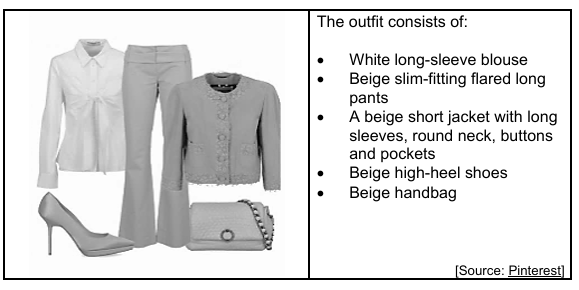
The outfit consists of:
- White long-sleeve blouse
- Beige slim-fitting flared long pants
- A beige short jacket with long sleeves, round neck, buttons and pockets
- Beige high-heel shoes
- Beige handbag
[Source: Pinterest]
4.5.1 Explain why the blouse and the pants of the outfit can be regarded as classic styles. (3)
SHOW ANSWER – 4.5.1
The white blouse is a simple, traditional and timeless garment that does not depend on a short-lived fashion fad. It can be worn for many years and remains suitable for different occasions, including the professional workplace.
The long pants have a simple, conventional design that can be worn across different seasons and fashion cycles. They can be combined with different tops, jackets and accessories, making them versatile and easy to coordinate.
Both garments are classic because their basic designs remain acceptable and useful over time. They can be updated with accessories or combined with more fashionable items without becoming completely outdated.
4.5.2 Analyse the optical illusions created by the outfit. (5)
SHOW ANSWER – 4.5.2
The outfit uses a largely monochromatic beige colour scheme. Wearing similar colours from the jacket through to the pants and shoes creates a continuous visual line, which can make the wearer appear taller and slimmer.
The long, slim-fitting pants create a narrow vertical line along the legs. This can make the lower body appear longer and more streamlined.
The flared shape at the bottom of the pants adds width around the lower legs. This balances the fitted upper part of the pants and can make the hips and thighs appear more proportionate.
The high-heeled shoes raise the heel and change the angle of the legs. They make the legs appear longer and can make the wearer look taller.
The short jacket creates a horizontal line around the waist or upper hip area. This can visually define the waist and make the legs appear longer because the upper garment does not cover much of the lower body.
The fitted shape of the pants and the coordinated colours create a neat, streamlined appearance. The overall effect is a taller, more elongated silhouette, while the flared hems add visual balance.
Optical-illusion effects can vary with the wearer's body proportions and the exact fit of the garments. In an examination answer, link each effect to a visible feature of the outfit.
QUESTION 5: HOUSING AND INTERIOR (20 marks)
SHOW ANSWER
Any TWO of the following:
- Cash transaction.
- Instalment sale transaction / hire purchase.
- Lay-by.
- Store account.
- Bank credit card transaction.
SHOW ANSWER
All acceptable costs for revision:
- Property rates.
- Service fees.
- Insurance on the buildings and cover for accidental damage.
- Wages and salaries of employees working for the complex.
- Water and electricity for common areas.
- Maintenance and repair of the common property.
- Security for the complex.
SHOW ANSWER
All acceptable disadvantages for revision:
- The tenant pays for accommodation but will not own the property in the future.
- The tenant does not acquire an asset or property.
- The tenant does not build wealth through ownership of the property.
- The tenant may not receive the deposit back.
- The rented property cannot be used as security/collateral for a loan.
- The tenant cannot sell the property for a profit.
- The property cannot be left to family members as part of an inheritance.
- Rental payments usually increase every year.
- The tenant may lose money spent on repairs, improvements or alterations made to the property.
The floods in June displaced about 4 724 households, with 2 145 homes partially damaged and 3 000+ damaged or destroyed informal dwellings in South Africa.
[Source: www.sanews.gov.za]
Discuss the financial implications for homeowners whose homes were affected by the floods. (4)
SHOW ANSWER
Homeowners who are fully insured may have their insurance cover the cost of repairing their houses and replacing or repairing the contents of their homes. This can reduce the amount they have to pay from their own savings.
Homeowners who are not insured will have to use their own money to repair or rebuild their homes. If they do not have sufficient savings, they may need to take out a loan, which creates additional debt and interest costs. Rebuilding may therefore take longer.
Homeowners may still have to pay their mortgage bond or home loan and insurance premiums even if their homes have been badly damaged or destroyed. They may have to continue meeting these financial commitments while also paying for alternative accommodation.
Homeowners who rented out their properties may lose rental income while the properties are uninhabitable. This reduces the money available to cover bond repayments and other expenses.
Families may need to find and pay for temporary accommodation while repairs are being completed. They may also have to spend additional money replacing furniture, appliances, clothing and other household contents lost in the floods.
All relevant points for revision:
- If fully insured, insurance may pay for repairs to the house and household contents.
- If uninsured, homeowners must use their own funds to rebuild or repair the house.
- Mortgage bond/home-loan repayments and insurance payments may still have to be paid even if the house is destroyed.
- Homeowners who rented out the property may lose rental income.
- They may not have enough money and may need to take out a loan to rebuild.
- It may take longer to rebuild the home.
- They may need to find and pay for temporary accommodation.
- Lost household contents will cost money to replace.
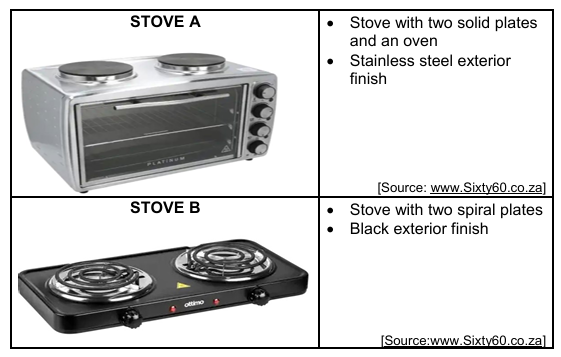
STOVE A
- Stove with two solid plates and an oven
- Stainless steel exterior finish
STOVE B
- Stove with two spiral plates
- Black exterior finish
[Source: www.Sixty60.co.za]
5.5.1 Compare the plates of STOVE A and STOVE B in terms of functionality. (3)
SHOW ANSWER – 5.5.1
Heating time: The solid plates on Stove A heat up more slowly and take longer to reach the required temperature, whereas the spiral plates on Stove B heat up faster.
Cooling time: The solid plates on Stove A retain heat for longer after being switched off, whereas the spiral plates on Stove B cool down more quickly.
Cleaning: The smooth solid plates on Stove A are easier to wipe clean, whereas the spiral plates on Stove B are more difficult to clean because food and dirt can collect around and underneath the coils.
5.5.2 Describe why STOVE A is suitable for a person who stays in a backroom/granny flat and enjoys cooking a variety of meals. (3)
SHOW ANSWER – 5.5.2
Stove A is compact and the correct size to fit on a kitchen counter in a backroom or granny flat. Its small size makes it suitable for a person who has limited kitchen space and may be cooking for one person.
It has an oven as well as two solid plates, so the person can prepare a variety of meals using different cooking methods. The oven can be used for baking and roasting, while the plates can be used for boiling, frying and simmering.
The stainless-steel exterior and solid plates are easy to clean, which is practical in a small living space. The oven can also be used to store baking trays when it is not in use.
All acceptable points for revision:
- It is the correct size/small enough to fit on a kitchen counter in a backroom or granny flat and to prepare food for one person.
- It has an oven that can be used to prepare a variety of dishes.
- The stainless-steel exterior and solid plates are easy to clean.
- The oven can be used to store baking trays.
SHOW ANSWER
- Routine / regular / scheduled / preventative maintenance: Equipment is serviced and checked at planned intervals to prevent breakdowns.
- Corrective / unscheduled maintenance: Equipment is repaired after it has broken down or developed a fault.
SHOW ANSWER
- Radio, television or cinema advertising.
- Cellphone advertising, such as WhatsApp, SMS or email.
- Social media platforms, such as Facebook, Instagram, X or TikTok.
- A business website / internet advertising.
- Electronic billboards.
Any TWO relevant methods.
SHOW ANSWER
- It prevents wastage and damage to raw materials or finished products.
- It prevents financial losses and helps with accurate stock control.
- It prevents contamination.
- It delays spoilage and preserves the quality of food products.
- It allows products to be accessed easily when needed.
Any TWO relevant reasons.
SHOW ANSWER
Start-up costs are costs that must be paid before production can begin, for example business registration, initial equipment or setting up the premises.
Production costs are expenses paid to produce goods or provide services to customers, such as raw materials and the costs directly involved in production.
SHOW ANSWER
The business needs workers with the correct skills, knowledge and experience to make the products and operate the business. If the entrepreneur does not have a skill required by the business, he or she may need to learn that skill.
SHOW ANSWER
There must be enough suitable workspace to produce the quantity and type of product that the business plans to make.
6.6 Case study: SEW HOOKED
Sew Hooked started as a mother-and-daughter team in 2015. They wanted to add a modern twist to traditional crocheting by crocheting hats and home accessories in a large range of different colours.
They use locally produced recycled yarn to make their products. All products are produced in their factory in Durban. The products are sold throughout the country by mail order, website, social media pages, a craft stall at a flea market and in the Waterfront in Cape Town, which is a major tourist destination.
They store all their yarns, hooks and accessories in labelled transparent containers on built-in shelves.
[Adapted from Sew Hooked.co.za]
SHOW ANSWER
Tourists.
SHOW ANSWER
“They use locally produced recycled yarn to make their products.”
SHOW ANSWER
- Fibre content.
- Size.
- Care instructions.
- Sew Hooked / name of the business / trade name / brand name.
- Price.
- Country of origin.
- Contact details.
- An indication that recycled materials were used.
Any FOUR.
SHOW ANSWER
- A tidy workplace helps workers work faster and saves time.
- Workers can work more accurately.
- It is easier to clean the workplace.
- Items can be located easily.
- It can prevent accidents and fires.
- Yarn and other items are kept clean.
- Yarns and tools are easier to identify and find.
- It improves production.
Any TWO relevant points.
SHOW ANSWER
- Crochet is fashionable / popular.
- The products give traditional crochet a modern twist.
- The products are made in a wide range of colours, appealing to consumers with different tastes and needs.
- The use of recycled yarn may appeal to environmentally conscious consumers.
- The products can be ordered online, which is a popular shopping method.
- The business has a social media presence and a website, and sells at a flea market, making the products more accessible to consumers.
- The products are locally made / proudly South African.
Any FIVE relevant reasons.
Calculate the selling price of ONE hat. Show ALL calculations. (3)
SHOW ANSWER
40% of R195,00 = 0,40 × R195,00 = R78,00
Selling price = Production cost + Mark-up
= R195,00 + R78,00
= R273,00
Alternative method:
100% + 40% = 140% = 1,4
R195,00 × 1,4 = R273,00
Selling price of one hat: R273,00.
SHOW ANSWER
Recycled materials may negatively affect the quality of the finished products. If the quality is poor, consumers may reject the products, resulting in unsold stock and financial losses. Consumers may also be dissatisfied if the products do not meet their needs or expectations.
It may be difficult to standardise recycled raw materials because their quality can vary. This can make quality control more challenging. The price of the finished products may also be affected, and the products may not last as long because they could have reduced durability or a shorter useful life.
[Adapted from bizcash, March 2025]
SHOW ANSWER
An increase in VAT may raise the cost of raw materials. This increases the cost of producing goods and may also increase a business’s overhead costs. As a result, it may become more difficult for a small business to reach its break-even point and make a profit.
Transport costs may also increase, adding to production expenses. Higher electricity prices may further increase the business’s overhead costs. Businesses may therefore have to increase their selling prices to cover these higher production and operating costs.
Small businesses that are required to charge VAT may need to charge customers more when the VAT rate increases. Higher selling prices may cause customers to stop buying from the business or to choose cheaper alternatives. Demand may fall, fewer products or services may be sold, and the business may make less profit. This can negatively affect the long-term, sustainable profitability of small-scale businesses.