Management Communication N4
Paper 2 — November 2023
MANAGEMENT COMMUNICATION N4 (Second paper) · (5140364)
22 November 2023 (X-paper) · 09:00–11:00
CLOSED-BOOK EXAMINATION.
TWO dictionaries (bilingual and/or explanatory) may be used.
This question paper consists of 9 pages.
INSTRUCTIONS AND INFORMATION
1. Answer all the questions. 2. Read all the questions carefully. 3. Number the answers according to the numbering system used in this question paper. 4. Use only a black or blue pen. 5. Write neatly and legibly.
Use each SHOW ANSWER control to reveal the answer.
QUESTION 1: COMMUNICATION PRINCIPLES
35 marksVarious options are given as possible answers to the following questions. Choose the answer and write only the letter (A–D) next to the question number (1.1.1–1.1.10) in the ANSWER BOOK.
1.1 Multiple-choice questions
B — Non-verbal communication.
C — Oral indirect communication.
D — A and B (direct written communication and direct oral communication).
C — Encoding.
B — Appreciative (empathic) listening.
D — A and C (eye contact and smiling).
D — B and C (phatic communication and establishing rapport).
D — A and C (cultural barriers and semantics).
B — Acoustic semiology.
B — Tacesics.
Give ONE term for each of the following descriptions by writing it next to the question number (1.2.1–1.2.5) in your ANSWER BOOK.
1.2 Give ONE term
Verbal communication.
Extra-personal communication.
Mass communication.
Intrapersonal communication.
Interpersonal communication.
Business communication is a process of sharing information, internally, between employees and externally, with clients of a company. Communication in business is not just about giving instructions. Most of the time, communication within business is HOW employees talk to each other AND how employees talk to their managers. Today, companies employ workers who can work effectively in a team environment. Research shows that effective communication improves company productivity by 25%.
[Source: adapted from Business communication - Wikipedia]
1.3 Business communication
Example diagram:
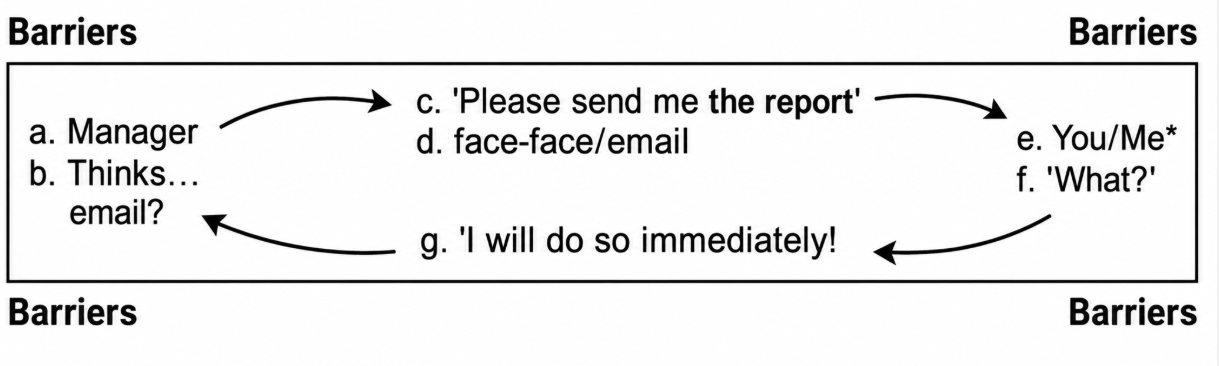
- Sender: The manager starts the communication.
- Encoding: The manager thinks about the instruction and chooses words or language to express it.
- Message: “Please send me the report.”
- Medium: The message is sent by email or communicated face-to-face.
- Receiver: You, the employee, receive the message.
- Decoding: You interpret the message and work out what the manager wants you to do.
- Feedback: You respond, for example, “I will do so immediately.”
- Barriers/noise: Barriers can occur at different points, such as background noise, an incorrect email address or an interruption.
The question asks for a graphic illustration using examples from work, so label the stages and show the direction of the message and feedback.
Effective communication is important because it:
- Provides effective communication. Clear messages help employees understand instructions and expectations.
- Obtains accurate information. People can clarify details and reduce errors caused by incomplete information.
- Supports business negotiations. Parties can explain their needs, discuss terms and work towards agreements.
- Establishes good interpersonal relations. Respectful communication builds trust between employees, managers and clients.
- Motivates staff. Managers can explain goals, recognise effort and encourage employees.
- Solves problems logically. Sharing facts and listening to different views helps people identify causes and choose solutions.
- Facilitates group discussions. Participants can contribute ideas, ask questions and understand different viewpoints.
- Enhances teamwork. Team members can coordinate tasks, share updates and understand their responsibilities.
- Prevents conflict. Clear, respectful messages reduce confusion and help resolve disagreements early.
- Handles misunderstandings calmly. People can explain what they meant and listen to one another without escalating the problem.
- Improves meeting outcomes. Clear discussion helps members make decisions and agree on actions.
- Helps achieve organisational aims. Staff understand objectives and coordinate their work towards shared targets.
- Reduces queries, complaints and possible legal action. Accurate information can prevent avoidable mistakes and disputes.
- Promotes a good public image. Professional communication helps build the public’s confidence in the organisation.
1.4 Identify the communication barrier
Physiological barrier.
Psychological barrier.
Ethnocentricity, multiculturalism, xenophobia or prejudice.
Perceptual barrier.
Gatekeeping.
QUESTION 2: INTERPERSONAL COMMUNICATION AND SOCIAL INTERACTION
20 marksRead the scenario below and answer the questions.
Your self-image (the way you see yourself) is linked to how you value yourself. Self-esteem is having confidence in your worth and ability. Be careful of the beliefs you hold about yourself. You probably compare yourself to others. Having a realistic view of your strengths and abilities will bolster your confidence and the way you see yourself overall. What you think of yourself is what matters most.
[Source: adapted from Self-esteem-Wikipedia]
2.1 Poor self-image
Any THREE of the following behaviours may indicate a poor self-image:
- Feelings of inferiority. Your friend may believe they are less capable or less worthy than other people.
- Being overly critical of themselves. They may focus on their mistakes and dismiss their achievements.
- Withdrawal or shyness. They may avoid social situations because they feel uncomfortable or lack confidence.
- Aggressive or domineering behaviour. They may try to hide insecurity by controlling or bullying others.
- Jealousy or suspicion. They may assume others are better than them or have negative intentions.
- Taking offence easily. They may interpret ordinary comments as personal attacks.
- Rejecting constructive feedback. They may struggle to accept advice that could help them improve.
- Becoming emotional under stress. They may find it difficult to manage feelings when facing pressure.
- Setting unrealistic goals. They may expect too much of themselves and feel like a failure when goals are not reached.
2.2 Dimensions of self-image
Choose any THREE dimensions and explain why you are proud of each one. Begin each answer with “I feel that I …”.
- Physical: I feel that I am physically healthy, and I am proud that I take care of my body.
- Psychological/personality: I feel that I am friendly and enjoy interacting with others, and I am proud that I can build positive relationships.
- Sexual/identity: I feel comfortable with who I am and proud of my identity.
- Skills: I feel that I am skilled at communicating, typing, cooking or driving, and I am proud that I can use these skills in everyday life.
- Intellectual: I feel that I am capable of learning new things, and I am proud that I can develop my knowledge and understanding.
2.3 Improving self-image
Any FIVE of these methods can help improve self-image:
- Set realistic goals. Choose achievable targets so progress can be recognised and confidence can grow.
- Plan and take action. Break a goal into small steps and work through them instead of only wishing for change.
- Adopt a positive attitude. Try to notice opportunities and what can be learned from setbacks.
- Avoid negative self-talk. Replace harsh statements about yourself with fair and constructive ones.
- Take pride in achievements. Recognise effort and progress, even when the achievement seems small.
- Accept compliments gracefully. Say thank you instead of immediately dismissing positive feedback.
- Evaluate criticism carefully. Consider whether feedback is useful and apply what can help you improve.
- Control your emotions. Pause and choose a helpful response instead of reacting impulsively.
- Remember that change starts with you. Take responsibility for the actions and habits you can change.
2.4 Maslow’s Hierarchy of Needs at work
Maslow arranged human needs in five levels. In the workplace, employers can support these needs in the following ways:
- Physiological needs. Provide basic facilities such as drinking water, meal breaks, a suitable place to eat and access to toilets.
- Safety and security needs. Support employees through safe working conditions, clear rules, job security where possible and appropriate benefits.
- Social needs. Encourage belonging through teamwork, respectful relationships, staff meetings and opportunities to interact.
- Esteem needs. Recognise good performance, give constructive feedback and offer awards or opportunities that show employees their contributions are valued.
- Self-actualisation needs. Provide opportunities for training, further study, coaching and career development so employees can develop their potential.
The theory proposes that basic needs generally require attention before higher-level needs become strong motivators.
QUESTION 3: INTERVIEWS
20 marksYou have been invited for a job interview.
3.1 Definition
An interview is a pre-planned or formal oral interaction between one or more people (such as an interviewer and interviewee, or a panel and interviewee) to exchange information for a specific purpose within a specific time. Any four relevant points, presented coherently, may earn marks.
3.2 Preparing for an interview
Discuss any FOUR hints in full sentences. For example:
- Research the organisation. Learn about its products or services, values and work before the interview so your answers show preparation.
- Understand the job requirements. Read the job description and think of examples that demonstrate the skills the employer needs.
- Plan the journey. Check the venue and route in advance and allow enough time to arrive punctually.
- Practise possible questions. Prepare clear answers about your experience, strengths and suitability for the position.
- Prepare questions to ask. Think of relevant questions about the role or workplace for the end of the interview.
- Dress appropriately and groom neatly. A professional appearance helps create a positive first impression.
- Bring the necessary documents. Take your CV, certificates, identification and any other documents requested.
- Bring a notebook and pen. These allow you to record important details or questions during the interview.
- Maintain a positive mindset. Remind yourself of your strengths and approach the interview calmly and confidently.
3.3 Expect the following question types in your interview.
Choose a term from COLUMN B that matches a description in COLUMN A. Write only the letter (A–E) next to the question number (3.3.1–3.3.4) in the ANSWER BOOK.
| COLUMN A | COLUMN B |
|---|---|
| 3.3.1 When did you matriculate? | A Leading |
| 3.3.2 How would you grow our online marketing? | B open |
| 3.3.3 Would you please tell me more about yourself? | C closed |
| 3.3.4 Are you willing to travel? | D specific |
| E hypothetical |
(4 × 1) (4 marks)
- 3.3.1 — D: Specific. The question asks for a precise piece of factual information: when the applicant matriculated.
- 3.3.2 — E: Hypothetical. The applicant is asked to suggest what they would do in a possible situation to grow online marketing.
- 3.3.3 — B: Open. This invites the applicant to give a fuller answer and choose which information to share about themselves.
- 3.3.4 — C: Closed. This can be answered briefly, for example “yes” or “no”.
3.4 Unconscious bias
Briefly explain how an interviewer’s unconscious bias in terms of each of the following can impact on an interviewee:
Older applicants may be overlooked or excluded because they are assumed to be too old, incapable, slow, not technologically skilled or unable to fit the organisation’s culture. Younger applicants may be seen as insufficiently capable or mature.
Women may be viewed sceptically or considered unsuitable for traditionally male-dominated jobs and judged as too weak or not capable. Men may also experience bias when applying for traditionally female-dominated jobs.
(1 × 2) (4) [20]
QUESTION 4: MASS MEDIA AND ADVERTISING
15 marks4.1 Definition of advertising
Advertising is any paid form of non-personal presentation and promotion of ideas, goods or services by an identified sponsor.
4.2 Study the advert below and answer the questions.

- The picture of the legs. It is large and prominent, so it attracts the reader’s attention first.
- The headline. “Get in shape without setting foot in a gym” stands out and makes the reader curious about how the product works.
- A bold promise. The wording suggests that people can get in shape without going to a gym, which encourages them to keep reading.
- Wordplay and repetition. The link between “shape-up” and the product name “Shape-Ups” makes the message memorable and reinforces the product’s claimed benefit.
Quote TWO facts from the advert. For example:
- “Designed to tone muscles.” This suggests that wearing the shoes may help the user work on muscle tone while walking.
- “Promote weight loss.” This appeals to people who want to manage their weight.
- “Improve posture.” This appeals to people who want to improve how they stand or walk.
The target market includes:
- Fitness enthusiasts. They may be interested in products that claim to help them stay in shape.
- Sportspeople. They may be interested in footwear promoted as supporting fitness or physical activity.
Skechers (Fitness Group). The sponsor is the company identified with the advertised Shape-Ups product.
QUESTION 5: MEETING PROCEDURES
10 marks5.1 Qualities of a good chairperson
Any FIVE qualities of a good chairperson:
- Strong leadership. The chairperson guides the meeting, keeps discussion focused and encourages members to contribute.
- Intelligence and understanding. The chairperson needs to understand the topics being discussed to guide the meeting effectively.
- An outgoing, approachable personality. This helps members feel comfortable sharing their views.
- Self-discipline. The chairperson remains calm, follows procedures and helps maintain order.
- Good judgement. Decisions should be fair, balanced and impartial.
- Articulateness. The chairperson should express ideas and instructions clearly so members understand them.
Choose one word from the list below that applies to each sentence. Write only the answer next to the question number (5.2.1–5.2.5) in the ANSWER BOOK.
agenda; quorum; minutes; convene; constituted; general; special
5.2 Meeting terminology
Choose one word from the list below that applies to each sentence. Write only the answer next to the question number (5.2.1–5.2.5) in the ANSWER BOOK.
Word bank: agenda; quorum; minutes; convene; constituted; general; special
General.
Quorum.
Convene.
Minutes.
Agenda.